
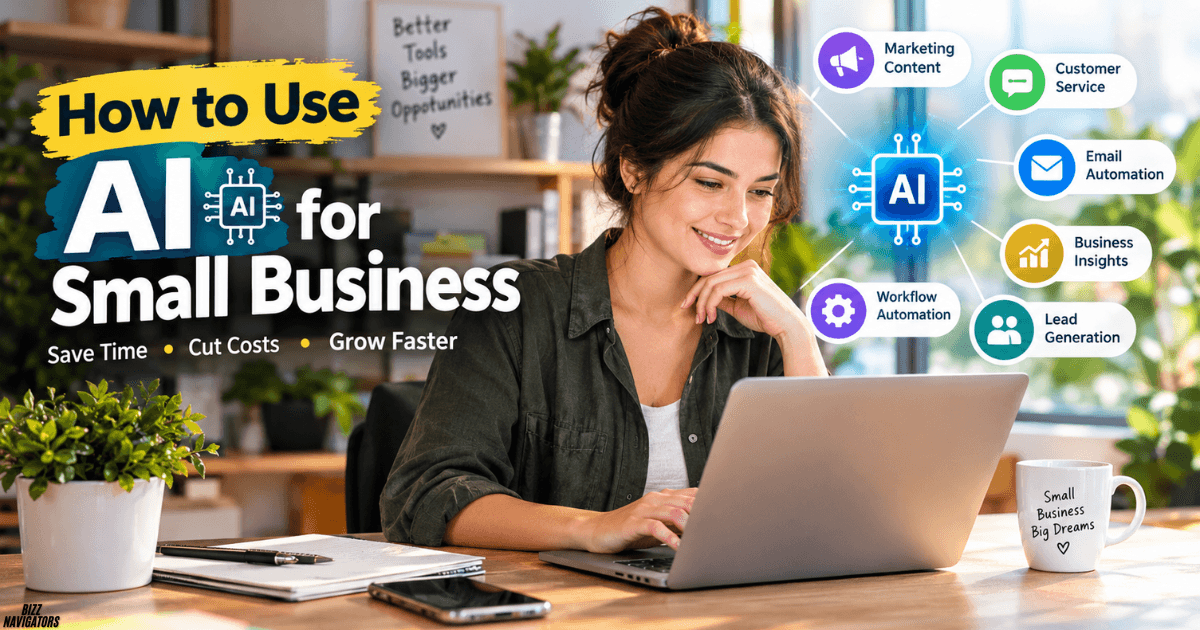
How to Use AI for Small Business: Use AI to automate repetitive tasks, create marketing content, improve customer service, and make better business decisions without hiring a large team. Start with one time-consuming task, choose an affordable AI tool, and measure whether it saves you time or money.
You don’t need advanced technical skills to get started. With the right approach, AI can help you manage daily operations, attract customers, and grow your business while keeping costs under control.
What Can AI Do in Business?
AI can help you write emails, analyze customer feedback, generate marketing ideas, answer common questions, organize information, and summarize business data. It works best when you give it clear instructions and review its output before using it.
For example, you can use AI to draft a week’s worth of social media posts, prepare customer responses, or turn sales data into a simple performance summary.
10 Examples of How to Use AI for Small Business
You can begin with practical tasks that don’t require expensive software or complicated setup.
1. Create Marketing Content
Use AI to draft blog posts, product descriptions, email campaigns, advertisements, and social media captions. You can also adapt one piece of content for different platforms instead of starting from scratch each time.
For better results, provide your audience, product details, preferred tone, and marketing goal. Edit the final content to include your experience and accurate business information.
2. Improve Customer Service
AI chatbots can answer common questions about prices, opening hours, delivery, returns, and services. This can reduce repetitive support work and help customers find information faster.
Start with frequently asked questions. Make sure customers can reach a real person when a problem requires judgment or personal attention.
3. Automate Emails and Administrative Tasks
You can use AI to draft replies, summarize long email conversations, organize meeting notes, and prepare reports. When combined with automation software, it can also move information between supported business applications.
Review messages before sending them, particularly when they involve payments, complaints, contracts, or confidential information.
4. Research Customers and Competitors
AI can summarize customer reviews, identify recurring complaints, compare product features, and organize market research.
Use these findings to improve your products, understand customer needs, and identify opportunities. Verify important claims with reliable sources rather than treating AI-generated research as automatically correct.
5. Improve Sales and Lead Generation
AI can help you draft personalized outreach messages, qualify leads using your chosen criteria, and prepare follow-up emails. You can also use it to identify common questions that prevent customers from purchasing.
Keep your outreach relevant and respectful. Check contact details and avoid sending automated messages without appropriate consent.
6. Manage Inventory and Business Data
If you maintain sales or inventory records, AI-enabled tools can help summarize trends, flag unusual changes, and estimate future demand.
You should verify calculations against your original records before making purchasing or financial decisions. Forecasts are estimates, not guarantees.
7. Support Accounting and Financial Planning
AI features in accounting software can categorize transactions, extract invoice details, and summarize expenses. These functions can reduce manual work, but you should still review the results.
Don’t share bank credentials or unnecessary financial information with an AI chatbot. Use trusted business software and retain appropriate human oversight.
8. Create Product Images and Designs
Generative AI tools can help you develop advertising concepts, product mockups, promotional graphics, and design ideas.
Check image accuracy, product representation, licensing terms, and brand consistency before publishing. AI-generated visuals should not misrepresent what you actually sell.
9. Personalize Customer Experiences
You can use AI to group customers by interests, summarize purchase patterns, and tailor recommendations or email campaigns.
Use information customers have appropriately provided, follow privacy requirements, and avoid making sensitive assumptions about individual customers.
10. Build Reports and Make Better Decisions
AI can turn spreadsheets, survey responses, and sales summaries into readable reports. You can ask it to identify trends, compare periods, or explain business metrics in plain English.
Give it accurate data and check its conclusions. Use the results to support your decisions rather than allowing AI to make important business choices without supervision.
How to Choose the Right AI Tools for Your Business
You don’t need a separate AI tool for every task. Choose tools based on your immediate needs, budget, existing software, and the sensitivity of your data.
- For writing and research: Try ChatGPT, Google Gemini, or Microsoft Copilot.
- For design: Explore Canva’s AI features or dedicated image-generation tools.
- For customer support: Consider chatbot platforms that integrate with your website or help desk.
- For automation: Look for tools that connect your existing apps and support the workflows you need.
- For accounting: Start with AI features offered by reputable accounting software.
Compare free and paid plans before committing. Check usage limits, privacy settings, integration options, and the cost of adding more users.
Which AI Do Most Businesses Use?
Businesses use different AI tools depending on their size and needs. ChatGPT, Microsoft Copilot, Google Gemini, and AI features built into existing business software are common options to consider.
There is no single tool that suits every business. Choose one that works with your daily tasks, provides useful results, and fits your budget.
How to Start Using AI Without Coding
You can start using AI without building your own software. Most small businesses can get value from existing AI applications before considering custom development.
Can I Create AI Agents Without Coding?
Yes. Some no-code platforms let you create AI agents using visual workflows, templates, and integrations. Depending on the platform, an agent may answer questions, retrieve approved information, or perform specific tasks in connected applications.
Start with a limited task and test the agent thoroughly. Restrict its access to sensitive information and require approval before it performs important actions.
How to Create an AI?
If you want to create an AI-powered solution, begin by identifying one business problem. Then choose an existing AI API or no-code platform, connect the required information, and test the results with real-world examples.
Training a model from scratch is usually unnecessary for a small business. An existing model or specialized business application is often more affordable and easier to maintain.
Can I Build an AI on My Own?
Yes, you can build a basic AI-powered application on your own using existing models, APIs, and development tools. You can also create simple workflows through no-code platforms.
However, the difficulty depends on what you want to build. A basic writing assistant is much easier than a reliable system that processes payments, handles private customer information, or makes high-impact decisions.
What Does It Mean to Build an AI?
Building an AI means creating or configuring a system that performs tasks such as generating text, recognizing patterns, answering questions, or making predictions. You might use an existing model, connect it to your business data, and define how it should respond.
For most small businesses, configuring an existing tool is more practical than developing a new AI model.
AI Business Ideas for Small Business Owners
AI can help you run your existing business or support a new service. Focus on solving a genuine customer problem rather than launching something simply because it uses AI.
What Are the Top 10 AI Business Ideas?
Here are 10 ideas you can explore based on your skills and available resources:
- AI-assisted content writing for businesses.
- Social media content creation and management.
- AI chatbot setup for small websites.
- Product description and e-commerce content services.
- AI-assisted video editing and short-form content.
- Workflow automation for local businesses.
- Customer review analysis and reporting.
- AI-supported market research services.
- Business document and presentation creation.
- AI training and implementation support for small teams.
You can begin with a service business that requires little upfront investment. However, you still need to develop relevant skills, find customers, protect their information, and deliver reliable work.
What Are Some Good AI Business Ideas?
Good AI business ideas address a specific problem that customers are willing to pay to solve. For example, you could help local retailers create product listings, automate appointment reminders, or set up a chatbot that answers routine questions.
Before investing, speak with potential customers and test whether they need the service. A small paid trial can tell you more than launching a complete product without validating demand.
Learn the Basics Before You Invest
You don’t need to become an AI engineer to use AI effectively. However, understanding its limitations will help you avoid expensive mistakes.
Where Can I Learn About AI and How It Can Be Used in Marketing?
You can learn through official training resources from Microsoft, Google, OpenAI, and established online learning platforms. Start with introductory lessons on generative AI, prompt writing, data privacy, and practical marketing applications.
Then apply what you learn to a real task, such as writing product descriptions or planning a campaign. Testing AI on your own work helps you understand where it performs well and where human editing remains necessary.
What Are the 7 Types of AI?
There is no universally accepted list of exactly seven AI types. AI can be classified by capabilities, functionality, or the techniques it uses.
One common capability-based framework discusses narrow AI, artificial general intelligence, and artificial superintelligence. Other frameworks include reactive machines, limited-memory systems, theory-of-mind AI, and self-aware AI. These are theoretical or conceptual categories, not seven equally established commercial technologies.
For your business, understanding practical applications is more useful than memorizing classifications.
What Is the 30% Rule in AI?
The “30% rule” is not a universal AI standard. It may refer to a particular claim about automating a share of work, improving productivity, or allocating human oversight.
Don’t assume AI will automatically reduce your costs by 30%. Measure the actual time, expense, error rate, and quality of a specific task before deciding whether automation is worthwhile.
What Not to Ask an AI?
Avoid sharing passwords, private customer records, payment credentials, confidential contracts, or sensitive business information with an AI tool unless you have verified that the tool and its settings are appropriate for that data.
You should also avoid treating AI as the final authority on legal, tax, medical, or major financial decisions. Ask for general explanations when useful, then verify important information with qualified professionals or reliable sources.
Common Questions About AI and Business
What Are 10 Examples of Artificial Intelligence?
Examples include virtual assistants, recommendation systems, fraud detection, image recognition, language translation, predictive maintenance, spam filters, generative writing tools, speech recognition, and customer-service chatbots.
What Are Some Examples of How AI Is Used in Business?
Businesses use AI to create marketing content, answer customer questions, analyze sales, forecast demand, personalize recommendations, detect suspicious transactions, summarize documents, and automate administrative work.
What Are 8 Examples of How Artificial Intelligence Is Used in the Workplace?
Eight examples are drafting emails, summarizing meetings, analyzing spreadsheets, preparing presentations, translating documents, searching internal knowledge bases, supporting customer service, and automating repetitive workflows.
Which 3 Jobs Will Not Survive AI?
No one can reliably identify three jobs that will definitely disappear because of AI. The impact varies by industry, task, adoption costs, regulation, and customer expectations.
Jobs built around repetitive tasks may change significantly, while roles requiring physical work, human judgment, trust, and personal interaction may evolve differently. Focus on learning to use AI alongside your existing skills.
What Is a $900000 AI Job?
A “$900000 AI job” generally refers to a headline about exceptionally high compensation for certain AI roles. Such figures may represent total compensation, including bonuses, stock awards, or multi-year packages, rather than ordinary annual salary.
Actual earnings depend on the employer, role, experience, location, and compensation structure. Treat exceptional salary claims carefully and verify the original job listing before relying on them.
Which Is the Smartest AI Right Now?
There is no single smartest AI for every task. Different models perform differently in reasoning, writing, coding, research, and multimodal work. Compare current models on the tasks your business actually needs and test their accuracy before choosing one.
What AI Does Elon Musk Use?
Elon Musk is associated with xAI, the company behind Grok. However, knowing which AI company he is associated with does not establish every tool he personally uses for daily work. For your business, choosing a tool based on its capabilities, cost, and privacy features is more useful than following a public figure’s preferences.
A Simple Plan to Start Using AI Today
You can begin with three steps:
- Choose one repetitive task. Pick something that consumes time, such as drafting emails or creating social media content.
- Test one suitable tool. Use a small sample of non-sensitive information and compare the results with your current process.
- Measure the outcome. Track time saved, cost, accuracy, and the amount of editing required.
If the tool provides consistent value, expand its use gradually. Keep human review in place for important decisions and customer-facing work.
The bottom line: The best way to use AI for small business is to start small, solve a real problem, and measure the results. You don’t need a complex AI system to benefit. A well-chosen tool that saves you an hour every week can be a more useful investment than an expensive solution you rarely use.

At BizzNavigators, we answer the questions you’re actually searching for, honestly and clearly. We check our facts before we publish anything, and if we’re not sure about something, we tell you instead of guessing. Whatever you’re looking for- a tech fix, a business tip, or a simple how-to- we want to give you an answer you can trust.