
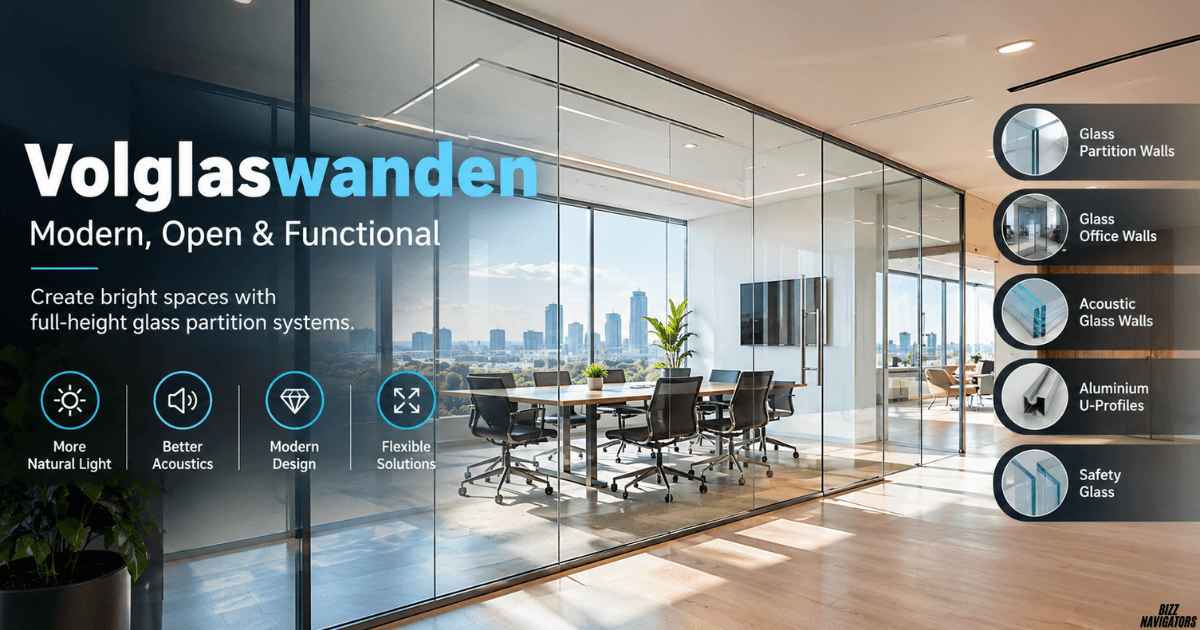
What Are Volglaswanden?
Volglaswanden are full-height glass partition systems used to divide interior spaces while keeping them bright, open, and visually connected. They are commonly used in offices, meeting rooms, showrooms, reception areas, and modern residential interiors.
Instead of replacing an open space with a solid wall, these systems use large glass panels with slim supporting profiles. The result is a clear separation between rooms without blocking most of the available light.
Depending on the system, Volglaswanden can use tempered, laminated, or acoustic laminated glass. Some systems also offer aluminium profiles in different finishes and RAL colors.
Why Are Volglaswanden Popular?
The main reason to choose Volglaswanden is that they combine room separation with natural light and visual openness.
A conventional solid partition can make an interior feel smaller or darker. Glass allows light to pass between areas while still creating dedicated rooms for meetings, work, consultation, or other activities.
They also provide considerable design flexibility. Clear glass can create a completely open appearance, while frosted film, tinted glass, or decorative patterns can provide more privacy.
Key Benefits
- Maximizes natural light
- Creates a spacious visual effect
- Separates rooms without a heavy appearance
- Supports modern office and interior designs
- Can include acoustic glass
- Works with different door configurations
- Allows privacy films and decorative finishes
- Can use slim aluminium profiles
- Suitable for customized layouts
These features make full-glass partitions particularly useful when both appearance and practical space planning matter.
Glass Partition Walls for Modern Interiors
Glass partition walls divide a space without creating the closed feeling associated with traditional solid partitions.
They are especially useful in open-plan offices where separate meeting rooms, private offices, and consultation areas are still required.
A glass partition can create a dedicated room while maintaining visual contact with the surrounding workspace. This also allows daylight to reach deeper into the interior.
Full-glass systems can be configured in different ways. Depending on the product, they may use fixed glass panels, minimal framing, glass-to-glass connections, or more visible profile systems.
The right configuration depends on the building, required wall height, glass specification, privacy needs, and desired appearance.
Glass Office Walls: Where Do They Work Best?
Glass office walls are particularly suitable for meeting rooms, private offices, reception areas, and other workspaces that need separation without losing transparency.
A meeting room surrounded by glass remains visually connected to the office. Employees can see the room while natural light continues to move through the workspace.
For private offices, the glass can also be modified with a privacy film. This creates a balance between transparency and visual separation.
Glass office walls can be combined with matching glass doors, allowing the entire installation to maintain a consistent appearance.
They are also suitable for showrooms and commercial interiors where visibility is important. The products, displays, or activities inside a room can remain visible even when the space has been divided.
Acoustic Glass Walls
Acoustic glass walls can reduce sound transmission between rooms while maintaining the visual advantages of glass.
However, not every glass wall provides the same acoustic performance. The result depends on the glass construction, wall configuration, seals, connections, doors, and installation quality.
Laminated acoustic glass can be used where improved sound insulation is required. Some systems also use double glazing for higher acoustic performance. TechnoWand, for example, lists hardened, laminated, and acoustic laminated glass among its available configurations.
This makes acoustic performance an important consideration for meeting rooms, management offices, consultation spaces, and areas where conversations need more privacy.
What Affects Acoustic Performance?
Several components work together:
- Glass thickness and construction
- Laminated acoustic interlayer
- Single or double glazing
- Door construction
- Sealing around the wall
- Connections between panels
- Floor and ceiling junctions
For this reason, buyers should check tested acoustic values for the complete wall system, rather than assuming that thicker glass automatically means better sound insulation.
Aluminium U-Profiles and Panel Connections
Aluminium U-profiles provide a slim structural framework for securing glass panels at the floor, ceiling, or other connection points.
Some systems use aluminium profiles around the glass, while others minimize visible framing to create a cleaner appearance.
Current commercial systems show how different configurations can be achieved. TechnoWand, for example, specifies aluminium profiles with anodized or RAL-coated finishes and offers systems with glass panels bonded together using narrow tape connections.
Other systems use small transparent polycarbonate profiles or narrow aluminium joints between glass panels. These details help maintain the continuous appearance associated with full-glass walls.
The profile finish can also be matched to the interior. An anodized aluminium finish creates a different appearance from a colored powder-coated profile.
What Glass Thickness Is Used?
There is no single glass thickness suitable for every Volglaswanden project. The required thickness depends on the system, panel size, wall height, glass type, and performance requirements.
Documented systems use different specifications. A TNO report on two specific interior glass wall systems describes 8 mm and 10 mm glass constructions.
Another current system lists 10 mm, 12 mm, and 18 mm glass options, depending on the wall configuration.
This means the commonly cited range of around 8–18 mm can be useful as a general reference, but it should not be treated as a universal specification.
The final glass thickness should always be selected according to the manufacturer’s tested system and the requirements of the project.
Safety Glass for Full-Glass Walls
Safety glass is an important part of a full-glass partition because large interior panels need an appropriate glass specification for their intended use.
Tempered glass is processed to increase its strength and is commonly used in interior glass systems. Laminated glass contains an interlayer that helps keep the glass together after breakage.
The appropriate choice depends on factors such as panel dimensions, location, impact requirements, building regulations, and the specific wall system.
For this reason, glass selection should not be based only on appearance or thickness. The complete system should meet the applicable technical and safety requirements.
Privacy Options Without Losing Natural Light
Privacy can be added to a glass wall without completely removing its transparent appearance.
Frosted or matte film is one of the simplest options. It can cover the entire panel or only a selected section.
For example, a meeting room may use a horizontal frosted strip at eye level. A consultation room may require a larger privacy area.
Other options include:
- Frosted glass
- Matte privacy film
- Tinted glass
- Decorative patterns
- Printed graphics
- Partial frosting
- Custom branding
This flexibility allows businesses to control visibility while keeping the benefits of natural light.
Glass Doors and Volglaswanden
Glass doors can be integrated into full-glass wall systems to create a consistent and modern room enclosure.
Depending on the system and project requirements, options may include hinged, pivot, or sliding doors.
The door should be considered together with the wall rather than as a separate component. This is particularly important when acoustic performance matters.
A highly insulated glass wall can still lose performance if the door or its seals provide a significantly weaker barrier.
Door hardware, closers, handles, locks, and seals should therefore match the intended use of the room.
Where Are They Used?
Volglaswanden can be used in many interior environments where light, visibility, and space division are important.
| Application | Main purpose |
| Offices | Create separate work areas |
| Meeting rooms | Provide enclosure while retaining visibility |
| Reception areas | Create zones without blocking the entrance |
| Showrooms | Separate areas while keeping products visible |
| Consultation rooms | Combine separation with privacy options |
| Residential interiors | Divide rooms without a heavy wall |
| Commercial spaces | Create flexible interior layouts |
The exact glass, profile, door, and privacy configuration should match the purpose of the space.
What Are the Main Advantages and Limitations?
The biggest advantage is the balance between separation and openness, while the main limitation is that clear glass does not automatically provide visual or acoustic privacy.
Advantages
- Excellent visual transparency
- Better distribution of natural light
- Modern minimalist appearance
- Multiple customization options
- Suitable for different interior layouts
- Acoustic configurations are available
- Privacy can be added with film or glass treatments
Limitations
- Clear glass offers limited visual privacy
- Acoustic performance varies between systems
- Glass requires regular cleaning
- Installation needs accurate measurements
- Specialized configurations can increase project costs
Understanding these points before installation makes it easier to select the right system instead of choosing purely based on appearance.
How Much Do Volglaswanden Cost?
The cost depends on the glass specification, wall dimensions, profile system, doors, acoustic requirements, finishes, and installation.
A simple single-glazed partition with standard profiles will have different requirements from a system using acoustic laminated glass, multiple doors, privacy film, and custom-colored aluminium profiles.
The number and size of glass panels also affect the final price.
For an accurate quotation, suppliers normally need the wall dimensions, desired height, glass type, number of doors, profile finish, and any acoustic or privacy requirements.
A price per square meter alone therefore cannot accurately represent the cost of every project.
How to Choose the Right System
Start with the function of the room, then select the glass, acoustic performance, privacy level, profiles, and doors around that requirement.
For a simple open office divider, clear glass may be enough. For a meeting or consultation room, acoustic laminated glass and privacy film may make more sense.
Also check the maximum wall height, supported glass thicknesses, profile options, door compatibility, and tested performance of the complete system.
Professional measurement is equally important. Small errors in floor, ceiling, or opening dimensions can affect panel production and installation.
Frequently Asked Questions
Are Volglaswanden suitable for offices?
Yes. They are commonly used for offices, meeting rooms, private workspaces, and reception areas because they provide room separation while maintaining light and visual openness.
Can Volglaswanden reduce noise?
Yes. Acoustic laminated glass and suitable wall constructions can improve sound insulation. The actual performance depends on the complete wall and door system.
Can they provide privacy?
Yes. Frosted film, matte glass, tinted glass, and decorative treatments can reduce visibility while retaining some natural light.
Can doors be installed in the system?
Yes. Full-glass wall systems can be designed with compatible glass doors, depending on the manufacturer’s configuration and project requirements.
What glass thickness should be used?
It depends on the specific system and project. Documented examples include 8 mm and 10 mm systems, while other current products offer 10 mm, 12 mm, and 18 mm options.
Final Takeaway
Volglaswanden provide a practical way to divide interior spaces while preserving natural light, visibility, and a modern appearance.
Their performance depends on more than the glass itself. Glass type, thickness, acoustic construction, aluminium profiles, panel connections, doors, privacy treatments, and installation all influence the final result.
For the best outcome, choose the system according to the actual purpose of the room rather than selecting glass based only on appearance.

At BizzNavigators, we answer the questions you’re actually searching for, honestly and clearly. We check our facts before we publish anything, and if we’re not sure about something, we tell you instead of guessing. Whatever you’re looking for- a tech fix, a business tip, or a simple how-to- we want to give you an answer you can trust.