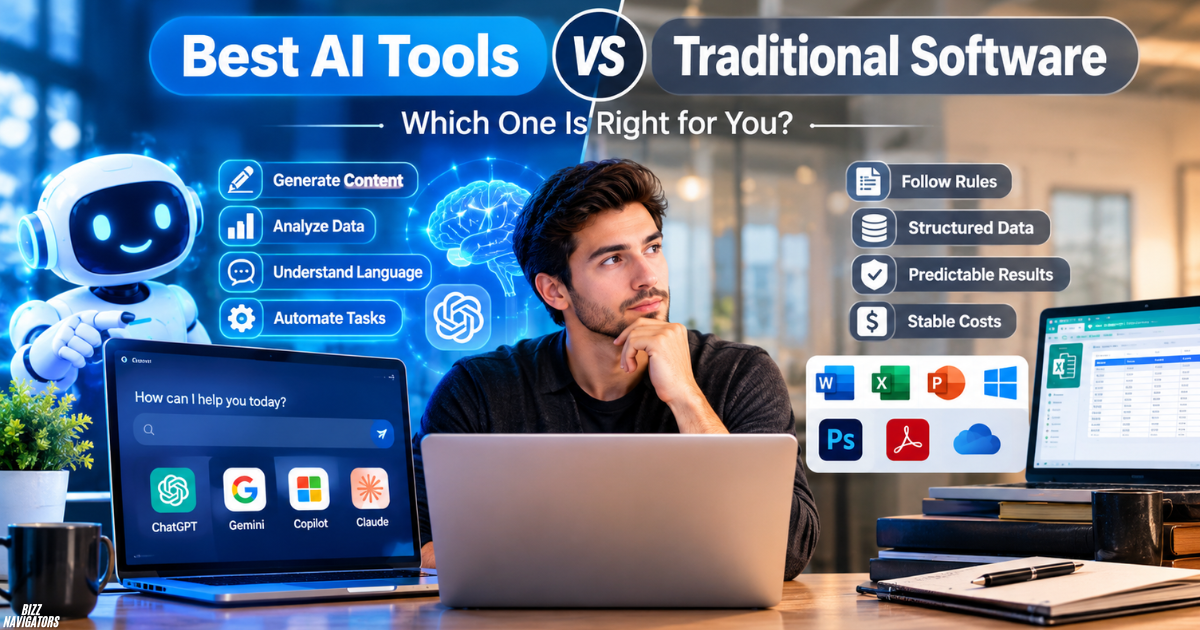
The best AI tools vs traditional software comparison comes down to how you work. AI tools can understand language, recognize patterns, generate content, and automate complex tasks. Traditional software follows predefined rules to perform specific tasks consistently.
If you want to save time, reduce manual work, or improve accuracy, the right choice depends on your needs, budget, and the type of work you handle.
What Distinguishes Artificial Intelligence From Traditional Software?
Artificial intelligence learns patterns from data and uses them to generate predictions, recommendations, or responses. Traditional software follows instructions written by developers to produce expected results.
For example, traditional accounting software calculates totals using fixed formulas. An AI tool can analyze financial records, identify unusual spending patterns, and summarize potential problems.
The main difference is flexibility. AI adapts its responses to context, while traditional software usually performs predefined operations more consistently.
Best AI Tools vs Traditional Software: Key Differences
| Feature | AI Tools | Traditional Software |
| How they work | Learn patterns and generate outputs | Follow predefined rules |
| Data processing | Handle text, images, audio, and other unstructured data | Work best with structured inputs |
| Accuracy | Can produce incorrect or inconsistent results | Usually predictable for defined operations |
| Automation | Handle complex, language-based tasks | Automate repetitive, rule-based tasks |
| Cost | May require subscriptions or usage-based fees | Often has fixed licensing or subscription costs |
| Speed | Fast for analysis, drafting, and summarization | Fast for routine calculations and standard operations |
| Human involvement | Often needs review and guidance | Usually needs setup and maintenance |
| Best use | Creative work, analysis, and flexible assistance | Reliable workflows and repeatable processes |
Neither option is better for every task. You should choose based on the results you need rather than the technology’s popularity.
Which AI System Is Best for What?
The best AI system depends on your goal. Some tools specialize in writing, others excel at research, coding, image generation, or data analysis.
- Writing and research: ChatGPT and similar AI assistants help you draft, summarize, and organize information.
- Programming: AI coding assistants help you write, explain, and debug code.
- Design: AI image generators help you create visual concepts and marketing assets.
- Business operations: AI-powered platforms can support customer service, document processing, and workflow automation.
- Accounting and calculations: Traditional spreadsheets and accounting software remain dependable for structured calculations.
Before choosing a platform, test it against your actual workload. A popular tool may not be the most useful option for your specific requirements.
What Software Is Used for AI?
AI software includes applications that use machine learning, natural language processing, computer vision, or generative models.
Common examples include ChatGPT for conversational assistance, Microsoft Copilot for productivity, Google Gemini for AI-assisted tasks, and specialized tools for coding, design, and data analysis.
Traditional software can also support AI. For example, a business application may use conventional databases to store records while an AI model analyzes those records and generates recommendations.
This combination allows you to benefit from AI without replacing your existing systems.
What Are Some Free AI Chat Bots Available?
Several AI chatbots offer free access with usage limits or restricted features. Options include ChatGPT, Google Gemini, Microsoft Copilot, and Claude, although availability and free-plan limits can change.
You can use these tools to answer questions, summarize documents, generate ideas, and explain complicated topics. However, free access does not guarantee unlimited use, the newest model, or access to every feature.
If you need an AI chatbot for everyday tasks, compare response quality, file support, privacy options, and usage limits before paying for a subscription.
Which AI Aggregator Is the Best?
An AI aggregator brings multiple AI models or services together in one interface. It can help you compare responses or access different tools without switching between separate applications.
The best AI aggregator depends on the models it supports, its pricing, privacy policies, and available features. If you only need basic writing and research, a standalone chatbot may be sufficient.
An aggregator is more useful when you regularly compare model outputs or need different AI capabilities for different tasks.
What Is the Most Commonly Used AI Platform?
ChatGPT is one of the most widely recognized AI platforms, with other major options including Google Gemini and Microsoft Copilot. However, the most commonly used AI platform depends on the country, industry, and type of user.
For your own work, popularity should be only one consideration. Reliability, accuracy, ease of use, and compatibility with your existing workflow matter more than choosing a platform simply because everyone knows it.
What Are Some Good AI Alternatives to ChatGPT?
You can consider Google Gemini, Claude, and Microsoft Copilot as alternatives to ChatGPT. Each offers different strengths, integrations, and usage limits.
- Choose Gemini if you want AI assistance connected to Google’s ecosystem.
- Consider Claude for writing, document analysis, and complex text-based tasks.
- Try Copilot if you work extensively with supported Microsoft products.
- Compare other specialized AI tools when your needs focus on coding, research, or image creation.
The best alternative is the one that performs your required tasks well at a reasonable cost.
Is AI Better Than Traditional Software?
AI is better for tasks that require language understanding, pattern recognition, flexible analysis, or content generation. Traditional software is often better for exact calculations, fixed business rules, and predictable operations.
For example, AI can summarize customer feedback, while a traditional database can store customer records and retrieve them reliably. Using both together may deliver better results than relying on either one alone.
Cost and Performance
Traditional software can have predictable operating costs and run efficiently on standard hardware. AI tools may require additional computing resources, model subscriptions, or per-request fees.
However, AI costs vary significantly by model, workload, deployment method, and usage volume. It is not accurate to claim that every AI system costs five to ten times more than traditional software.
You should compare the total cost of ownership, including licensing, computing, maintenance, employee time, and the cost of checking AI-generated results.
Can Software Be Replaced by AI?
AI can replace some software functions, but it cannot replace every software system. Many applications depend on databases, authentication, payment processing, security controls, and business rules that must operate reliably.
AI can help developers build applications faster and automate selected features. However, businesses still need dependable systems to store data, manage permissions, process transactions, and maintain operational records.
The more practical approach is to integrate AI into existing software where it provides measurable benefits.
Is AI Going to Replace Software Developers?
AI is changing software development by helping programmers generate code, identify bugs, write tests, and understand unfamiliar projects. These capabilities can reduce the time needed for some development tasks.
However, developers still need to understand requirements, design systems, review generated code, manage security, and solve problems that AI tools may not handle correctly.
If you work in software development, learning to use AI tools effectively can help you remain adaptable. Strong programming fundamentals and problem-solving skills are still important.
What Did Elon Musk Say About Coding?
Elon Musk has made public comments about AI’s growing ability to write code and the changing role of programmers. However, specific claims about what he said should be checked against the original interview or post rather than repeated without context.
Regardless of any individual prediction, AI coding tools are already changing how developers write and review software. Their practical impact depends on code quality, project complexity, and human oversight.
What Is the 30% Rule for AI?
There is no single, universally accepted 30% rule for AI. The phrase can refer to different ideas, such as using AI for a portion of your work or reviewing AI-generated output before accepting it.
If you use AI professionally, treat any percentage as a personal workflow guideline unless a specific study or policy defines it. Measure whether the tool saves time, improves quality, or reduces errors instead of relying on an arbitrary target.
Is AI Better Than Humans at Anything?
AI can outperform humans on certain narrow tasks, including processing large datasets, identifying some patterns, and performing repetitive operations at scale.
Humans remain essential for judgment, empathy, accountability, understanding social context, and making decisions that require real-world experience. AI performance also varies by task, data quality, and model limitations.
What Things Are Humans Better at Than AI?
Humans often have advantages in relationship building, ethical judgment, complex negotiation, and understanding emotions within real-world situations. They can also take responsibility for decisions and adapt using lived experience.
AI can assist with these activities, but you should not assume that a convincing answer demonstrates genuine understanding or reliable judgment.
Does AI Have a Higher IQ Than Humans?
AI does not have a single, universally meaningful IQ score that can be compared directly with human intelligence. IQ tests measure selected cognitive abilities, and AI performance depends on the test, model, and evaluation method.
A model may perform extremely well on certain reasoning or knowledge tests without possessing the full range of human abilities. Test results alone cannot establish that AI is generally more intelligent than a person.
What Are Seven Human Skills That AI Cannot Fully Replace?
No skill is guaranteed to remain beyond AI’s capabilities forever. However, these seven human strengths remain important in many workplaces:
- Empathy: Understanding another person’s feelings and needs.
- Leadership: Motivating people and taking responsibility for outcomes.
- Ethical judgment: Weighing competing values and consequences.
- Negotiation: Building trust and managing conflicting interests.
- Creativity: Developing original ideas grounded in human experience.
- Adaptability: Responding to unpredictable real-world situations.
- Relationship building: Creating meaningful professional and personal connections.
AI can support these skills, but human involvement remains valuable when decisions affect people.
What Jobs Will Be Gone by 2030?
It is not possible to reliably identify exactly which jobs will disappear by 2030. AI and automation are more likely to change the tasks performed in many occupations, with the effects varying by industry and employer.
Routine data entry, repetitive administrative work, and some basic content-production tasks may face greater automation pressure. At the same time, many roles will continue to require technical expertise, communication, judgment, and human oversight.
Instead of assuming your job will disappear, identify which tasks AI can automate and develop skills that complement the technology.
What Job Pays $400,000 a Year Without a Degree?
Some experienced professionals and business owners can earn $400,000 or more annually without a traditional university degree, but these outcomes are uncommon and never guaranteed. Examples may include successful entrepreneurs, specialized sales professionals, and certain high-performing technology consultants.
Income depends on expertise, experience, location, demand, and business performance. AI skills can create opportunities, but a particular tool or career path does not guarantee a high salary.
Is ChatGPT an AI Tool?
Yes. ChatGPT is an AI tool that can answer questions, generate text, summarize information, assist with coding, and support many research and productivity tasks.
It differs from traditional software because it can respond flexibly to natural-language instructions. However, its answers can contain mistakes, so you should verify important facts and review its output before using it professionally.
Which Option Should You Choose?
Choose AI tools when you need flexible assistance with writing, research, analysis, or creative work. Choose traditional software when accuracy, repeatability, fixed rules, and predictable processing are your priorities.
For many businesses, the strongest solution is a combination of both: traditional software handles essential operations, while AI helps you analyze information and complete selected tasks faster.

At BizzNavigators, we answer the questions you’re actually searching for, honestly and clearly. We check our facts before we publish anything, and if we’re not sure about something, we tell you instead of guessing. Whatever you’re looking for- a tech fix, a business tip, or a simple how-to- we want to give you an answer you can trust.