
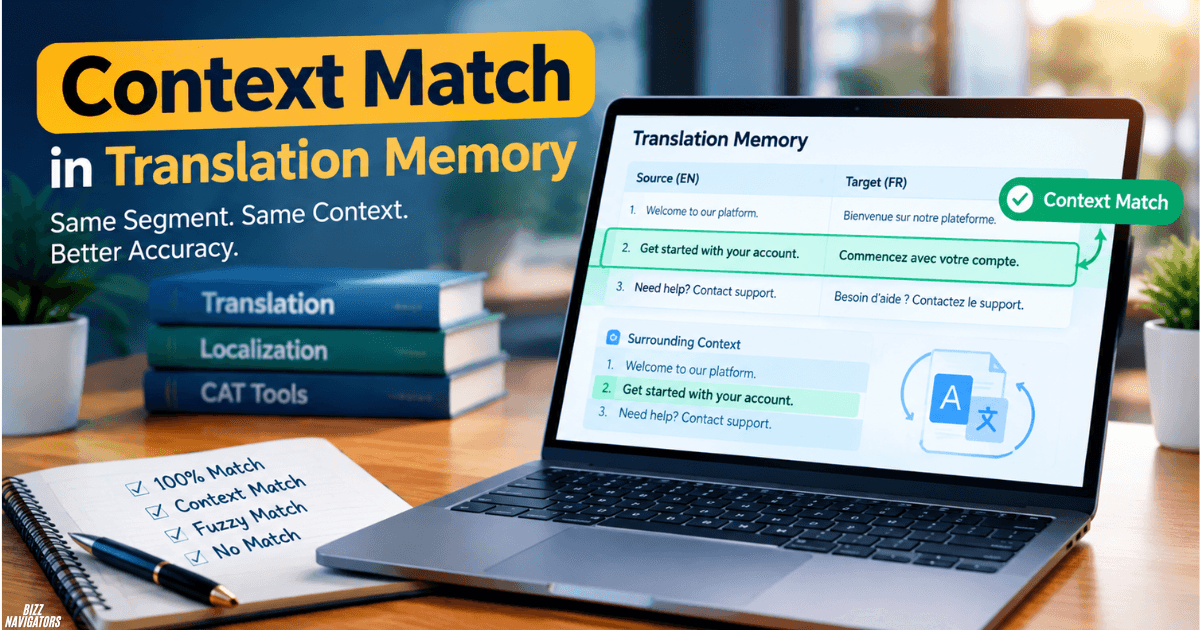
What Is a Context Match?
A Context Match is an exact translation-memory match where the same source segment appears with the same relevant surrounding context as a previously translated segment.
In simple words, the text matches and its context matches too.
For example, if a translator previously translated a sentence between the same preceding and following segments, a CAT tool may recognize it as a context match when that sequence appears again.
This gives the translator stronger evidence that the stored translation is suitable.
How Does a Context Match Work?
A Translation Memory (TM) stores previously translated source and target segments. When new content is opened in a CAT tool, the software compares each segment with its stored translations.
A 100% match means the source segment is identical to a stored segment.
A Context Match adds another check. The system also looks at relevant information around that segment. Depending on the CAT tool, this may include:
- Previous segment
- Following segment
- A sequence of nearby segments
- Segment identifiers
- Document structure
- Other contextual information
The exact rules vary between CAT tools.
Why Does Context Matter?
The same sentence can have different meanings in different situations.
For example, “Open” could be a button label, an instruction, or a description. Its correct translation can depend on where it appears.
Context matching helps the system determine whether the previous translation was used in the same environment.
Context Match vs 100% Match
The difference is simple:
| Match Type | Meaning |
| 100% Match | The source segment is identical |
| Context Match | The source segment and relevant context match |
| Fuzzy Match | The source is similar but not identical |
| No Match | No suitable translation is found |
Some CAT tools use percentages such as 101% to identify context matches.
This does not mean the text is “more than 100% identical.” The extra percentage represents additional contextual information.
What Is a 101% Context Match?
A 101% Context Match generally means the source segment is an exact match and its relevant context also matches.
Phrase and memoQ use 101% to identify this type of match.
For example:
Previous context → Target segment → Following context
If the same sequence appears again, the CAT tool can identify the target segment as an in-context match.
The exact context rules depend on the software.
What Is a 102% Match?
Some CAT tools use 102% for an even stronger contextual match.
memoQ describes 102% as a double-context match where additional contextual information also agrees.
The important point is that these percentages are software-specific labels.
They should not be treated as a universal translation industry standard.
Context Match vs Fuzzy Match
A context match and a fuzzy match are not the same.
A context match normally starts with an identical source segment and adds contextual verification.
A fuzzy match is only similar to a previous segment.
For example:
Stored:
“Click the Save button to continue.”
New:
“Click the Save button to proceed.”
The sentences are similar, but they are not identical. A CAT tool may therefore return a fuzzy match.
Fuzzy matches require more review because the translator must check what changed.
Why Is Context Matching Useful?
Context matching can save time and improve consistency.
When the same content appears repeatedly, translators do not need to translate every segment from scratch.
It is especially useful for:
- Software localization
- Technical documentation
- User manuals
- Legal content
- Product documentation
- Website localization
- Repeated UI text
RWS explains that context matches provide stronger evidence than ordinary exact matches because the segment appears in the same sequence as the previously translated content.
Faster Translation
A reliable context match can allow a translator to reuse an approved translation with little or no editing.
This becomes particularly useful in large projects where thousands of segments repeat.
Better Consistency
Translation Memory helps teams reuse approved terminology.
Context matching adds another layer by checking whether the same wording appears in the same environment.
This can reduce unnecessary changes between similar documents.
Does a Context Match Guarantee a Correct Translation?
No.
A context match shows that the source and relevant context match a previous translation. It does not prove that the old translation is still correct.
A project may have:
- A new style guide
- Updated terminology
- Changed product names
- New client preferences
- Errors in older translations
Translators should therefore review important matches before approving them.
A context match is a strong reuse signal, not a replacement for human review.
How Should You Check a Context Match?
Before accepting a match, check these five things:
1. Source text
Confirm that the current segment really matches the stored segment.
2. Surrounding context
Check the previous and following segments when available.
3. Terminology
Make sure the translation follows the current glossary.
4. Tags and variables
Check numbers, placeholders, formatting tags, and product names.
5. Target translation
Confirm that the existing translation still fits the current project.
Phrase notes that differences in tags can affect match quality and cause an expected exact match to receive a lower score.
Which CAT Tools Use Context Matching?
Several professional CAT tools support contextual matching, but they do not all use exactly the same rules.
Trados/RWS
RWS describes context matches as matches where the segment occurs in the same sequence as previously translated content.
memoQ
memoQ documents:
- 100% — exact match
- 101% — context match
- 102% — double-context match
Phrase
Phrase uses 101% for an in-context match and considers surrounding segments and other contextual information.
Smartcat
Smartcat also distinguishes context matches from standard 100% matches and documents higher match levels for stronger contextual agreement.
Because each platform can apply different rules, always check the documentation for the CAT tool you are using.
Context Match in Translation Memory: Simple Example
Suppose a translation memory contains:
Previous: Welcome to our platform.
Current: Create your account.
Next: Contact support if you need help.
The same three-segment sequence appears in a new document.
The middle sentence is already an exact match. Because the surrounding segments also match, the CAT tool may identify it as a Context Match.
This gives the translator more confidence than an isolated 100% match.
Final Answer
A Context Match is an exact translation-memory match with matching surrounding context.
The key difference is simple:
100% Match = same segment.
Context Match = same segment + relevant context.
Some CAT tools label a context match as 101% and stronger contextual matches as 102%. The exact scoring system depends on the platform.
For translators, the main benefit is simple: faster reuse, better consistency, and more confidence when repeated content appears in the same context.

At BizzNavigators, we answer the questions you’re actually searching for, honestly and clearly. We check our facts before we publish anything, and if we’re not sure about something, we tell you instead of guessing. Whatever you’re looking for- a tech fix, a business tip, or a simple how-to- we want to give you an answer you can trust.