
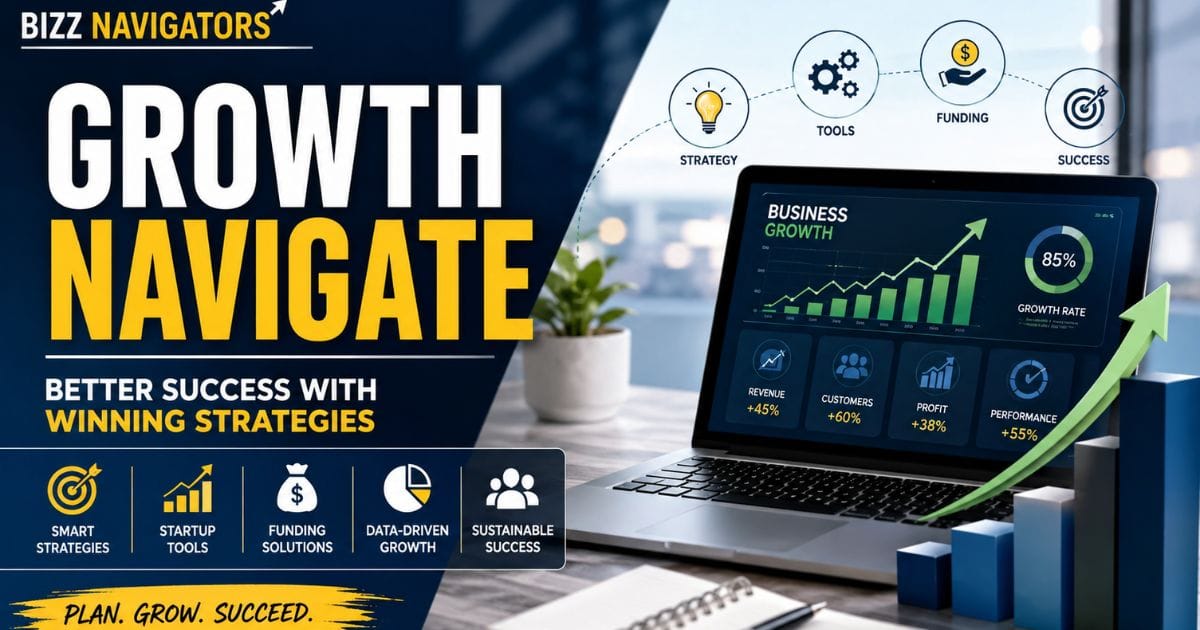
What Is Growth Navigate and Why Does It Matter?
Growing a business today requires more than intuition; it demands a clear strategy backed by data, efficient systems, and continuous improvement. Growth Navigate helps businesses scale with confidence by combining practical growth strategies, modern technology, and measurable decision-making into one sustainable framework.
Whether you’re launching a startup or expanding an established company, Growth Navigate shows you how to build scalable processes, improve customer acquisition, secure the right funding, and achieve long-term success without unnecessary risks.
If you’re looking for a proven roadmap to grow faster while staying competitive, this guide covers everything you need to know about Growth Navigate.
Why Businesses Are Adopting Growth Navigate
Companies today face increasing competition, changing customer expectations, and rapid technological innovation. Without a clear strategy, even businesses with excellent products can struggle to grow.
Growth Navigate helps organizations by:
Creating measurable growth objectives
Improving operational efficiency
Supporting data-driven decision-making
Increasing customer retention
Reducing unnecessary business risks
Building scalable systems for future expansion
Instead of chasing every new trend, businesses focus on strategies that generate consistent and measurable progress.
The Core Principles Behind Growth Navigate
Every successful growth framework is built on a few essential principles. Growth Navigate combines these fundamentals into a practical system that businesses of every size can implement.
Sustainable Growth Over Rapid Expansion
Fast growth often sounds appealing, but expanding too quickly can create financial pressure, operational bottlenecks, and declining customer satisfaction.
Growth Navigate encourages businesses to expand at a pace they can manage. This approach strengthens internal processes before increasing demand, reducing the likelihood of expensive mistakes.
Data-Driven Decision Making
Successful companies rarely rely on assumptions. Instead, they use performance metrics to understand customer behavior, marketing effectiveness, and operational efficiency.
Important business metrics include:
Customer Acquisition Cost (CAC)
Customer Lifetime Value (CLV)
Revenue Growth Rate
Customer Retention Rate
Conversion Rate
Monthly Recurring Revenue (MRR)
Monitoring these indicators allows businesses to identify opportunities before problems become costly.
Customer-Centered Business Development
Every growth strategy should begin with customer needs. Businesses that continuously improve their products, services, and customer experience often achieve stronger long-term performance than competitors focused only on sales.
Growth Navigate encourages companies to collect customer feedback, analyze buying behavior, and improve every stage of the customer journey.
Continuous Innovation
Markets evolve quickly. Companies that regularly update their products, marketing strategies, and internal processes remain competitive even during economic uncertainty.
Innovation does not always require creating something entirely new. Sometimes, improving an existing product or simplifying a customer experience delivers significant growth.
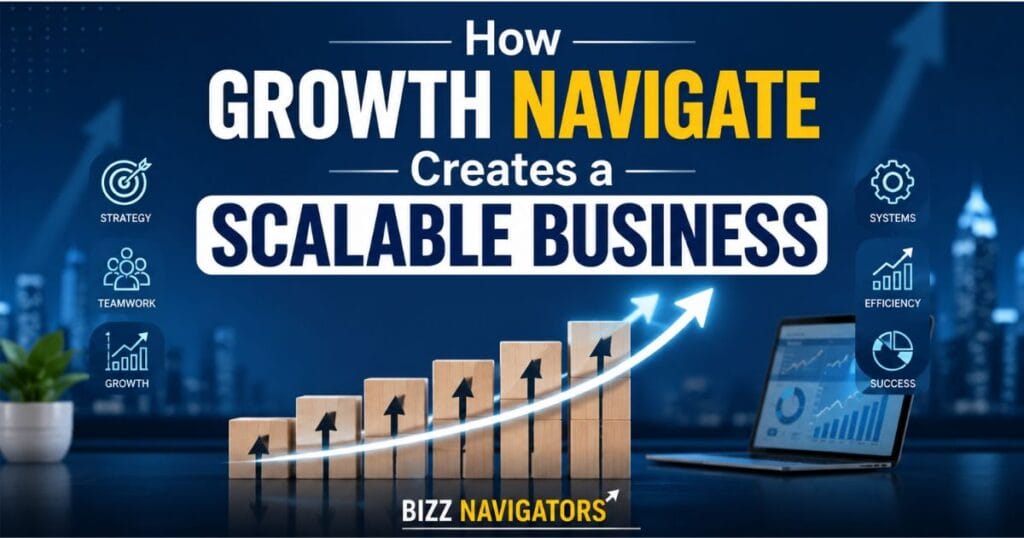
How Growth Navigate Creates a Scalable Business
Many businesses struggle because they grow without establishing repeatable systems. As demand increases, daily operations become more complicated, leading to delays, rising costs, and inconsistent customer experiences.
Growth Navigate addresses these challenges by focusing on scalable business foundations.
Developing a Clear Growth Roadmap
Every successful business begins with a clear direction.
A structured roadmap should define:
Long-term business vision
Quarterly objectives
Revenue targets
Marketing priorities
Product development goals
Key performance indicators
With clear milestones, teams understand where the business is heading and how success will be measured.
Building Repeatable Systems
Growing businesses cannot rely on manual processes forever.
Growth Navigate promotes documented workflows for:
Sales
Customer support
Marketing campaigns
Employee onboarding
Financial reporting
Inventory management
Standardized systems improve efficiency while reducing human error.
Making Smarter Decisions with Business Analytics
Modern analytics platforms allow businesses to understand customer behavior in real time.
Instead of asking, “What happened last month?” Growth Navigate encourages leaders to ask:
Which marketing channels generate the highest ROI?
Where are customers leaving the sales funnel?
Which products create the highest profit margin?
What customer segments have the greatest lifetime value?
These insights lead to more confident business decisions.
Improving Customer Acquisition and Retention
Finding new customers is important, but keeping existing customers is often more profitable.
Growth Navigate balances both objectives by helping businesses:
Improve customer onboarding
Personalize communication
Increase repeat purchases
Strengthen customer loyalty
Deliver consistent service quality
Satisfied customers frequently become brand advocates, reducing future marketing costs.
Growth Navigate Startup Tools Every Growing Business Should Know
Technology has become one of the biggest drivers of business growth. The right software reduces manual work, improves collaboration, and provides valuable insights that help businesses scale efficiently.
Choosing the right Growth Navigate startup tools depends on your company’s size, goals, and growth stage. Instead of purchasing dozens of applications, businesses should build a focused technology stack that solves real operational challenges.
Team Collaboration Platforms
Effective communication keeps projects moving forward.
Collaboration platforms allow teams to:
Share updates instantly
Organize projects
Hold virtual meetings
Manage internal documentation
Track ongoing tasks
When communication improves, productivity often increases across every department.
Customer Relationship Management (CRM) Software
A CRM system helps businesses organize customer information throughout the sales process.
Benefits include:
Lead management
Sales pipeline tracking
Customer communication history
Automated follow-ups
Sales forecasting
A well-managed CRM allows businesses to build stronger relationships while improving conversion rates.
Marketing Automation Tools
Marketing becomes difficult to scale when every campaign requires manual effort.
Automation software can:
Schedule email campaigns
Segment audiences
Nurture leads automatically
Track campaign performance
Improve customer engagement
These tools save time while delivering a more personalized customer experience.
Analytics and Performance Tracking
Data is one of the most valuable business assets.
Analytics platforms help businesses understand:
Website traffic
User behavior
Conversion performance
Marketing ROI
Customer engagement
Product performance
Businesses that monitor analytics regularly can identify growth opportunities much faster than those relying on assumptions.
Project and Workflow Management Software
As teams expand, managing projects manually becomes inefficient.
Workflow management tools help businesses:
Assign responsibilities
Track deadlines
Monitor progress
Improve accountability
Reduce project delays
This creates greater visibility across departments and keeps teams aligned with company goals.
Financial Management Solutions
Healthy finances support sustainable growth.
Financial software helps businesses:
Track income and expenses
Manage invoices
Generate financial reports
Forecast cash flow
Prepare tax records
Accurate financial reporting also strengthens investor confidence when seeking funding.
AI-Powered Business Tools
Artificial intelligence has become an important part of modern business operations.
AI tools can assist with:
Customer support automation
Content creation
Sales forecasting
Data analysis
Workflow optimization
Market research
Rather than replacing employees, AI allows teams to focus on higher-value work that requires creativity and strategic thinking.
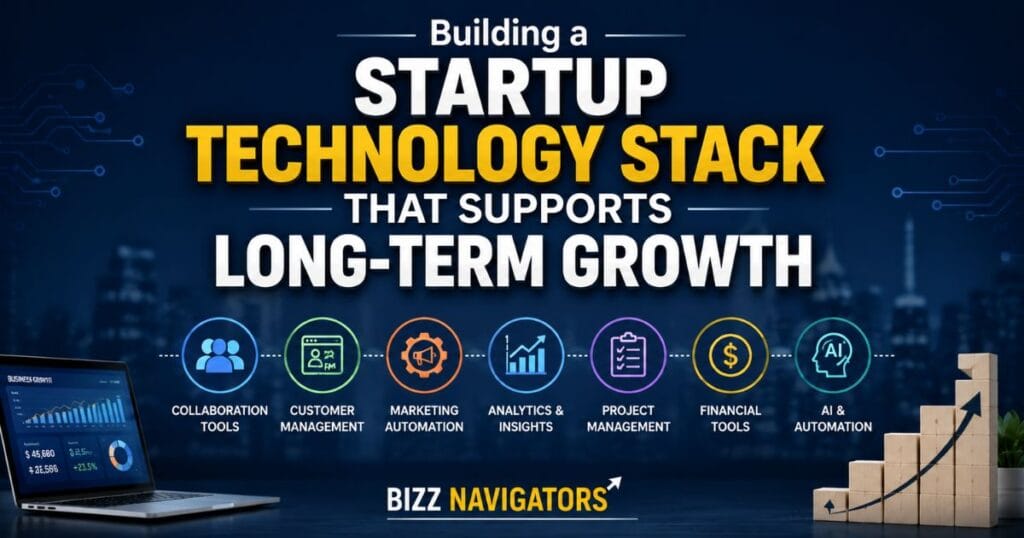
Building a Startup Technology Stack That Supports Long-Term Growth
Purchasing the most expensive software does not guarantee success. The most effective technology stack is one that aligns with your business objectives and integrates smoothly across departments.
Before investing in new tools, ask the following questions:
Does this software solve a real business problem?
Can it integrate with existing systems?
Will it remain useful as the company grows?
Is it easy for employees to adopt?
Does it provide measurable business value?
Businesses that regularly evaluate their technology stack avoid unnecessary software costs while maintaining operational efficiency.
Growth Navigate Funding: Smart Ways to Finance Business Expansion
Securing the right funding is one of the biggest challenges for startups and growing businesses. Growth Navigate funding focuses on choosing financing options that match your growth stage instead of taking on unnecessary financial risk. The goal is to secure capital while maintaining healthy cash flow and long-term stability.
Bootstrapping
Many successful businesses begin with self-funding. Bootstrapping allows founders to retain complete ownership and make decisions independently. Although growth may be slower, it encourages disciplined spending and efficient resource management.
Angel Investors
Angel investors provide capital in exchange for equity. Beyond funding, they often contribute industry expertise, mentorship, and valuable business connections that can accelerate growth.
Venture Capital
For startups with high-growth potential, venture capital can provide significant investment. However, founders should be prepared to share ownership and meet aggressive growth expectations.
Business Loans
Traditional banks and financial institutions offer loans that help businesses expand operations, purchase equipment, or improve infrastructure. A strong credit history and well-prepared business plan increase approval chances.
Government Grants
Many governments support innovation, technology, exports, and entrepreneurship through grants and incentive programs. Unlike loans, grants generally do not require repayment, making them an attractive funding source.
Crowdfunding
Crowdfunding platforms allow businesses to raise funds directly from customers and supporters. Besides generating capital, successful campaigns validate product demand before a full market launch.
Revenue-Based Financing
Instead of giving away equity, businesses repay investors through a percentage of future revenue. This option works well for companies with consistent monthly income.
Preparing Your Business Before Seeking Investment
Receiving funding is easier when your business demonstrates stability and growth potential.
Before approaching investors or lenders, make sure you have:
A Professional Business Plan
Your business plan should clearly explain:
Business model
Target audience
Competitive advantage
Revenue model
Growth strategy
Financial projections
Organized Financial Records
Accurate financial statements build trust with investors. Maintain updated:
Profit and loss statements
Cash flow reports
Balance sheets
Tax records
Realistic Revenue Forecasts
Avoid exaggerated projections. Investors appreciate practical assumptions supported by market research and historical performance.
Defined Growth Strategy
Explain exactly how new funding will be used. Whether expanding into new markets, hiring employees, or launching products, every investment should have measurable objectives.
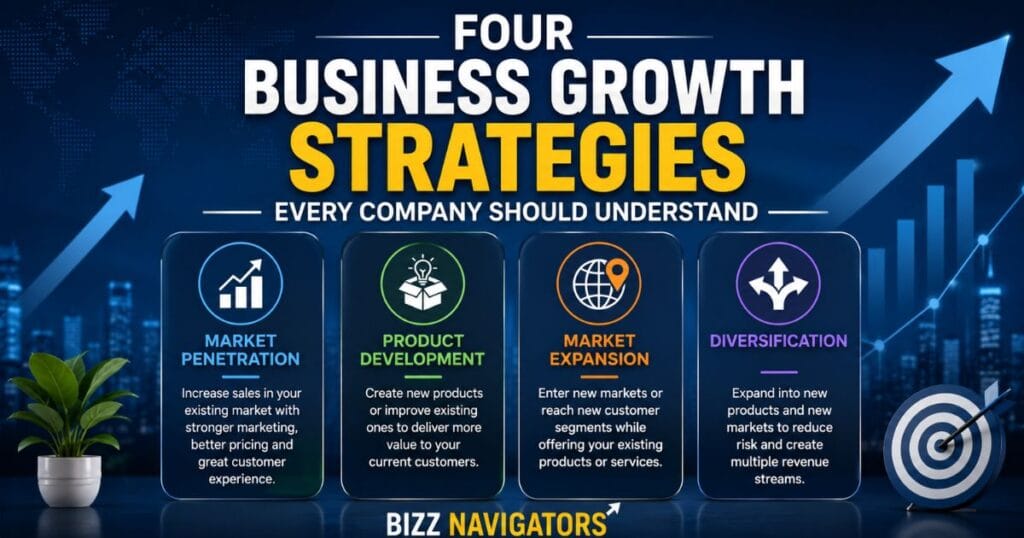
Four Business Growth Strategies Every Company Should Understand
Every successful expansion plan typically follows one or more proven growth strategies.
Market Penetration
Increase sales within your existing market by improving marketing, pricing, customer service, or promotional campaigns.
Product Development
Introduce new products or improve existing offerings to create additional value for current customers.
Market Expansion
Enter new geographic regions or target different customer segments while maintaining your existing products or services.
Diversification
Expand into completely new products and markets. Although this carries greater risk, it can create multiple revenue streams.
Understanding the Seven Stages of Business Growth
Businesses rarely grow in a straight line. Recognizing each stage helps leaders prepare for upcoming challenges.
| Stage | Primary Focus |
| Idea Validation | Testing demand and refining the concept |
| Startup Launch | Building the first customer base |
| Customer Growth | Increasing revenue and brand awareness |
| Expansion | Hiring staff and improving operations |
| Scaling | Automating systems and optimizing efficiency |
| Market Leadership | Strengthening competitive advantage |
| Sustainability | Maintaining long-term profitability and innovation |
Each stage requires different priorities, making strategic planning essential.
The Five Stages of Entrepreneurial Growth
Entrepreneurs also experience predictable development phases.
- Survival – Establishing consistent income.
- Stability – Creating repeatable operations.
- Success – Achieving profitable growth.
- Expansion – Entering larger markets.
- Maturity – Building a resilient and scalable organization.
Understanding these stages helps founders make better decisions at every milestone.
Essential Metrics That Drive Sustainable Growth
Growth without measurement often leads to costly mistakes. Businesses should regularly monitor these key performance indicators (KPIs):
Customer Acquisition Cost (CAC) – Measures the cost of acquiring each customer.
Customer Lifetime Value (CLV) – Estimates total revenue generated by a customer.
Monthly Recurring Revenue (MRR) – Tracks predictable monthly income.
Conversion Rate – Shows how effectively visitors become customers.
Customer Churn Rate – Indicates how many customers stop using your product or service.
Net Profit Margin – Measures overall profitability.
Cash Flow – Ensures daily business operations remain financially healthy.
Return on Investment (ROI) – Evaluates the effectiveness of business investments.
Reviewing these metrics consistently enables faster and more informed decision-making.
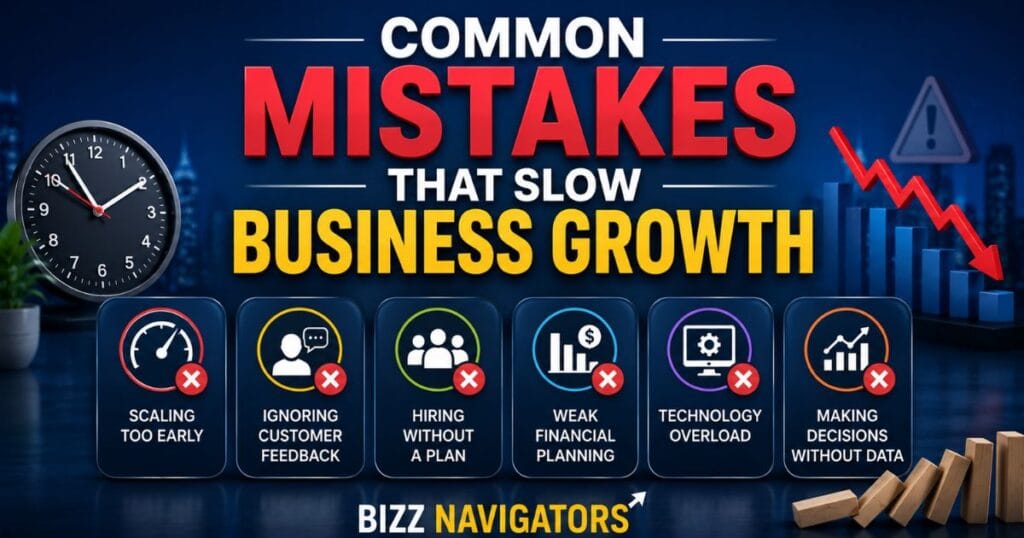
Common Mistakes That Slow Business Growth
Even promising companies can lose momentum because of avoidable mistakes.
Scaling Too Early
Expanding before achieving product-market fit often creates operational and financial pressure.
Ignoring Customer Feedback
Customer insights reveal opportunities for improvement. Businesses that listen carefully adapt faster than competitors.
Hiring Without a Plan
Rapid hiring increases expenses and management complexity. Every new role should support measurable business objectives.
Weak Financial Planning
Poor budgeting and cash flow management can limit growth even when sales increase.
Technology Overload
Using too many disconnected tools creates inefficiency. Choose software that integrates well and solves genuine business problems.
Making Decisions Without Data
Growth should be guided by measurable performance, not assumptions or short-term trends.
Growth Navigate vs. Traditional Business Growth Models
| Feature | Growth Navigate | Traditional Growth |
| Decision Making | Data-driven | Experience-based |
| Technology | Integrated automation | Limited automation |
| Customer Focus | Continuous optimization | Periodic improvements |
| Risk Management | Proactive planning | Reactive responses |
| Scalability | Built into systems | Added later |
| Long-Term Growth | Sustainable | Often focused on rapid expansion |
Growth Navigate emphasizes consistent improvement instead of pursuing growth at any cost.
A Practical Framework for Implementing Growth Navigate
Businesses can begin applying the Growth Navigate approach by following these steps:
- Define clear business objectives.
- Analyze your current operations and identify bottlenecks.
- Select tools that improve productivity and collaboration.
- Establish measurable KPIs.
- Automate repetitive processes wherever possible.
- Review business performance regularly.
- Adjust strategies using customer feedback and analytics.
Small improvements made consistently often produce stronger long-term results than large, infrequent changes.
Real-World Example
Imagine a software startup struggling with slow customer growth.
Instead of immediately increasing advertising spend, the company applies Growth Navigate principles by:
Implementing a CRM to improve lead management.
Using analytics to identify customer drop-off points.
Automating email follow-ups.
Tracking CAC and CLV monthly.
Refining onboarding based on customer feedback.
Within months, customer retention improves, conversion rates increase, and marketing costs become more efficient. This example illustrates how structured systems can produce sustainable growth without unnecessary spending.
Key Takeaways
Growth Navigate combines strategy, technology, and measurable goals to support long-term business success.
Choosing the right startup tools improves efficiency and productivity.
Funding should match your business stage and growth objectives.
Sustainable growth depends on data-driven decisions rather than assumptions.
Monitoring KPIs helps identify opportunities before problems become serious.
Continuous optimization creates stronger competitive advantages over time.
Frequently Asked Questions
What are the four growth strategies in business?
The four primary strategies are market penetration, product development, market expansion, and diversification.
What are the seven stages of business growth?
The stages include idea validation, startup launch, customer growth, expansion, scaling, market leadership, and long-term sustainability.
What are the five stages of entrepreneurial growth?
Entrepreneurs typically progress through survival, stability, success, expansion, and maturity.
What are the five effective strategies to grow a business?
Improve customer retention, increase conversion rates, expand into new markets, develop innovative products, and build strategic partnerships.
Is Growth Navigate suitable for small businesses?
Yes. The framework works for startups, small businesses, and established companies because it emphasizes scalable systems, financial discipline, and customer-focused growth.
Which startup tools should businesses prioritize?
Start with collaboration software, CRM systems, marketing automation, analytics platforms, project management tools, and financial management applications.
How can startups improve their chances of receiving funding?
Prepare a detailed business plan, maintain accurate financial records, define realistic revenue projections, and clearly explain how investment will accelerate growth.
Conclusion
Growth Navigate gives businesses a clear path to sustainable growth instead of relying on trial and error. By combining the right startup tools, funding strategies, performance metrics, and scalable systems, Growth Navigate helps startups and established companies make smarter decisions with confidence.
If you want long-term success, stronger operations, and a competitive edge, adopting Growth Navigate is one of the most effective ways to build a business that continues to grow in today’s evolving market.

At BizzNavigators, we answer the questions you’re actually searching for, honestly and clearly. We check our facts before we publish anything, and if we’re not sure about something, we tell you instead of guessing. Whatever you’re looking for- a tech fix, a business tip, or a simple how-to- we want to give you an answer you can trust.