
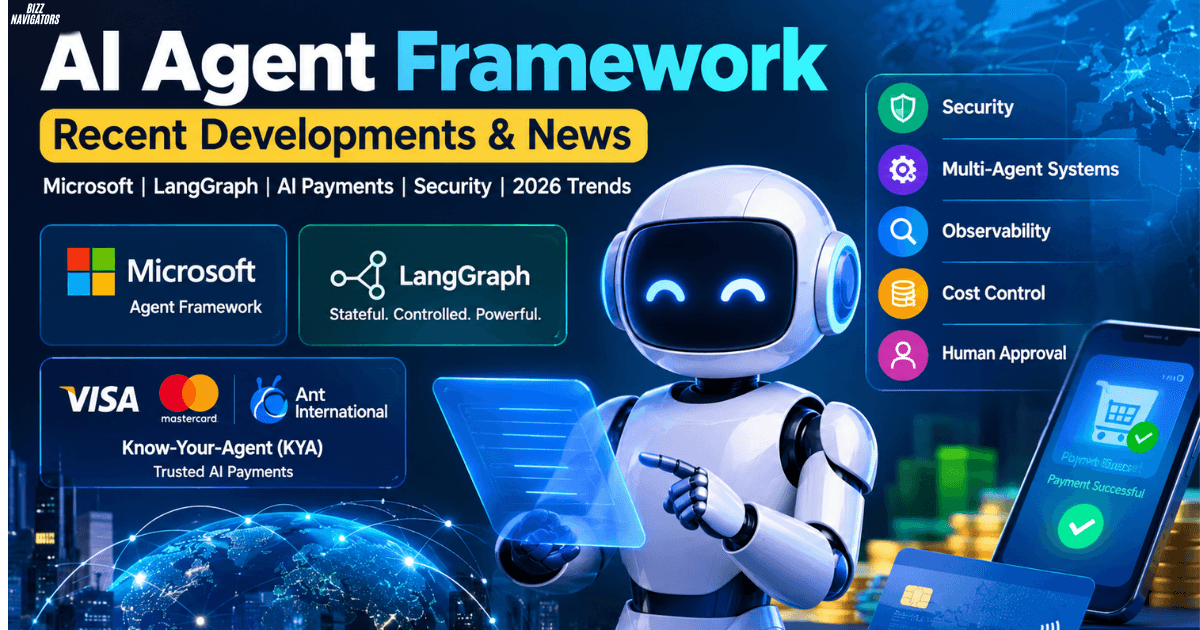
What Are the Latest AI Agent Framework Developments?
The biggest AI agent framework recent developments and news show one clear shift: AI agents are moving from experiments to controlled production systems.
The main changes are:
- Microsoft is consolidating AutoGen and Semantic Kernel capabilities into Microsoft Agent Framework.
- LangGraph remains focused on stateful and controllable agent workflows.
- AI agent security is becoming a core framework requirement.
- Payment companies are developing standards for trusted AI agents.
- Multi-agent systems are becoming more structured.
- Observability, human approval, and policy controls are gaining importance.
The focus is no longer only on making agents autonomous. The focus is on making them reliable, secure, observable, and easier to control.
Microsoft Agent Framework Is Replacing the Old Split
Microsoft Agent Framework is now Microsoft’s main direction for building AI agents and workflows.
It combines ideas from AutoGen and Semantic Kernel into one framework. Microsoft describes it as the direct successor to both projects. It adds graph-based workflows to agent abstractions and enterprise features such as state management, middleware, telemetry, and type safety.
For developers, this means new Microsoft-based agent projects can use one unified framework instead of choosing between separate AutoGen and Semantic Kernel paths.
What Does Microsoft Agent Framework Support?
Microsoft Agent Framework supports:
- AI agents
- Multi-agent workflows
- Graph-based execution
- Session-based state
- Middleware
- Tools
- RAG
- Human-in-the-loop approval
- Checkpoints and resuming
- Agent orchestration
- Security features
- Multiple model providers
It also supports Python and .NET development.
Microsoft’s documentation now includes migration paths from both AutoGen and Semantic Kernel.
Is AutoGen Still the Main Microsoft Choice?
No.
AutoGen remains available, but Microsoft has moved its new development direction toward Agent Framework. The official migration documentation describes Agent Framework as the new foundation for building AI applications and guides moving AutoGen applications.
For a new Microsoft-based project, developers should therefore evaluate Agent Framework first.
LangGraph Remains Strong for Controlled Agent Workflows
LangGraph is still a major option for developers who need detailed control over agent execution.
Its main strength is stateful orchestration.
Developers can define how an agent moves between steps, stores state, calls tools, pauses for approval, and continues a workflow.
This makes LangGraph useful for:
- Long-running agents
- Stateful applications
- Multi-agent systems
- Human approval steps
- Custom workflows
- Complex tool execution
- Production agent systems
LangGraph’s approach is different from simply asking an LLM to decide what happens next. Developers can define the workflow and control important execution points.
Which Is Better: Microsoft Agent Framework or LangGraph?
Neither is automatically better.
Choose Microsoft Agent Framework when you want Microsoft’s ecosystem, .NET or Python support, enterprise features, and a unified successor to AutoGen and Semantic Kernel.
Choose LangGraph when you need detailed control over state, workflow logic, and agent execution.
| Need | Better fit |
| Microsoft ecosystem | Microsoft Agent Framework |
| AutoGen migration | Microsoft Agent Framework |
| Semantic Kernel migration | Microsoft Agent Framework |
| Custom stateful workflows | LangGraph |
| Detailed execution control | LangGraph |
| Human approval workflows | Both |
| Multi-agent systems | Both |
| Production orchestration | Both |
The right choice depends more on the application than on the framework’s popularity.
AI Agent Payments Are Creating a New Framework Problem
One of the biggest September 2026 developments is happening in financial technology.
Visa, Mastercard, and Ant International are developing a Know-Your-Agent (KYA) interoperability framework.
The goal is to help payment networks, digital wallets, agent platforms, and marketplaces identify trusted AI agents across different systems.
The companies are working through BuildFin.ai, a platform convened by Singapore’s Monetary Authority of Singapore.
The initiative focuses on:
- Agent identification
- Operator traceability
- Shared certification principles
- Cross-network recognition
- Continuous monitoring
- Transaction risk visibility
The companies will still keep their own verification and decision-making systems.
This is important because AI agents are moving from recommending products to completing purchases for users.
Why Does Know-Your-Agent Matter?
Traditional payment systems mainly need to identify the customer and merchant.
Agentic commerce adds another layer: the AI agent acting for the customer.
Payment systems now need answers to practical questions:
- Who controls the agent?
- Which user authorized it?
- What can it buy?
- How much can it spend?
- Can its permissions be revoked?
- How can another platform verify it?
- What happens if the agent makes an unauthorized transaction?
KYA frameworks are designed to address these problems.
This makes agent identity and authorization an important part of the next generation of AI infrastructure.
Agentic Payments Are Also Expanding in India
India is developing its own approach to AI-agent payments.
The National Payments Corporation of India is working on protocols to identify and authorize AI agents within the UPI ecosystem.
Reuters also reported that NPCI is developing an agent registry as part of its planned Unified Agentic Protocol. The initial use cases are expected to focus on smaller, frequent transactions before more complex actions are considered.
This shows that agent frameworks are no longer only a software-development issue.
They are becoming part of payment infrastructure and financial regulation.
Security Is Becoming a Core Agent Framework Feature
The latest framework direction puts more attention on control.
A production agent should not have unlimited access to tools, data, or transactions.
Developers increasingly need:
- Permission controls
- Middleware
- Audit trails
- Human approval
- Monitoring
- Policy enforcement
- Checkpoints
- Identity controls
- Transaction limits
Microsoft Agent Framework already includes security, middleware, human-in-the-loop workflows, and checkpointing among its framework capabilities.
The key change is simple:
More autonomy requires more control.
Multi-Agent Frameworks Are Becoming More Structured
Multi-agent systems are also becoming less experimental.
Instead of creating several agents that simply communicate, developers can assign specific roles.
For example:
- One agent researches.
- One agent checks the result.
- One agent uses a tool.
- One agent handles the final response.
- A human approves high-risk actions.
Microsoft Agent Framework supports workflow patterns for sequential, concurrent, handoff, and group-based collaboration.
LangGraph also supports customized multi-agent architectures.
The important development is not simply having more agents. It is controlling what each agent does and when it can act.
Observability Is Now a Major Agent Requirement
Production AI agents need monitoring.
Developers need to know:
- Which model was called?
- Which tool was used?
- What decision did the agent make?
- How long did the task take?
- Where did the workflow fail?
- How much did the task cost?
- When did a human intervene?
A 2026 LangChain survey of more than 1,300 professionals found that 89% reported implementing observability for their agents, while 52% reported using evaluations.
That makes observability more than an optional developer feature. It is becoming part of production agent engineering.
Model Flexibility and Cost Control Matter More
AI agents can make many model calls during one task.
A complex workflow may involve planning, retrieval, tool use, validation, retries, and final generation.
That can increase cost quickly.
Modern frameworks therefore benefit from flexible model support.
Teams can use different models for different tasks instead of forcing every step through one expensive model.
For example, a smaller model may handle classification while a stronger model handles complex reasoning.
This approach can reduce unnecessary model spending while keeping quality where it matters.
What Should Developers Look for in an AI Agent Framework?
A modern framework should provide more than basic tool calling.
Look for:
- State management for long-running tasks.
- Workflow control for predictable execution.
- Human approval for sensitive actions.
- Observability for debugging and monitoring.
- Security controls for tools and data.
- Model flexibility to avoid vendor lock-in.
- Multi-agent support when several specialized agents are required.
- Checkpoints so failed workflows can resume.
- Interoperability for agents that need to work across platforms.
If a simple function can complete the task, an AI agent may not be necessary. Microsoft’s current guidance also makes this distinction: use agents for open-ended tasks and workflows when execution needs explicit control.
What Is the Direction of AI Agent Frameworks in 2026?
The direction is clear.
AI agent frameworks are moving toward controlled autonomy.
Microsoft is unifying its agent development stack through Agent Framework.
LangGraph continues to provide detailed workflow control.
Financial networks are working on agent identity and interoperability.
Banks and payment systems are exploring ways to authorize and monitor AI agents.
Developers are also putting more attention on observability, security, evaluation, and cost.
The next stage of agent development will therefore not be about making agents act without limits.
It will be about making them capable enough to act and controlled enough to trust.
Key Takeaways
- Microsoft Agent Framework is Microsoft’s unified successor to AutoGen and Semantic Kernel.
- AutoGen is no longer the primary direction for new Microsoft agent development.
- LangGraph remains a strong choice for stateful and controlled workflows.
- KYA is becoming important as AI agents start handling financial transactions.
- Visa, Mastercard, and Ant International are working on cross-network AI-agent trust standards.
- India’s NPCI is also developing systems to identify and authorize payment agents.
- Security, observability, and human approval are becoming core agent requirements.
- Model flexibility and cost control are increasingly important for production systems.
- The main trend is moving from simple AI autonomy toward reliable, governed agent execution.
The biggest takeaway from recent AI agent framework developments and news is that agent technology is entering a more practical phase. The winning frameworks will not simply make agents autonomous. They will make agents easier to control, monitor, secure, and trust.

At BizzNavigators, we answer the questions you’re actually searching for, honestly and clearly. We check our facts before we publish anything, and if we’re not sure about something, we tell you instead of guessing. Whatever you’re looking for- a tech fix, a business tip, or a simple how-to- we want to give you an answer you can trust.