
Introduction: Why Laser Engraving Technology Has Become Essential Across Industries
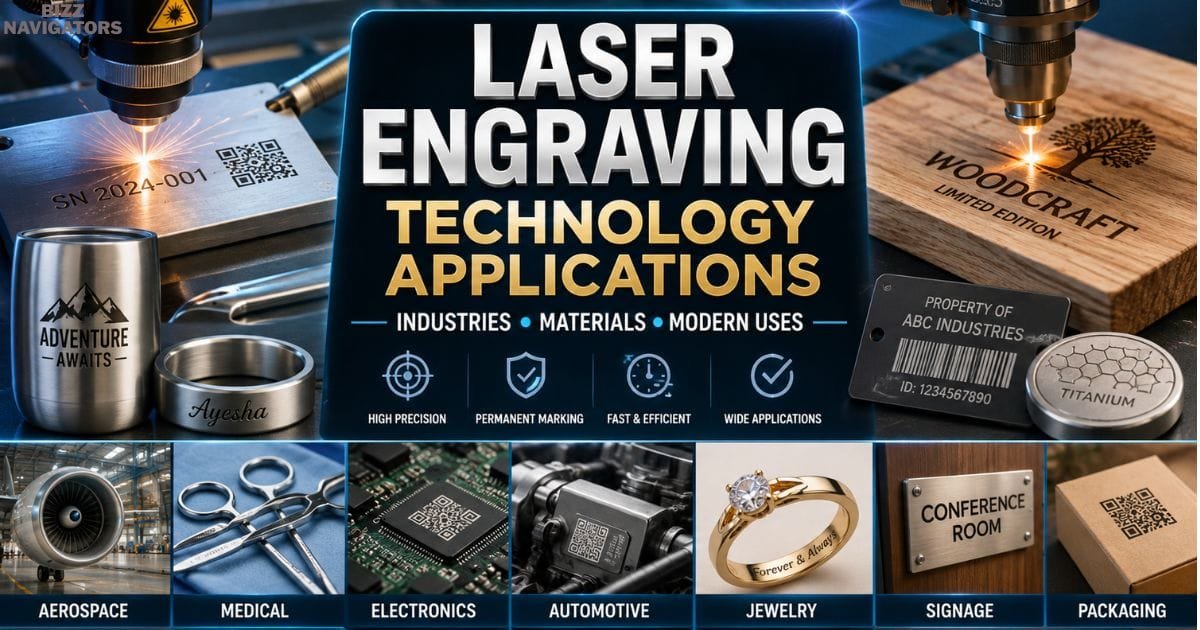
Laser engraving technology applications are transforming modern manufacturing by delivering permanent, high-precision markings across industries. From aerospace and healthcare to automotive, retail, and personalized products.
Businesses rely on laser engraving to improve traceability, branding, and product quality. Unlike traditional engraving methods, it uses a focused laser beam to create clean, durable results without physical contact, reducing material waste and maintenance.
In this article, you’ll discover how laser engraving works, its real-world applications, compatible materials, key benefits, and how to choose the right solution for your needs.
Understanding Laser Engraving Technology
Laser engraving is a precision manufacturing process that permanently engraves text, graphics, logos, barcodes, QR codes, and identification marks onto a material using a focused laser beam.
The laser generates intense heat that vaporizes or melts a controlled amount of the surface. Since the beam is digitally controlled, every engraving is highly accurate and repeatable.
Unlike ink printing or adhesive labels, laser engraving creates markings that resist scratching, fading, corrosion, chemicals, moisture, and extreme temperatures. This durability makes it ideal for products that require lifelong identification.
Another major advantage is versatility. Depending on the laser source, the same technology can engrave metals, wood, acrylic, leather, glass, ceramics, plastics, stone, and many other materials.
How Laser Engraving Works
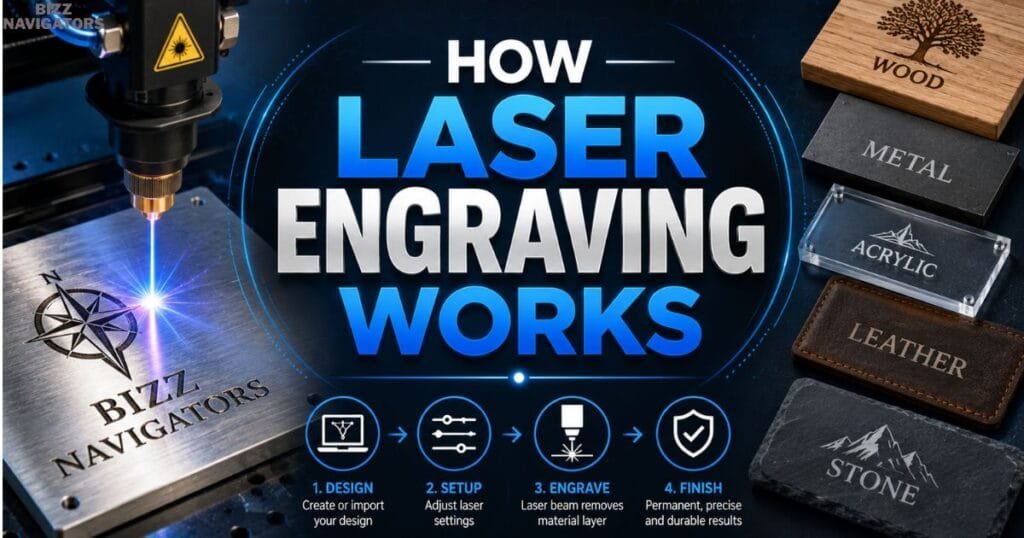
Although laser engraving machines vary in size and capability, they all follow the same basic workflow.
Step 1: Design Preparation
The process begins with a digital design created in compatible laser engraving software. Businesses typically prepare:
Company logos
Product names
QR codes
Serial numbers
Artwork
Barcodes
Decorative patterns
Vector files usually produce the cleanest results because they maintain sharp edges regardless of size.
Step 2: Machine Configuration
The operator selects the correct settings based on:
Material type
Material thickness
Laser power
Engraving speed
Frequency
Resolution
Proper configuration is essential because different materials react differently to laser energy.
Step 3: Laser Engraving
Once the design is loaded, the laser beam follows the programmed path with remarkable precision.
The beam removes microscopic layers of material while maintaining smooth edges and crisp details.
Step 4: Inspection
After engraving, operators verify that:
Text is readable.
Logos are accurate.
QR codes scan correctly.
Depth is consistent.
No unwanted burn marks appear.
This quality check ensures the final product meets production standards.
Types of Laser Engraving Machines
Choosing the right laser engraver depends on the materials you plan to process and the type of work you perform.
CO₂ Laser Engravers
CO₂ lasers are among the most widely used engraving systems because they perform exceptionally well on non-metal materials.
They are commonly used for:
Wood
Acrylic
Leather
Paper
Rubber
Glass
Fabric
These machines are popular with sign makers, furniture manufacturers, schools, and gift businesses.
Fiber Laser Engravers
Fiber lasers are the preferred choice for industrial metal engraving.
They easily engrave:
Stainless steel
Aluminum
Brass
Copper
Titanium
Gold
Silver
Fiber laser systems offer excellent speed, long service life, and minimal maintenance, making them ideal for manufacturing environments.
Diode Laser Engravers
Diode lasers are compact, affordable, and well-suited for hobbyists and small businesses.
They work best with:
Wood
Leather
Cardboard
Some plastics
Painted metals
Although less powerful than industrial systems, they are an excellent starting point for custom product businesses.
UV Laser Engravers
UV lasers generate very fine markings with minimal heat, making them suitable for delicate materials such as:
Medical plastics
Glass
Electronic components
Transparent materials
These systems are often used where precision matters more than engraving depth.
Which Machine Is Right for You?
The best machine depends on your workload, budget, and materials.
| Laser Type | Best For | Common Users |
| CO₂ | Wood, acrylic, leather, glass | Small businesses, signage |
| Fiber | Metal engraving | Manufacturing, automotive |
| Diode | Crafts and personalization | Hobbyists, startups |
| UV | Delicate materials | Electronics, medical industry |
Laser Engraving Technology Applications Across Major Industries
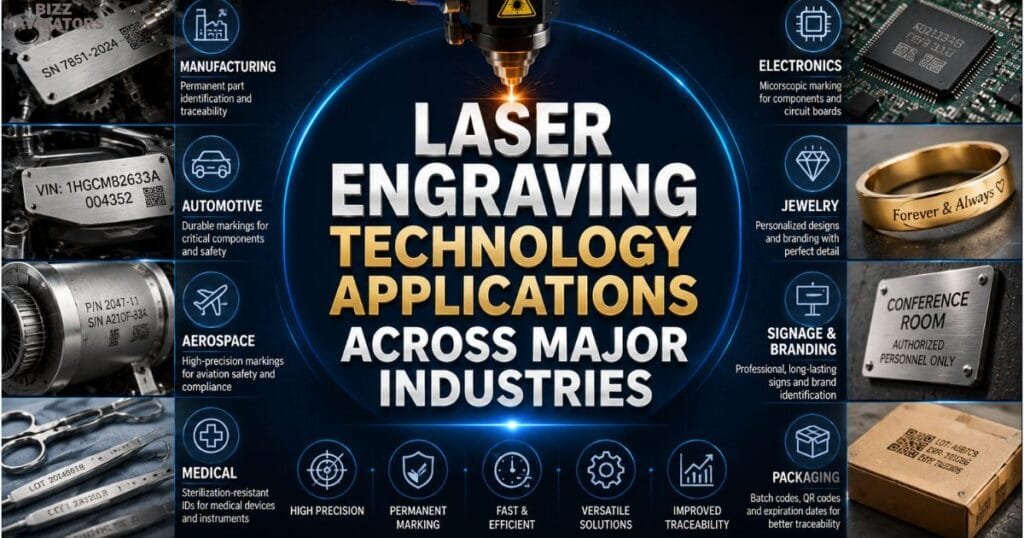
One of the biggest strengths of laser engraving is its versatility. It supports everything from large-scale industrial manufacturing to customized consumer products.
Manufacturing and Industrial Production
Factories use laser engraving to create permanent product identification that remains readable throughout the product’s life.
Typical industrial applications include:
Serial numbers
Batch codes
Production dates
Machine labels
Part identification
Quality control markings
Permanent identification simplifies inventory management and improves traceability.
Automotive Industry
Vehicle manufacturers rely on laser engraving for thousands of individual components.
Common applications include:
Engine parts
Brake components
Gear assemblies
VIN plates
Safety labels
Replacement parts
Because laser engravings resist heat, oil, and chemicals, they remain readable for years.
Aerospace and Aviation
Every aircraft component must be traceable for safety and regulatory compliance.
Laser engraving helps identify:
Aircraft parts
Turbine components
Flight hardware
Inspection records
Maintenance identification
The precision of fiber lasers makes them especially valuable for aerospace manufacturing.
Medical Equipment Manufacturing
Medical devices require permanent identification that withstands repeated sterilization without affecting performance.
Laser engraving is commonly used for:
Surgical instruments
Dental equipment
Orthopedic implants
Medical devices
Laboratory equipment
The process produces clean, contamination-free markings that support patient safety and regulatory compliance.
Electronics Manufacturing
Electronic products contain many tiny components that require accurate identification.
Laser engraving enables manufacturers to add:
PCB markings
QR codes
Product numbers
Brand logos
Security identifiers
Because laser systems can engrave microscopic details, they are widely used in electronics production.
Jewelry and Luxury Goods
The jewelry industry depends heavily on customization and authenticity.
Laser engraving creates beautiful personalized designs such as:
Names
Initials
Dates
Messages
Fingerprints
Logos
It also allows luxury brands to add discreet authentication marks that help reduce counterfeiting.
Signage and Business Branding
Professional laser engraving enhances a company’s visual identity while providing durable identification.
Popular applications include:
Office signs
Directional signage
Nameplates
Control panels
Product branding
Corporate gifts
Unlike printed graphics, engraved designs remain attractive even after years of daily use.
Defense and Security
Military and security organizations require permanent identification that survives demanding environments.
Laser engraving supports:
Equipment tracking
Asset management
Component identification
Military inventory
Durable compliance markings
Its resistance to wear makes it suitable for mission-critical equipment.
Packaging and Product Labeling
Modern packaging increasingly includes permanent laser markings for better traceability and consumer information.
Manufacturers engrave:
QR codes
Batch numbers
Expiration dates
Product identifiers
Anti-counterfeit markings
These markings improve supply chain transparency and help verify product authenticity.
Personalized Products and Small Businesses
One of the fastest-growing laser engraving technology applications is product customization.
Entrepreneurs use laser engraving to personalize:
Wooden gifts
Leather wallets
Phone cases
Tumblers
Watches
Keychains
Trophies
Wedding gifts
Because every design can be customized digitally, businesses can produce unique products without changing physical tooling.
Materials Compatible with Laser Engraving
Laser engraving works on an impressive variety of materials, making it suitable for countless industries.
Metals
Fiber laser systems produce outstanding results on:
Stainless steel
Aluminum
Brass
Copper
Titanium
Gold
Silver
These materials are commonly used in industrial manufacturing, aerospace, automotive production, and jewelry.
Wood
Wood remains one of the most popular engraving materials due to its natural appearance and excellent engraving contrast.
Common options include:
Hardwood
Softwood
Plywood
MDF
Bamboo
Cork
Wood engraving is widely used for signs, furniture, decorative art, and personalized gifts.
Acrylic
Laser engraving creates crisp white frosted designs on clear acrylic, making it ideal for:
Awards
Display panels
Retail signage
Business branding
Decorative products
Glass and Ceramics
Properly configured laser systems can engrave:
Drinking glasses
Mirrors
Ceramic mugs
Tiles
Decorative plates
These products are popular in both commercial branding and personalized gift markets.
Leather, Fabric, and Textiles
Fashion brands increasingly use laser engraving to create premium finishes on:
Wallets
Belts
Bags
Jackets
Denim
Shoes
Laser engraving produces detailed patterns without damaging surrounding material.
Key Advantages of Laser Engraving Technology
Businesses continue adopting laser engraving because it offers significant operational benefits.
Exceptional precision and repeatability
Permanent, wear-resistant marking
High production speed
Contact-free processing
Minimal maintenance
Reduced material waste
Easy integration with automated production lines
Excellent compatibility with multiple materials
Supports product traceability and regulatory compliance
These advantages make laser engraving a reliable investment for both small businesses and large-scale manufacturers.
Comparison Table: Choosing the Right Laser Engraver
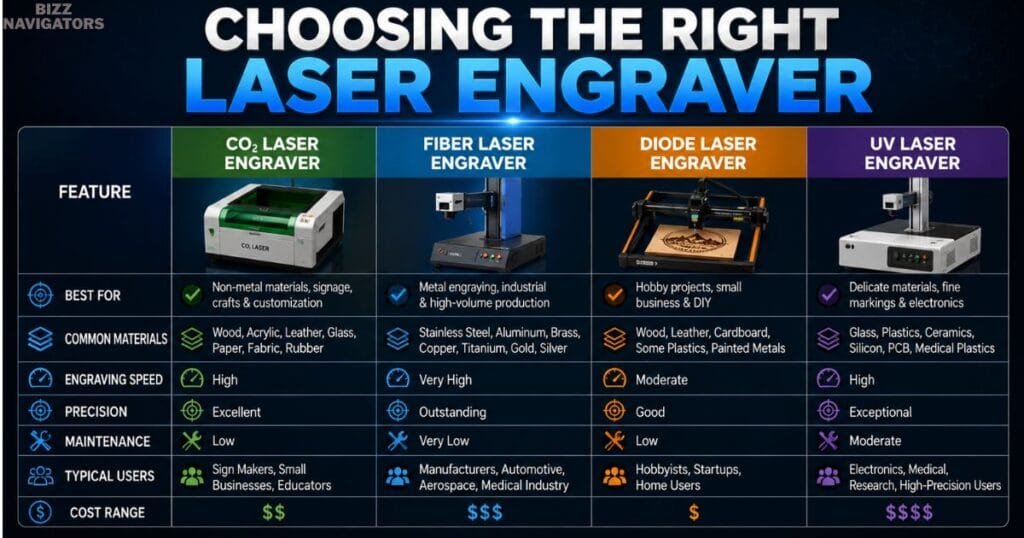
| Feature | CO₂ Laser | Fiber Laser | Diode Laser | UV Laser |
| Best Materials | Wood, Acrylic, Leather | Metals | Wood, Leather | Glass, Plastics, Electronics |
| Engraving Speed | High | Very High | Moderate | High |
| Precision | Excellent | Outstanding | Good | Exceptional |
| Maintenance | Low | Very Low | Low | Moderate |
| Typical Users | Sign Makers, Small Businesses | Industrial Manufacturers | Hobbyists | Medical & Electronics Industries |
Laser Engraving vs. Laser Marking, Etching, and Cutting
Many people use these terms interchangeably, but they are different processes designed for different purposes. Understanding the distinction helps businesses choose the right technology for their production needs.
Laser Engraving
Laser engraving removes a noticeable layer of material to create a deep, permanent mark. It is ideal for serial numbers, logos, industrial identification, custom artwork, and personalized products.
Best for:
Product branding
Industrial part identification
Jewelry
Awards and gifts
Deep permanent markings
Laser Marking
Laser marking changes the surface color without removing much material. It creates high-contrast markings while preserving the material’s structure.
Best for:
Barcodes
QR codes
Medical devices
Electronics
Product labels
Laser Etching
Laser etching melts only the outer surface, creating a shallow mark. It is faster than engraving but less durable for harsh environments.
Best for:
Decorative designs
Consumer products
Lightweight industrial applications
Laser Cutting
Laser cutting uses a much higher energy level to cut completely through the material.
Best for:
Sheet metal fabrication
Acrylic cutting
Woodworking
Industrial manufacturing
Custom fabrication
Quick Comparison
| Feature | Engraving | Marking | Etching | Cutting |
| Material Removed | Deep | Very Little | Shallow | Complete Cut |
| Permanence | Excellent | Excellent | Good | Not Applicable |
| Decorative Use | Yes | Limited | Yes | No |
| Industrial Identification | Excellent | Excellent | Moderate | No |
Popular Laser Engraving Software
Even the best laser engraver depends on quality software to produce accurate results. Modern programs allow users to create designs, adjust machine settings, preview projects, and control production.
Some of the most widely used laser engraving software includes:
LightBurn
LightBurn is one of the most popular solutions for hobbyists and professionals. It supports vector editing, image engraving, camera alignment, and advanced machine controls.
EZCAD
EZCAD is commonly used with fiber laser engravers. Manufacturers rely on it for metal engraving, serial number generation, barcode creation, and industrial production.
LaserGRBL
LaserGRBL is a free, beginner-friendly option for many diode laser machines. It offers basic engraving controls and G-code support.
RDWorks
RDWorks is widely used with CO₂ laser systems. It provides efficient control for engraving and cutting projects.
Adobe Illustrator and CorelDRAW
Many professional businesses create artwork in Adobe Illustrator or CorelDRAW before importing the files into laser software. This workflow allows designers to produce highly detailed graphics while maintaining excellent vector quality.
Choosing the Right Laser Engraving Machine
Not every laser engraver is suitable for every project. Selecting the right machine requires careful evaluation of your production goals.
For Hobby Users
A compact diode laser often provides enough power for:
Wooden crafts
Personalized gifts
Leather accessories
Small DIY projects
For Small Businesses
CO₂ laser engravers are excellent for businesses producing:
Signage
Awards
Acrylic products
Promotional items
Customized merchandise
For Industrial Manufacturing
Fiber laser systems remain the preferred choice for:
Metal engraving
Automotive production
Aerospace components
Medical devices
High-volume manufacturing
Important Buying Factors
Before purchasing a machine, consider:
Laser source
Working area
Maximum engraving speed
Material compatibility
Cooling system
Software support
Warranty
Technical support
Upgrade possibilities
Maintenance costs
A slightly higher initial investment often results in better productivity and lower operating expenses over time.
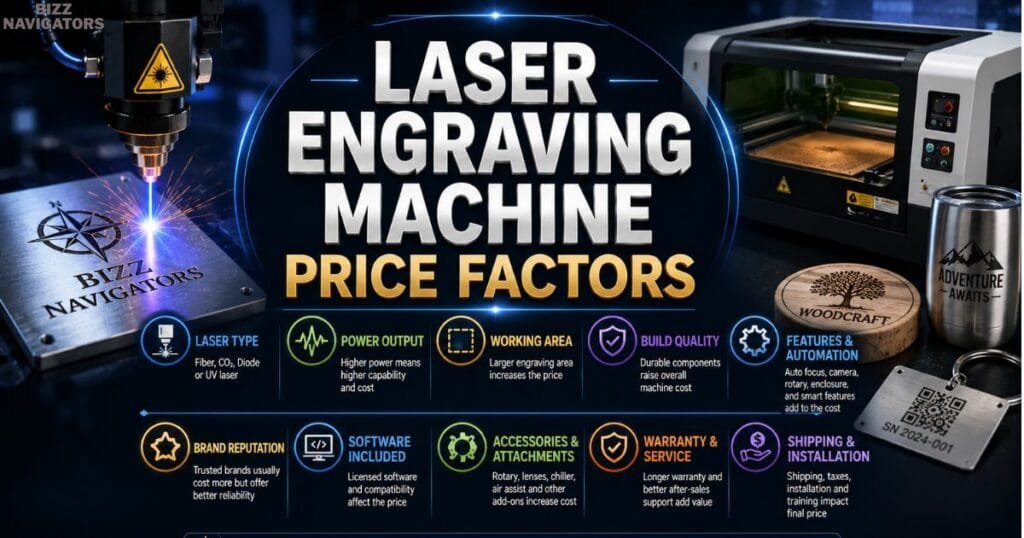
Laser Engraving Machine Price Factors
The cost of a laser engraving machine depends on several factors, not a single fixed price.
Major pricing factors include:
Laser type
Output power
Working area
Build quality
Automation features
Brand reputation
Included software
Rotary attachments
Camera systems
Warranty and service
Industrial fiber laser machines generally cost significantly more than hobby-grade diode engravers because they deliver greater speed, durability, and production capacity.
Real-World Laser Engraving Technology Applications
Understanding how industries use laser engraving helps demonstrate its practical value.
Automotive Manufacturing
Automotive companies permanently engrave engine components, brake systems, transmission parts, and identification plates to improve quality control and simplify warranty tracking.
Aerospace Production
Aircraft manufacturers engrave every critical component with permanent identification that allows technicians to track manufacturing history, maintenance records, and replacement schedules throughout the aircraft’s operational life.
Medical Industry
Hospitals and medical equipment manufacturers engrave surgical tools, orthopedic implants, and laboratory equipment with permanent identification that remains readable after repeated sterilization cycles.
Electronics Manufacturing
Electronics manufacturers use laser engraving to add microscopic QR codes, serial numbers, and logos to printed circuit boards and electronic components where traditional labels cannot fit.
Luxury Retail
Jewelry stores and premium brands offer customized engraving for rings, watches, bracelets, pens, and gifts, creating products with greater sentimental and commercial value.
Materials That Should Never Be Laser Engraved
Although laser engraving supports many materials, some should never be processed because they release hazardous fumes or become damaged.
Avoid engraving:
PVC
Vinyl
Chlorinated plastics
Certain foam materials
Unknown plastics
Fiberglass with harmful coatings
These materials may produce toxic gases that endanger operators and damage laser equipment.
Always confirm material compatibility before starting any engraving project.
Laser Safety and Best Practices
Safe operation is essential in every workshop or production facility.
Understand Laser Safety, Classes
Laser systems are classified according to their potential hazard. Commercial engraving machines generally require controlled operating environments and appropriate safety measures.
Wear Proper Eye Protection
Use laser safety glasses designed specifically for the wavelength of your machine.
Ensure Good Ventilation
Many engraving materials produce smoke or fumes. A quality extraction system helps maintain air quality and protects machine components.
Keep Optics Clean
Dirty mirrors and lenses reduce engraving quality and decrease machine efficiency.
Follow Manufacturer Maintenance Schedules
Regular inspections improve performance while extending machine lifespan.
Expert Tips for Better Laser Engraving Results
Professionals follow consistent procedures to maximize quality.
Clean materials before engraving.
Test settings on scrap material first.
Maintain proper focus distance.
Use air assist when recommended.
Inspect optics regularly.
Keep software updated.
Store materials in dry conditions.
Calibrate the machine periodically.
Small adjustments often produce significantly better engraving quality.
Common Laser Engraving Mistakes to Avoid
Many beginners experience avoidable problems.
Using Incorrect Power Settings
Excessive power can burn materials, while insufficient power produces faint engravings.
Ignoring Material Differences
Each material requires unique speed and power settings.
Skipping Focus Calibration
Poor focus reduces engraving clarity and consistency.
Neglecting Machine Maintenance
Dirty lenses and mirrors decrease engraving quality over time.
Poor Design Preparation
Low-resolution artwork often produces disappointing results.
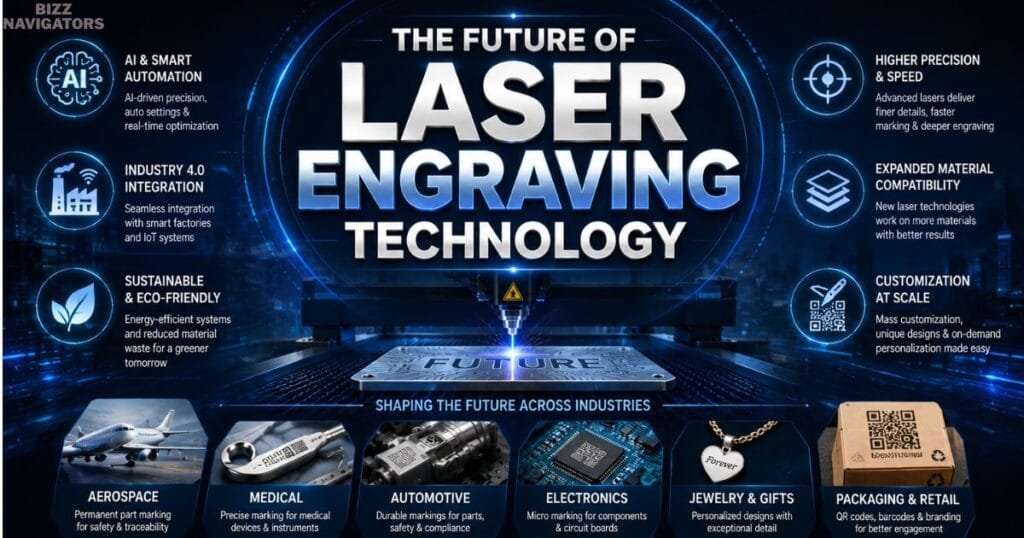
The Future of Laser Engraving Technology
Laser engraving continues to evolve alongside digital manufacturing.
Several innovations are transforming the industry.
Artificial Intelligence
AI-powered software automatically recommends engraving settings, reducing setup time and improving consistency.
Industry 4.0 Integration
Modern production lines connect laser engravers with factory management systems for real-time monitoring and automated production tracking.
Smart Vision Systems
Advanced cameras automatically align materials, reducing positioning errors and increasing productivity.
Cloud-Based Monitoring
Manufacturers can monitor production remotely, analyze machine performance, and schedule preventive maintenance using cloud-connected systems.
Sustainable Manufacturing
Because laser engraving eliminates inks, chemicals, and disposable labels in many applications, it supports environmentally responsible manufacturing practices.
Comparison Table: Selecting the Right Laser Technology
| Requirement | Recommended Solution |
| Metal engraving | Fiber Laser |
| Wood engraving | CO₂ Laser |
| Glass engraving | CO₂ or UV Laser |
| Medical plastics | UV Laser |
| Hobby projects | Diode Laser |
| High-volume production | Fiber Laser |
| Personalized gifts | CO₂ or Diode Laser |
| Industrial identification | Fiber Laser |
Key Takeaways
Laser engraving creates permanent, high-precision markings without physical contact.
The technology supports industries ranging from manufacturing and aerospace to healthcare, retail, and education.
Different laser sources are optimized for different materials.
Proper software, maintenance, and safety practices greatly improve engraving quality.
Automation, AI, and Industry 4.0 are making laser engraving faster, smarter, and more efficient.
Conclusion
Laser engraving technology applications are becoming an essential part of modern manufacturing because they deliver permanent, precise, and cost-effective results across multiple industries. Whether you’re producing industrial components, personalized products, or branded items, choosing the right laser machine.
Software and materials ensure consistent quality and long-term efficiency. As automation and AI continue to advance, laser engraving will remain a trusted solution for businesses seeking greater productivity, accuracy, and lasting product identification.
Frequently Asked Questions
What are the most common laser engraving technology applications?
Common applications include industrial traceability, product branding, custom gifts, medical device identification, aerospace component marking, automotive manufacturing, signage, packaging, and jewelry personalization.
Can one laser engraving machine engrave every material?
No. Different laser sources are designed for different materials. Fiber lasers perform best on metals, while CO₂ lasers excel with wood, acrylic, leather, and many non-metal materials.
Is laser engraving permanent?
Yes. Properly engraved markings are highly resistant to scratches, fading, moisture, chemicals, and extreme temperatures.
What is the difference between laser engraving and laser marking?
Laser engraving removes material to create a deeper mark, whereas laser marking changes the surface color with minimal material removal.
Which industries benefit most from laser engraving?
Manufacturing, automotive, aerospace, healthcare, electronics, jewelry, defense, retail, packaging, and interior design all benefit from laser engraving technology.
Is laser engraving suitable for small businesses?
Yes. Many startups use desktop CO₂ or diode laser engravers to create personalized gifts, branded merchandise, promotional products, and custom décor with relatively low operating costs.
What maintenance does a laser engraving machine require?
Routine maintenance includes cleaning lenses and mirrors, checking alignment, inspecting cooling systems, updating software, and replacing worn components according to the manufacturer’s recommendations.
Can laser engraving help prevent counterfeiting?
Yes. Permanent serial numbers, QR codes, unique identification marks, and security patterns improve product authentication and make counterfeiting more difficult.

At BizzNavigators, we answer the questions you’re actually searching for, honestly and clearly. We check our facts before we publish anything, and if we’re not sure about something, we tell you instead of guessing. Whatever you’re looking for- a tech fix, a business tip, or a simple how-to- we want to give you an answer you can trust.
1 thought on “Laser Engraving Technology Applications: Top Modern Uses”