
Introduction: GME Max Pain and Why It Matters
GME Max Pain is the options strike price at which the largest number of GameStop options contracts would expire worthless. Many traders monitor this level before weekly and monthly expirations because it can highlight where options market positioning is strongest.
However, max pain is not a price prediction. It is simply one indicator based on options data. News, earnings, market sentiment, and heavy trading volume can easily move GME away from its max pain level. To make better trading decisions, use it alongside technical analysis and other options metrics.
What Is GME Max Pain?
GME Max Pain is the strike price where call and put option buyers would experience the highest combined loss if GameStop closed at that price on expiration day.
It is calculated using the open interest of all outstanding options. Because GME has one of the most active options markets, traders frequently track its max pain level to understand short-term market positioning.
Why Is It Called “Maximum Pain”?
The term “maximum pain” refers to the point where option buyers lose the most premium collectively.
If GameStop closes near this strike price, many call and put options will expire worthless, allowing option sellers to keep most of the premiums they collected. This is why traders pay close attention to the max pain level during expiration weeks.
Why Traders Follow GME Max Pain
GameStop’s high volatility and active options market make max pain a popular indicator.
Traders mainly use it to:
Identify important strike prices.
Analyze options positioning.
Compare open interest with price action.
Estimate potential price behavior before expiration.
Rather than relying on max pain alone, experienced traders combine it with technical and fundamental analysis.
How GME Max Pain Is Calculated
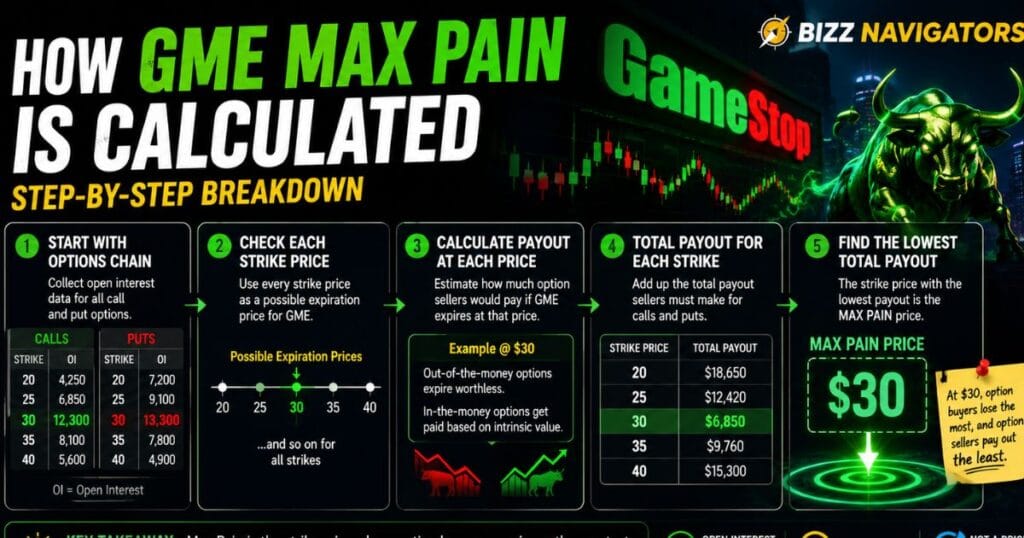
The calculation begins with the open interest for every call and put option.
Analysts estimate the payout option sellers would make if GME expired at each strike price. The strike requiring the lowest total payout becomes the max pain price.
Since traders continuously open and close positions, this value can change throughout the trading day.
The Role of Open Interest
Open interest represents the total number of active options contracts.
Unlike trading volume, it shows positions that remain open rather than contracts traded during the day.
Higher open interest at a strike price increases its influence on the max pain calculation, which is why changes in open interest often shift the reported max pain level.
How Calls and Puts Affect Max Pain
Both call and put options are included in the calculation.
Call options benefit from rising prices.
Put options benefit from falling prices.
The strike price that produces the smallest combined payout to both call and put holders becomes the GME maxpain point.
Why the Max Pain Price Changes Daily
Max pain is dynamic because options activity changes throughout the day.
Common reasons include:
New options contracts are being opened.
Existing contracts being closed.
Changes in GME’s stock price.
Shifting open interest.
Market makers are adjusting hedge positions.
For the most accurate analysis, traders should always check the latest max pain data before making decisions.
Where Can You Find the Current GME Max Pain Price?
Several financial websites and options analytics platforms publish updated GME maxpain data.
Keep in mind that the displayed value reflects current options positioning. As new trades occur, the max pain price may change, especially near expiration.
Most experienced traders compare this figure with implied volatility, open interest, and the put/call ratio instead of using it as a standalone signal.
Weekly vs. Monthly Max Pain
Weekly and monthly expirations often produce different market behavior.
Weekly options react quickly to changing positions and usually experience larger fluctuations in max pain. Monthly options generally have higher open interest, making them more useful for identifying broader market positioning.
Reviewing both helps traders understand short-term activity while keeping a wider perspective on GameStop’s options market.
Key Takeaways
GME MaxPain is the strike price where option buyers experience the greatest combined loss.
The calculation is based on open interest from call and put options.
Max pain changes as options positions are opened or closed.
It indicates options positioning, not guaranteed price direction.
For better results, combine max pain with technical analysis, implied volatility, and other options indicators.
How to Read GME Options Signals
Max pain is most effective when combined with other options or indicators. Instead of relying on one metric, experienced traders analyze multiple data points to understand market sentiment before expiration.
Put/Call Ratio
The put/call ratio compares the number of put options with the number of call options.
A high ratio often signals bearish sentiment or increased hedging.
A low ratio usually reflects stronger bullish expectations.
Since traders also use puts for protection, the ratio should always be analyzed alongside GME max pain and other market data.
Implied Volatility (IV)
Implied volatility (IV) estimates the market’s expected price movement.
High IV means traders expect larger price swings, making options more expensive. If IV rises while GME trades far from its max pain level, the market may be anticipating a significant move before expiration.
Open Interest Trends
Open interest shows where traders are adding or closing options positions.
For example:
Rising open interest at higher strikes may indicate bullish positioning.
Higher open interest at lower strikes can suggest bearish expectations or hedging.
Large open interest near one strike often strengthens its importance during expiration.
Monitoring these changes helps explain why the max pain price shifts over time.
Volume vs. Open Interest
Although often confused, these metrics measure different things.
| Metric | What It Measures | Why It Matters |
| Trading Volume | Contracts traded during the day | Shows current trading activity |
| Open Interest | Active contracts that remain open | Reflects existing market positions |
A stock can have high trading volume without a significant increase in open interest, making both metrics important when analyzing options activity.
Does GME Always Move Toward Max Pain?
No. While GME sometimes closes near its max pain level, it is not guaranteed.
Max pain indicates where options positioning is concentrated, but actual price movement depends on factors such as buying pressure, market sentiment, company news, and overall market conditions.
Treat it as a reference point rather than a prediction.
Why the Theory Sometimes Works
Some analysts believe market makers’ hedging activity can indirectly pull prices toward heavily traded strike levels.
Others argue that the pattern is simply a result of normal market mechanics and statistical probability.
Regardless of the explanation, traders should avoid assuming the stock will always finish at its max pain price.
When Max Pain Becomes Less Reliable
The indicator becomes less useful during high-impact events, including:
Earnings announcements
Major company news
Analyst upgrades or downgrades
Regulatory developments
Broad market volatility
Short squeezes
Heavy institutional trading
In these situations, market sentiment often outweighs options positioning.
Factors That Can Override GME Max Pain
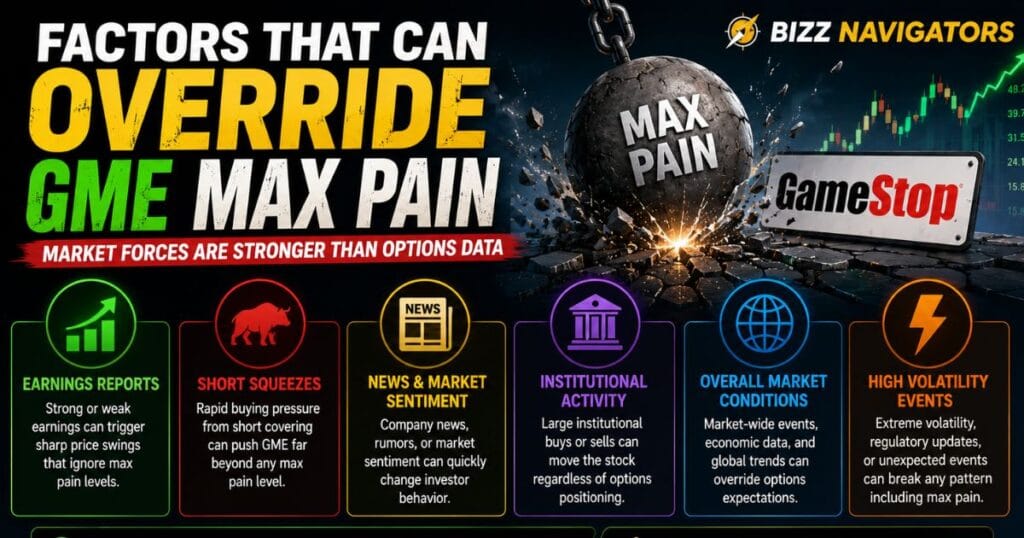
Several events can move GameStop far from its calculated max pain level.
Earnings Reports
Strong or weak earnings frequently trigger large price swings that override options-based expectations.
Short Squeezes
Rapid buying pressure from short sellers covering positions can push GME well beyond its max pain strike.
News and Market Sentiment
Company announcements, economic data, or broader market trends can quickly change investor behavior and price direction.
Institutional Activity
Large institutional trades can significantly impact GME’s share price regardless of where max pain is calculated.
How to Use GME Max Pain Effectively
Max pain works best as part of a broader trading strategy.
For better analysis:
Compare max pain with key support and resistance levels.
Monitor implied volatility before expiration.
Review changes in open interest.
Check the put/call ratio for market sentiment.
Confirm signals using price action instead of relying on max pain alone.
Combining these indicators provides a more balanced view of the market.
Advantages and Limitations of GME Max Pain
| Advantages | Limitations |
| Highlights important options strike prices | Does not predict future prices |
| Useful during expiration weeks | Can fail after major news events |
| Easy for beginners to understand | Changes throughout the trading day |
| Supports technical analysis | Ignores company fundamentals |
| Helps analyze market positioning | Should not be used as a standalone strategy |
Understanding both the strengths and limitations of max pain helps traders use it more effectively while avoiding unrealistic expectations.
Common Myths About GME Max Pain
Several misconceptions surround GME maxpain. Understanding the facts helps traders avoid unrealistic expectations.
Myth 1: Market Makers Always Push Prices to Max Pain
There is no evidence that market makers consistently force GME to close at its max pain level. While hedging activity may influence short-term price movements, many other market forces affect the stock price.
Myth 2: Max Pain Predicts Future Prices
Max pain is not a forecasting tool. It reflects current options positioning based on open interest and should be used as a reference rather than a guaranteed price target.
Myth 3: It Works Every Expiration
GME does not always close near its max pain price. Earnings, news, market sentiment, and unusual trading activity can easily outweigh options positioning.
Common Mistakes Beginners Make
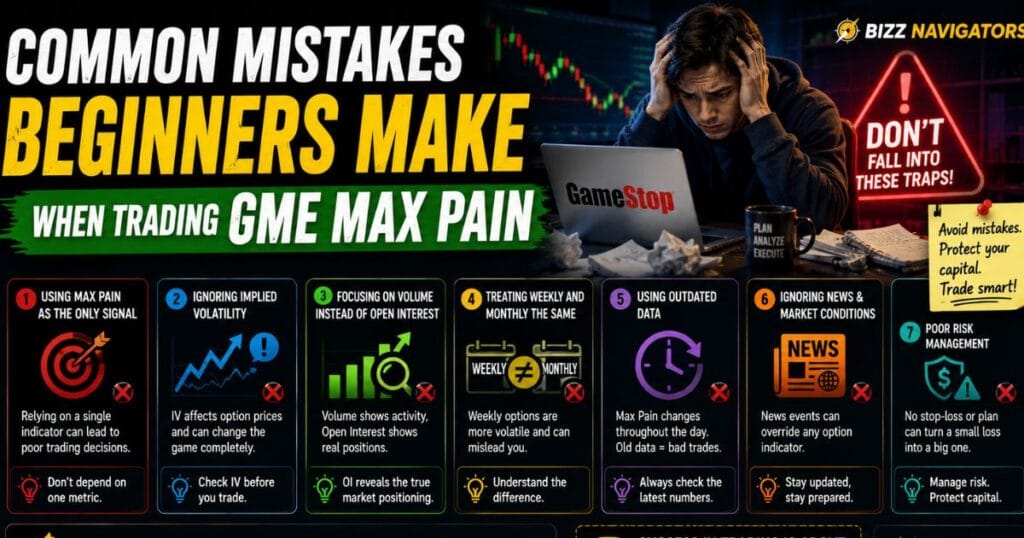
New traders often misuse max pain by depending on it too heavily.
Avoid these mistakes:
Using max pain as the only trading signal.
Ignoring implied volatility and open interest.
Confusing trading volume with open interest.
Treating weekly and monthly expirations the same.
Relying on outdated max pain data.
Ignoring news and overall market conditions.
A balanced strategy always combines multiple indicators.
Final Thoughts
GME max pain is a valuable options indicator that helps traders understand where options positioning is concentrated before expiration. However, it should never be treated as a guaranteed price prediction.
For the best results, combine max pain with open interest, implied volatility, the put/call ratio, technical analysis, and current market news. Using multiple indicators provides a clearer view of market conditions and supports more informed trading decisions while reducing unnecessary risk.
FAQs
What is GME max pain?
GME max pain is the strike price where GameStop option buyers experience the greatest combined loss at expiration based on current open interest.
How often does GME max pain change?
It can change throughout the trading day as new options positions are opened, closed, or adjusted.
Is GME max pain accurate?
The calculation is accurate because it uses real options data, but it does not guarantee where GME’s stock price will close.
Does GME always move toward max pain?
No. The stock may finish near, above, or below the max pain level depending on market conditions and investor activity.
What is a good put/call ratio for GME?
There is no fixed ideal ratio. It should always be analyzed together with max pain, implied volatility, and open interest.
Should beginners use max pain?
Yes, but only as one part of their analysis. Learning technical analysis, risk management, and options fundamentals is equally important.
Where can I check the live GME max pain?
Most options analytics platforms and financial websites publish updated GME maxpain estimates throughout the trading day.
Can max pain predict a short squeeze?
No. Short squeezes are driven by aggressive buying pressure and short covering, not by the max pain calculation.

At BizzNavigators, we answer the questions you’re actually searching for, honestly and clearly. We check our facts before we publish anything, and if we’re not sure about something, we tell you instead of guessing. Whatever you’re looking for- a tech fix, a business tip, or a simple how-to- we want to give you an answer you can trust.