What Is Technology Drive?
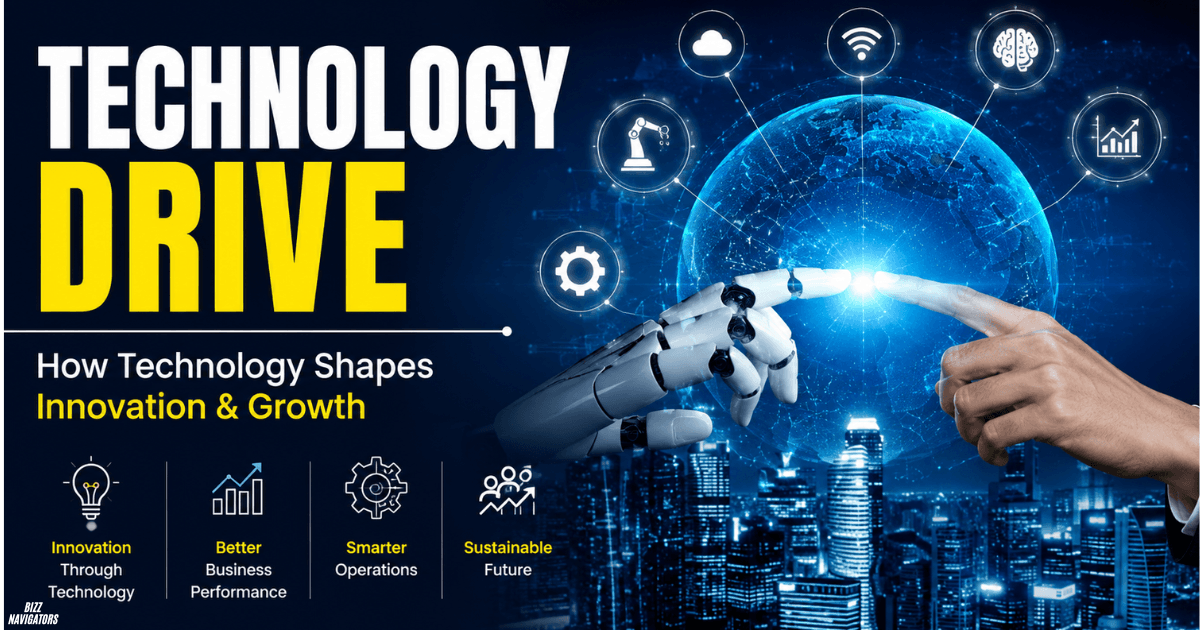
Technology drive is the process of using new technological capabilities to create innovation, improve performance, solve problems, and change how industries operate. It often starts with a technological breakthrough or capability and then finds practical uses for it.
A technology-driven approach is different from simply adopting existing software or digital tools. The technology itself becomes a major force behind new products, services, processes, and business models.
For example, advances in artificial intelligence, cloud computing, robotics, and connected devices have created capabilities that businesses can use in ways that were previously difficult or impossible.
What Does Technology-Driven Mean?
Technology-driven means that technology plays a primary role in deciding what can be developed or improved.
A company may discover a new technical capability first and then identify problems or markets where it can provide value.
This approach is commonly associated with technology-push innovation. By contrast, market-pull innovation starts with a known customer or market need and develops technology to address it.
How Does Technology Drive Innovation?
Technology drives innovation by expanding what people and organizations can do.
The basic process is:
New technology → Experimentation → Practical application → New solution → Adoption → Further innovation
A new technology can solve an existing problem, improve an existing product, or create an entirely new category.
For example, improvements in computing and connectivity helped create modern cloud services, smartphones, digital platforms, and AI applications.
Technology therefore does not only make existing work faster. It can change what work is possible in the first place.
What Is the Difference Between Technology Drive and Technology Adoption?
Technology drives the creation or enablement of new capabilities, while technology adoption means using an existing technology.
For example, developing an AI system that can understand natural language is part of technology-driven innovation. A company using that system for customer support is technology adoption.
The difference can be simplified as follows:
| Approach | Main Focus | Starting Point |
| Technology-driven | Create new capabilities | Technology |
| Market-driven | Meet market demand | Customers and market |
| User-driven | Improve user experience | User needs |
| Technology adoption | Use existing technology | Available solution |
These approaches are not always separate. A successful product can combine technical innovation with customer demand and good user experience.
What Is Technology Push and Market Pull?
Technology push starts with a technological opportunity, while market pull starts with a market need. Both can influence innovation.
Technology push occurs when research or technical progress creates a new capability that later finds applications.
Market pull happens when customer demand or a clear problem encourages organizations to develop better solutions.
The two forces can work together. Research on innovation suggests that technology push can be especially important during invention and development, while demand can become more important when technologies move toward wider use and adoption.
This explains why the best technology-driven strategy is rarely just about building something new. The technology must eventually create useful value.
How Does Technology Drive Business Growth?
Technology can drive business growth in four major ways: higher efficiency, better decisions, new revenue opportunities, and greater scalability.
1. It Improves Efficiency
Automation can handle repetitive tasks such as data entry, reporting, scheduling, document processing, and routine customer requests.
This reduces manual work and allows employees to spend more time on higher-value activities.
2. It Improves Decision-Making
Data analytics can help businesses understand customers, sales, costs, operations, and market behavior.
Better information can help managers identify problems faster and make more informed decisions.
3. It Creates New Business Models
Technology can create business models that did not previously exist.
Examples include:
- Software subscriptions
- Online marketplaces
- Cloud services
- Digital banking
- Streaming platforms
- App-based services
Technology can therefore change not only how a company operates, but also how it makes money.
4. It Supports Scalability
Digital systems can allow businesses to serve more customers without increasing every operational cost at the same rate.
Cloud infrastructure, automated workflows, online distribution, and digital payments make this easier.
How Does Technology Drive Different Industries?
Technology Drive in Healthcare
Technology is changing healthcare through telemedicine, AI-assisted analysis, wearable devices, electronic health records, and medical robotics.
These tools can improve access, support professionals, monitor patients, and streamline administrative work.
However, healthcare technology requires strong privacy, security, testing, and professional oversight.
Technology Drive in Manufacturing
Manufacturers use robotics, sensors, automation, AI, 3D printing, and connected systems to improve production.
These technologies can reduce errors, identify equipment problems, improve inventory control, and speed up production.
Technology-driven manufacturing can also support faster product testing and prototyping.
Technology Drive in Education
Technology has expanded access to online courses, digital classrooms, learning platforms, interactive content, and AI-assisted learning tools.
Students can access educational resources from different locations and learn at a more flexible pace.
The biggest challenge is ensuring that technology improves learning rather than simply adding more digital tools.
Technology Drive in Finance
Banks and financial companies use technology for online banking, digital payments, fraud detection, risk analysis, and automated customer service.
These systems can make financial services faster and more accessible while also creating new cybersecurity and privacy requirements.
Technology Drive in Retail
Retailers use AI, analytics, digital payments, recommendation systems, and inventory technology to improve the buying experience.
Businesses can analyze purchasing patterns and use those insights to improve product selection, pricing, marketing, and customer service.
What Are the Main Benefits of Technology Drive?
The main benefit of technology drive is that it allows organizations to create better ways of working and solving problems.
Key benefits include:
- Innovation: Creates new products and services.
- Efficiency: Reduces repetitive manual work.
- Productivity: Helps employees focus on valuable tasks.
- Cost control: Can reduce waste and unnecessary processes.
- Better decisions: Makes business data more useful.
- Customer experience: Enables faster and more personalized services.
- Scalability: Helps digital businesses grow efficiently.
- Competitive advantage: Gives companies new capabilities before competitors.
The actual benefit depends on how well technology fits the organization’s goals and processes.
What Are the Risks of Technology Drive?
Technology drive can create significant value, but rapid technological change also creates financial, social, security, and operational risks.
Job Disruption
Automation can reduce demand for some repetitive tasks.
At the same time, it can increase demand for technical, analytical, creative, and problem-solving skills.
Organizations therefore need to invest in employee training and reskilling.
Cybersecurity Threats
More connected systems can create more opportunities for cyberattacks.
Businesses need security controls, access management, monitoring, backups, and employee awareness to reduce these risks.
Privacy Concerns
AI and data-driven systems often depend on large amounts of information.
Organizations must handle personal and sensitive data responsibly and follow applicable privacy requirements.
Digital Inequality
People and businesses do not have equal access to devices, internet connectivity, infrastructure, or digital skills.
Technology can improve access for some groups while leaving others behind.
Technology Dependence
A business that depends heavily on digital systems can face serious disruption when those systems fail.
Backup systems, human oversight, and contingency plans remain important.
How Can a Business Build a Technology-Driven Strategy?
Start with a real business problem, then choose technology that can solve it. Do not start by buying technology simply because it is new.
A practical process is:
1. Define the Problem
Identify the specific issue that needs improvement.
2. Find the Right Technology
Evaluate whether AI, automation, cloud computing, analytics, robotics, or another technology can address it.
3. Run a Small Test
Start with a limited project instead of changing the entire operation at once.
4. Measure the Results
Track practical outcomes such as:
- Time saved
- Cost reduction
- Productivity
- Error rates
- Customer satisfaction
- Revenue impact
5. Train Employees
Employees need to understand both the technology and the new workflow.
6. Scale What Works
If the technology produces measurable value, expand it gradually.
This people-and-process element matters. Research on technology-driven innovation shows that technology investment alone does not guarantee innovation; organizational factors, leadership, capabilities, and business processes also affect the value created by technology.
Is Technology-Driven Better Than Market-Driven Innovation?
Not always. Technology drive is useful when a new capability can create meaningful value, but market-driven innovation is often better when customer demand is already clear.
The strongest approach combines both.
A business should ask:
“What can this technology do?”
and then:
“Who needs it, and what problem does it solve?”
This prevents companies from building technically impressive products that nobody wants.
A successful innovation usually connects a technical opportunity with a real-world opportunity.
What Is the Future of Technology Drive?
The future of technology drive will be shaped by AI, automation, robotics, connected systems, advanced computing, biotechnology, and sustainable technology.
AI is already expanding automation and decision support. Robotics can extend automation into physical work, while connected devices can make machines and environments more responsive.
Future progress will also depend on responsible development.
Cybersecurity, privacy, workforce skills, sustainability, and governance will become increasingly important as technology becomes more deeply integrated into business and society.
Key Takeaway
Technology drive is the process through which technological progress creates new capabilities, products, services, and ways of working.
It can improve efficiency, create new markets, support business growth, and transform industries.
But technology alone does not guarantee success.
The strongest technology-driven strategies connect technical capability, real problems, customer needs, skilled people, and measurable business value.

At BizzNavigators, we answer the questions you’re actually searching for, honestly and clearly. We check our facts before we publish anything, and if we’re not sure about something, we tell you instead of guessing. Whatever you’re looking for- a tech fix, a business tip, or a simple how-to- we want to give you an answer you can trust.