
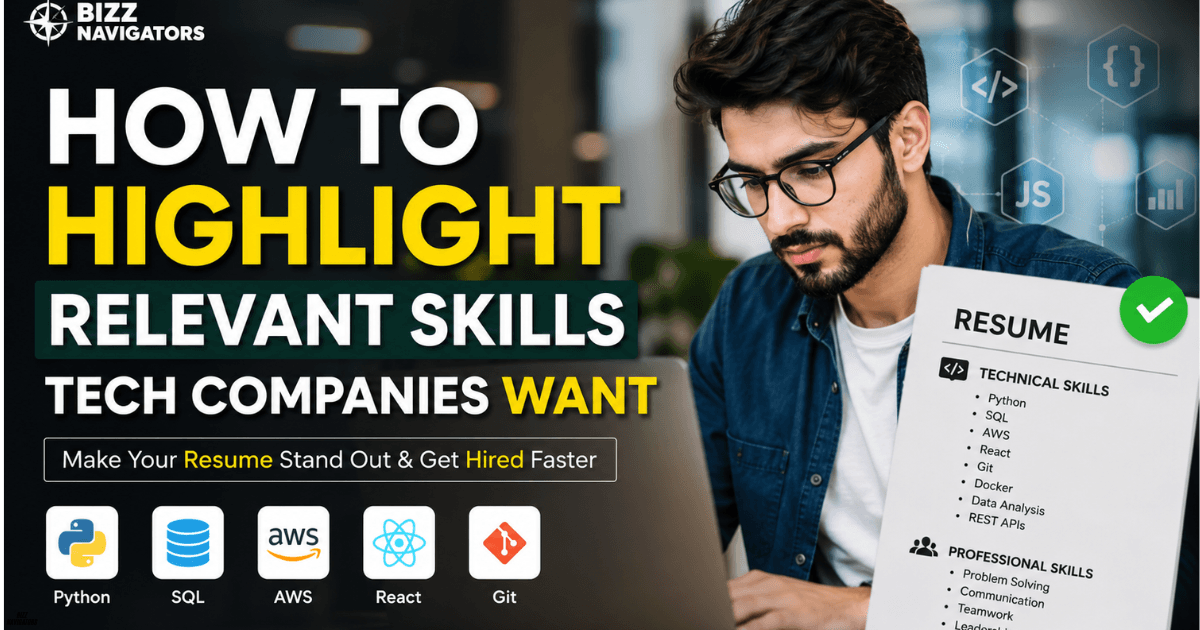
What Skills Do Tech Companies Actually Want on a Resume?
To highlight the skills tech companies want, match your resume to the job description, prioritize relevant technical abilities, and prove those skills through real results. A strong skills section should include the tools, programming languages, platforms, and workplace abilities that directly connect to the role rather than listing every skill you have.
Tech employers usually look for a combination of technical expertise, problem-solving ability, communication, adaptability, and practical experience. The right balance depends on the position.
Start With the Job Description
The job description is your best source for deciding which skills deserve attention. Recruiters often explain exactly which technologies, frameworks, platforms, and competencies they expect from candidates.
For example, a software developer position might mention:
- Python
- JavaScript
- SQL
- Git
- AWS
- React
- REST APIs
- Agile development
If you genuinely possess these skills, use the same terminology in your resume. This can also help your application pass through an Applicant Tracking System (ATS) that scans resumes for relevant terms.
Do not copy the entire job description. Instead, identify the requirements that genuinely match your experience.
Separate Technical Skills From Supporting Skills
A clean skills section makes your strongest qualifications easier to find.
Instead of creating one long list, group skills into logical categories:
| Category | Examples |
| Programming | Python, Java, JavaScript, C++ |
| Databases | SQL, PostgreSQL, MySQL, MongoDB |
| Cloud | AWS, Azure, Google Cloud |
| Frameworks | React, Node.js, Django, Spring |
| Tools | Git, Docker, Jira, GitHub |
| Data & AI | Machine Learning, Pandas, TensorFlow |
| Professional | Communication, Leadership, Problem-Solving |
This structure gives recruiters a quick understanding of your technical profile.
How Should You Put Skills on a Tech Resume?
Place your most relevant skills near the top of your resume, usually below your professional summary or contact information. Prioritize skills that directly match the position instead of filling the section with generic abilities.
A targeted skills section might look like this:
Technical Skills: Python, SQL, AWS, Docker, Git, REST APIs, PostgreSQL
Frameworks: Django, React, Node.js
Data: Pandas, NumPy, Data Analysis
Professional Skills: Problem-Solving, Team Collaboration, Technical Communication
This format is easier to scan than a large paragraph containing dozens of unrelated keywords.
Prioritize Skills Instead of Listing Everything
More skills do not automatically make a resume stronger.
If you are applying for a Python developer position, listing Photoshop, basic HTML, social media management, and Microsoft Word alongside Python may dilute your strongest qualifications.
Use this simple priority system:
- Required skills — put these first if you genuinely have them.
- Important preferred skills — include relevant ones you can demonstrate.
- Transferable skills — add abilities that strengthen your suitability.
- Unrelated skills — remove them unless they provide meaningful value.
The goal is relevance, not volume.
How Can You Prove Your Technical Skills?
The strongest resumes do more than claim expertise. They demonstrate how the candidate used a skill to produce an outcome.
Compare these two statements:
Weak:
“Experienced in SQL and database management.”
Stronger:
“Used SQL to optimize database queries and reduce average reporting time by 30%.”
The second version connects the skill to an actual result.
Whenever possible, include:
- What you worked on
- Which technology you used
- What problem you solved
- What changed because of your work
- A measurable result
This turns a keyword into evidence.
Use Numbers When They Are Genuine
Quantifiable achievements can make technical experience much more convincing.
For example:
- Reduced application load time by 25%
- Automated 40+ hours of repetitive monthly work
- Improved database query performance by 30%
- Managed cloud infrastructure supporting 10,000+ users
- Reduced deployment errors by 20%
Never invent statistics to make a resume appear stronger. If exact numbers are unavailable, describe the result honestly.
Which Technical Skills Should You Highlight?
The answer depends on the position, but several skill groups appear frequently across technology roles.
Programming and Development Skills
For development positions, highlight languages and technologies you can actually use.
Examples include:
- Python
- Java
- JavaScript
- TypeScript
- C#
- C++
- Go
- PHP
- SQL
Pair programming languages with relevant frameworks, libraries, APIs, and development tools.
For example, Python + Django + PostgreSQL + Git provides more useful context than simply writing “Python.”
Cloud and Infrastructure Skills
Cloud knowledge can be particularly valuable for software, DevOps, infrastructure, and engineering positions.
Relevant technologies may include:
- AWS
- Microsoft Azure
- Google Cloud
- Docker
- Kubernetes
- Terraform
- CI/CD
- Linux
Again, prioritize technologies mentioned in the specific vacancy.
Data and AI Skills
Data-focused positions may require skills such as:
- SQL
- Python
- Pandas
- NumPy
- Power BI
- Tableau
- Machine Learning
- Data Visualization
- Statistics
- TensorFlow
- PyTorch
Do not list advanced AI or machine learning technologies simply because they are popular. Employers can usually distinguish between genuine experience and keyword stuffing.
How Do Soft Skills Matter in Tech Jobs?
Technical ability gets attention, but successful technology work also requires people skills. Communication, collaboration, analytical thinking, and adaptability can influence whether someone performs effectively within a team.
Instead of simply writing:
Soft Skills: Communication, Leadership, Teamwork
show these qualities through your experience.
For example:
“Collaborated with a five-person engineering team to deliver a customer-facing application three weeks ahead of schedule.”
This demonstrates teamwork, communication, ownership, and execution without relying on empty claims.
Choose Soft Skills That You Can Demonstrate
Useful examples include:
- Problem-solving
- Technical communication
- Collaboration
- Leadership
- Adaptability
- Critical thinking
- Time management
- Stakeholder communication
- Project management
The best soft skills are those supported by specific examples elsewhere in your resume.
Should You Customize Skills for Every Tech Job?
Yes. Resume customization can significantly improve relevance. A single generic resume may contain the right experience but fail to emphasize the qualifications a particular employer is seeking.
Before applying, compare your resume with the vacancy.
Look for:
Job requirement → Your matching evidence
For example:
| Job Requirement | Resume Evidence |
| Python | Python development project |
| SQL | Database optimization experience |
| AWS | Cloud deployment experience |
| Git | Version-control workflow |
| Teamwork | Cross-functional project |
| Problem-solving | Documented technical improvement |
This approach helps you identify gaps before submitting an application.
How Can You Highlight Skills Without Keyword Stuffing?
Use keywords naturally in three places: skills, professional experience, and projects.
Suppose the employer asks for AWS.
Instead of mentioning AWS five times in your skills section, write it once in the skills section and demonstrate it in your experience:
“Deployed a web application on AWS and configured cloud resources to improve application availability.”
Now the keyword has context.
Avoid adding technologies you have never used. Keyword stuffing may make a resume look optimized while weakening its credibility.
Why Projects and Portfolios Strengthen Technical Skills
A portfolio gives employers something concrete to evaluate.
For technical candidates, useful evidence can include:
- GitHub repositories
- Personal applications
- Data analysis projects
- Technical case studies
- Open-source contributions
- Freelance projects
- Relevant certifications
- Personal websites
A project should explain what you built, which technologies you used, and what problem it solved.
For example:
Customer Analytics Dashboard — Built an interactive dashboard using Python, SQL, and Power BI to analyze customer behavior and identify monthly sales trends.
That is far more informative than simply listing the three technologies.
Common Mistakes When Highlighting Tech Skills
Avoid these mistakes when preparing your resume:
Listing Too Many Skills
A list of 50–60 technologies can make your expertise appear shallow. Focus on the skills most relevant to the position.
Claiming Skills Without Evidence
If your experience section never demonstrates a skill, recruiters may question how deeply you know it.
Using Outdated Technologies
Review your skills regularly and remove technologies that are no longer relevant to the roles you want.
Hiding Important Skills
If a required technology is buried near the bottom of your resume, a recruiter may miss it. Put high-priority skills where they can be quickly identified.
Using Generic Descriptions
“Worked on software development” tells an employer very little.
“Developed and tested Python APIs that reduced manual processing time by 25%” provides considerably more evidence.
A Simple Formula for Highlighting Skills
Use this formula throughout your resume:
Relevant skill + practical action + measurable or specific outcome
For example:
SQL + optimized reporting queries + reduced processing time by 30%.
Or:
AWS + deployed cloud application + improved infrastructure reliability.
This approach naturally combines keywords with evidence and keeps your resume focused on what employers actually care about.
Final Takeaway
The best way to highlight relevant skills tech companies want is to match your resume to the job, prioritize genuinely relevant technical skills, and demonstrate them through real achievements. A well-organized skills section helps recruiters find your qualifications, while measurable experience, projects, and portfolio evidence prove that you can actually apply them.
Your resume should not try to look like you can do everything. It should make one thing immediately clear: you have the right skills for this specific role, and you know how to use them.

At BizzNavigators, we answer the questions you’re actually searching for, honestly and clearly. We check our facts before we publish anything, and if we’re not sure about something, we tell you instead of guessing. Whatever you’re looking for- a tech fix, a business tip, or a simple how-to- we want to give you an answer you can trust.