

Understanding How Long Does It Take to Fill a Cavity
If you’re wondering how long does it take to fill a cavity, the good news is that most fillings are completed in 20 to 60 minutes per tooth. However, the exact time depends on the cavity’s size, its location, the filling material, and whether your dentist needs to numb the area. A small cavity may take less than 30 minutes, while deeper decay or multiple fillings can extend your appointment.
In this guide, you’ll discover the complete treatment timeline, what can speed up or delay the procedure, what to expect before and after your filling, and practical tips to make your visit as quick and comfortable as possible.
Quick Answer: How Long Does It Take to Fill a Cavity?
If you only need the short answer, here’s a quick overview.
| Situation | Average Time |
| Small cavity | 20–30 minutes |
| Medium cavity | 30–45 minutes |
| Deep cavity | 45–60 minutes |
| Two cavities | 45–75 minutes |
| Three cavities | 60–90 minutes |
| Multiple or complex cavities | 90–150 minutes |
These estimates include preparation, removing the decay, placing the filling, polishing the restoration, and checking your bite before you leave.
Keep in mind that every patient is different. Some appointments may finish sooner, while others take longer because of the tooth’s condition or additional treatments needed.

What Determines How Long Does It Take to Fill a Cavity?
Several factors influence the overall treatment time. Understanding these variables helps explain why one person’s appointment may last 25 minutes while another’s takes over an hour.
Size of the Cavity
The size of the cavity is usually the biggest factor.
A very small cavity requires minimal cleaning and only a small amount of filling material. Larger cavities require more careful removal of damaged tooth structure and more time to rebuild the tooth properly.
If the decay extends close to the tooth’s nerve, your dentist must work more carefully to avoid irritation while preserving as much healthy tooth structure as possible.
Location of the Tooth
Not every tooth is equally easy to treat.
Front teeth are generally easier to access because they have smoother surfaces and are easier to see.
Molars often take longer because they have deep grooves, multiple chewing surfaces, and are located farther back in the mouth.
Cavities that develop between two teeth also require additional precision because your dentist must protect the neighboring tooth while removing decay.
How long does it take to fill a cavity? Type of Filling Material
The material selected for your filling also affects treatment time.
Composite resin (tooth-colored fillings) usually takes longer because it is placed in several thin layers. Each layer is hardened using a special curing light before the next one is added.
Amalgam fillings are generally quicker to place because they don’t require light curing.
Some ceramic or porcelain restorations are created outside the mouth and may require two separate appointments.
Number of Cavities Being Treated
Many people ask how long does it take to fill a cavity when more than one tooth needs treatment.
Dentists often recommend completing several fillings during one visit because it reduces the number of appointments and minimizes repeated anesthesia.
Although the total appointment becomes longer, most patients find it more convenient than returning multiple times.
Need for Local Anesthesia
Not every filling requires anesthesia.
Very small cavities can sometimes be treated without numbing.
For moderate or deep cavities, however, the dentist usually administers a local anesthetic to keep you comfortable throughout the procedure.
The injection itself only takes a minute, but you’ll usually wait 5 to 10 minutes for the area to become fully numb before treatment begins.
A Minute-by-Minute Timeline of a Typical Filling Appointment
Many patients don’t realize that the filling itself is only one part of the visit. Here’s what usually happens from the moment you arrive until you leave the dental office.
| Stage | Typical Time |
| Check-in and preparation | 5 minutes |
| Dental examination | 5–10 minutes |
| X-rays (if needed) | 5–10 minutes |
| Local anesthesia | 5–10 minutes |
| Removing decay | 10–25 minutes |
| Placing the filling | 10–20 minutes |
| Bite adjustment and polishing | 5–10 minutes |
Overall, most appointments last between 30 and 60 minutes, although complex cases may take longer.
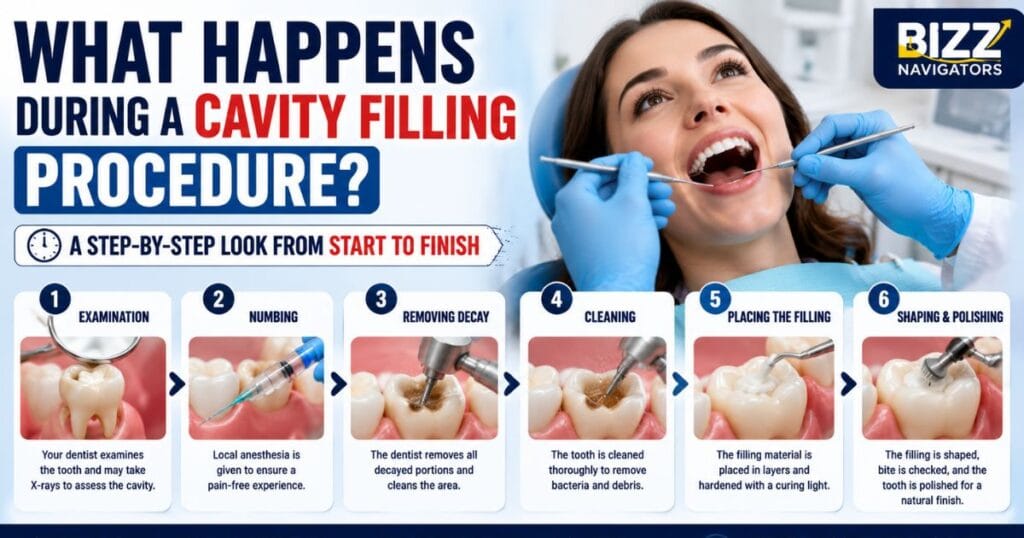
What Happens During a Cavity Filling Procedure?
Knowing each step of the process helps answer how long does it take to fill a cavity while also making the experience feel less intimidating.
Step 1: Dental Examination
Before beginning treatment, your dentist examines the affected tooth.
Recent X-rays may already provide enough information, but if the cavity has changed or additional decay is suspected, new X-rays may be taken.
The dentist also checks nearby teeth to ensure no additional problems are overlooked.
Step 2: Numbing the Tooth
If necessary, a local anesthetic is administered around the affected tooth.
You may feel a quick pinch during the injection, followed by a gradual numb sensation that spreads to the surrounding area.
This step helps ensure you remain comfortable while the decay is removed.
Step 3: Removing the Decay
Using specialized dental instruments, the dentist removes all decayed portions of the tooth.
This stage requires precision because the goal is to eliminate damaged tissue while preserving as much healthy enamel as possible.
For deeper cavities, this step naturally takes longer.
Step 4: Cleaning the Tooth
After the decay has been removed, the space is carefully cleaned.
Any remaining bacteria or debris must be eliminated before placing the filling material.
A clean surface improves the bond between the filling and the natural tooth.
Step 5: Placing the Filling
The filling material is then placed inside the prepared cavity.
For composite fillings, the dentist applies several thin layers, hardening each one with a blue curing light.
Each layer strengthens the restoration and reduces the risk of future fractures.
Step 6: Shaping and Polishing
Once the cavity has been filled, the dentist reshapes the restoration to match your natural bite.
You’ll usually be asked to bite on a piece of colored paper so the dentist can identify any high spots.
Minor adjustments ensure the tooth feels comfortable when chewing.
Finally, the filling is polished for a smooth, natural finish.
How long does it take to fill a cavity? Does it take the Same Amount of Time?
The simple answer is no.
Even though people often search how long does it take to fill a cavity, treatment time varies considerably depending on where the cavity is located and how advanced the decay has become.
Small Surface Cavities
These are the quickest to repair.
Because little tooth structure has been damaged, treatment often takes only 20 to 30 minutes.
Many patients don’t even require anesthesia for these minor restorations.
Moderate Cavities
Moderate cavities extend farther into the tooth and require additional cleaning before the filling is placed.
Most take 30 to 45 minutes to complete.
Deep Cavities
Deep cavities require extra care because the decay may be close to the dental pulp.
Dentists work slowly to avoid unnecessary irritation while ensuring all decay is removed.
These procedures commonly require 45 to 60 minutes and occasionally longer if a protective liner is needed.
Cavities Between Teeth
Cavities hidden between neighboring teeth can be more challenging to access.
The dentist must carefully remove the decay without damaging the adjacent tooth, making these procedures slightly longer than those for cavities on exposed chewing surfaces.
Front Teeth vs. Back Teeth
Front teeth are generally easier to restore because they’re smaller and easier to reach.
Back teeth, especially molars, usually require more time due to their larger chewing surfaces, deeper grooves, and limited visibility.

Can X-Rays or Other Procedures Increase Appointment Time?
Yes. While many patients focus only on the filling itself, additional diagnostic or preparatory steps can add several minutes to your visit.
For example, your appointment may take longer if:
New dental X-rays are required.
An old filling must be removed first.
The cavity extends deeper than expected.
Your dentist discovers another area of decay during the examination.
Extra isolation techniques are needed to keep the tooth dry.
You require short breaks due to dental anxiety or jaw fatigue.
These situations are common and are intended to improve the quality and longevity of your dental restoration rather than simply speed through the procedure.
How Long Does It Take to Fill Multiple Cavities?
Many people search how long does it take to fill a cavity because they need more than one filling during the same appointment. In most cases, dentists can safely restore several cavities in one visit, provided the procedures are not overly complex.
Here’s a general estimate:
| Number of Cavities | Estimated Appointment Time |
| 2 cavities | 45–75 minutes |
| 3 cavities | 60–90 minutes |
| 4–5 cavities | 90–120 minutes |
| 6 or more cavities | Often divided into multiple visits |
Completing several fillings in one appointment offers several benefits:
Fewer trips to the dental office.
Less time away from work or school.
Reduced need for multiple rounds of local anesthesia.
Faster completion of your overall treatment plan.
However, if several deep cavities require extensive work or involve different areas of the mouth, your dentist may recommend splitting treatment into separate appointments to improve comfort and reduce fatigue.
Does a Child’s Filling Take Less Time Than an Adult’s?
Children often have smaller teeth, so a simple filling may be completed more quickly. However, treatment time depends on more than tooth size.
Young children may require:
Extra reassurance before treatment.
More frequent breaks.
Behavior guidance techniques.
Sedation in certain cases.
As a result, a child’s appointment may sometimes last as long as, or even longer than, an adult’s, despite the filling itself being smaller.
Parents can help by explaining the visit positively and ensuring their child arrives well-rested and calm.
How Long Does It Take to Fill a Cavity? Comparing Different Filling Materials
The type of restoration your dentist recommends can influence how long does it take to fill a cavity, as well as how long the filling lasts.
| Filling Material | Average Treatment Time | Appearance | Typical Lifespan | Best For |
| Composite Resin | 30–60 minutes | Tooth-colored | 5–10 years | Front and visible teeth |
| Amalgam | 20–40 minutes | Silver | 10–15 years | Back teeth |
| Glass Ionomer | 20–40 minutes | Tooth-colored | Around 5 years | Children and small cavities |
| Ceramic/Porcelain | Usually two visits | Natural appearance | 15+ years | Large restorations |
Composite fillings generally take the longest because they are placed in thin layers, with each layer hardened using a curing light. This process creates a durable and natural-looking restoration.
Amalgam fillings are often quicker to place but are less commonly chosen today because many patients prefer tooth-colored restorations.
What Can Make a Filling Appointment Take Longer?
Even after your dentist estimates the appointment length, unexpected factors may increase treatment time.
These include:
Deep decay extends close to the tooth’s nerve.
Replacing a damaged or leaking old filling.
A cracked or weakened tooth.
Excessive saliva requires additional isolation.
Difficulty accessing back teeth.
Dental anxiety that requires extra breaks.
Complex bite adjustments after the filling is placed.
Although these situations may add time, they help ensure the restoration fits properly and lasts longer.
What If the Cavity Is Too Deep for a Filling?
Sometimes patients expect a simple filling but discover the decay has progressed further than anticipated.
If the cavity has reached the tooth’s pulp, your dentist may recommend another treatment instead of a standard filling.
Possible options include:
Root canal treatment.
A dental crown to strengthen the tooth.
Tooth extraction if the damage is beyond repair.
This is one reason regular dental checkups are so important. Treating cavities early is usually faster, less expensive, and more comfortable than waiting until extensive damage develops.
How to Prepare Before Your Appointment
Preparing in advance can help your visit go more smoothly.
Before arriving at the dental office:
Brush and floss your teeth.
Eat a light meal unless instructed otherwise.
Arrive a few minutes early.
Bring a list of medications.
Tell your dentist about allergies or medical conditions.
Mention if you’re pregnant.
Inform the dental team if you feel anxious so they can help you stay comfortable.
Simple preparation reduces unnecessary delays and allows treatment to begin promptly.
Recovery Timeline After a Cavity Filling
Many people worry about what happens once the procedure is finished. Fortunately, recovery is usually quick.
How long does it take to fill a cavity Immediately After Treatment
Your mouth may remain numb for one to three hours if local anesthesia was used.
Avoid chewing until the numbness wears off to prevent accidentally biting your tongue, lips, or cheeks.
Within the First 24 Hours
Mild sensitivity to hot, cold, or pressure is common.
This temporary discomfort generally improves on its own.
After Two to Three Days
Most patients notice little or no sensitivity.
The filling should begin to feel like a natural part of the tooth.
After One Week
If your bite still feels uneven or you experience persistent pain, schedule a follow-up visit.
Minor adjustments are quick and can prevent unnecessary discomfort.
What Can You Eat After a Filling?
Knowing what to eat can make recovery more comfortable.
Foods That Are Usually Safe
Yogurt
Scrambled eggs
Oatmeal
Soup (not extremely hot)
Mashed potatoes
Pasta
Bananas
Smoothies
Foods to Avoid Initially
Hard candies
Ice
Sticky caramel
Chewing gum
Very hot drinks
Extremely cold foods if sensitivity is present
If you received a composite filling, it hardens immediately after curing. However, waiting until the numbness disappears before eating is still the safest approach.

How Long Does It Take to Fill a Cavity? Warning Signs You Shouldn’t Ignore
Although complications are uncommon, contact your dentist if you notice:
Severe pain lasting more than two days.
Swelling around the treated tooth.
Fever.
Difficulty chewing because your bite feels uneven.
A filling that becomes loose or falls out.
Sharp pain when biting down.
Prompt treatment helps prevent more serious dental problems.
Can You Delay Filling a Cavity?
Many people postpone treatment because the cavity doesn’t hurt yet.
Unfortunately, tooth decay does not heal on its own.
A small cavity that could have been repaired in 20 to 30 minutes may eventually require:
A much larger filling.
A dental crown.
Root canal treatment.
Tooth extraction.
Early treatment saves time, money, and healthy tooth structure.
How to Prevent Future Cavities
The easiest way to avoid wondering how long does it take to fill a cavity is to reduce your risk of developing one.
Healthy habits include:
Brush twice daily with fluoride toothpaste.
Floss every day.
Limit sugary snacks and drinks.
Drink plenty of water.
Chew sugar-free gum after meals when appropriate.
Visit your dentist for regular examinations and professional cleanings.
Consider dental sealants if recommended.
Small daily habits make a significant difference in long-term oral health.
Myth vs. Fact
| Myth | Fact |
| Filling a cavity is always painful. | Modern local anesthesia makes most fillings comfortable. |
| Small cavities can wait for months. | Untreated cavities continue to grow over time. |
| Every filling takes an hour. | Many small fillings are completed in 20–30 minutes. |
| Fillings last forever. | All filling materials eventually wear out and may need replacement. |
| If a cavity doesn’t hurt, it isn’t serious. | Cavities often cause no symptoms until they become larger. |
Key Takeaways
Most cavity fillings take 20 to 60 minutes per tooth.
Small cavities are treated much faster than deep ones.
Composite fillings usually require more time than amalgam fillings.
Multiple cavities can often be treated during a single appointment.
Early treatment reduces both procedure time and treatment costs.
Good oral hygiene helps fillings last longer and prevents future cavities.
Conclusion
If you’re still wondering how long does it take to fill a cavity, the answer for most people is 20 to 60 minutes per tooth, depending on the cavity’s size, location, filling material, and the number of teeth being treated. The sooner you get a cavity filled, the faster and simpler the procedure is likely to be.
Helping you avoid more extensive treatments, such as crowns or root canals. If you notice signs of tooth decay, don’t delay; early treatment saves time, protects your natural tooth, and supports better long-term oral health.
Frequently Asked Questions
How long does it take to fill a small cavity?
A small cavity usually takes 20 to 30 minutes to fill and may not require local anesthesia.
How long does it take to fill a cavity between teeth?
Because these cavities are more difficult to access, treatment generally takes 40 to 60 minutes, depending on the extent of the decay.
How long does it take to fill three cavities?
Three uncomplicated cavities are often completed within 60 to 90 minutes, although complex cases may take longer.
How long does numbness last after a filling?
Most patients remain numb for 1 to 3 hours, depending on the type of anesthetic used.
Is it normal for a filling to hurt afterward?
Mild sensitivity for a few days is common. However, severe pain, swelling, or discomfort that persists for more than a week should be evaluated by your dentist.
Can I go back to work after getting a filling?
Yes. Most people return to work, school, or normal daily activities immediately after the appointment unless sedation was used.
How long do dental fillings usually last?
Composite fillings often last 5–10 years, while amalgam and ceramic restorations may last 10–15 years or longer with proper care.

At BizzNavigators, we answer the questions you’re actually searching for, honestly and clearly. We check our facts before we publish anything, and if we’re not sure about something, we tell you instead of guessing. Whatever you’re looking for- a tech fix, a business tip, or a simple how-to- we want to give you an answer you can trust.