
Introduction
Traditional SEO focused heavily on keywords, backlinks, and rankings. AI search platforms operate differently. Systems such as ChatGPT, Gemini, and Perplexity increasingly rely on entity understanding rather than keyword matching alone.
When a brand appears online with different names, URLs, products, or descriptions, AI models may interpret those references as separate entities. This confusion can reduce visibility, weaken trust signals, and increase the likelihood of competitors appearing in generated answers.
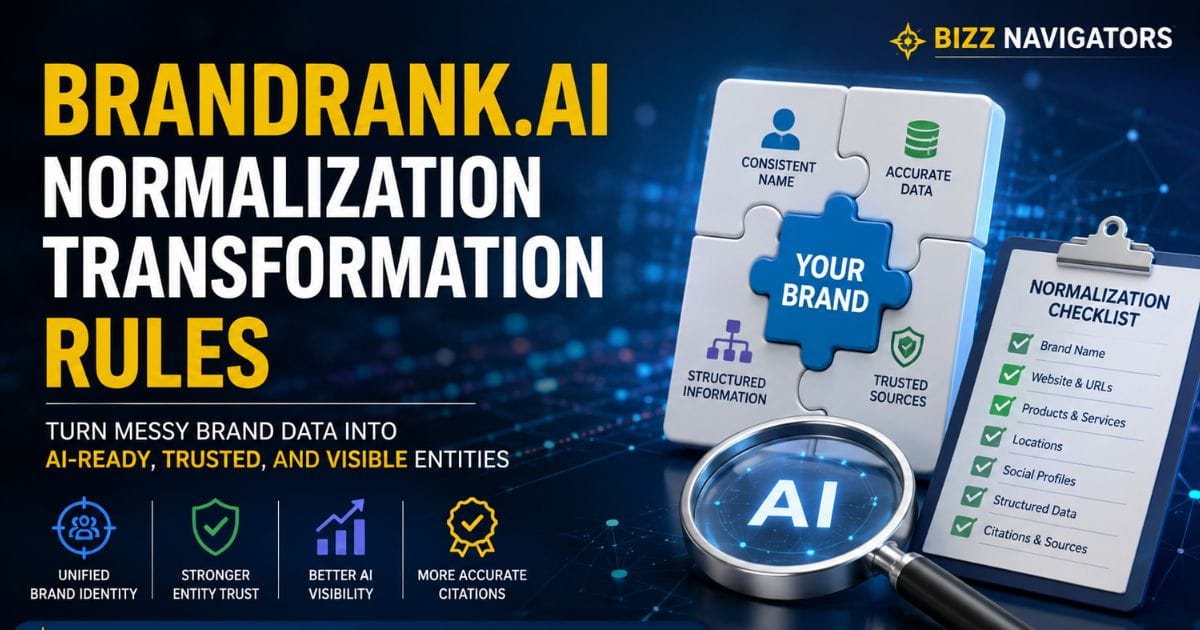
BrandRank.AI normalization transformation rules aim to solve this challenge by creating a clear and unified digital identity that AI systems can recognize with confidence.
Understanding the Purpose of BrandRank.AI
BrandRank.AI focuses on helping organizations improve their visibility inside AI-generated responses rather than only improving traditional search rankings.
The platform evaluates how consistently a brand appears across websites, social networks, directories, reviews, structured data, and media mentions.
Its objective is simple: make it easier for AI systems to identify, verify, and recommend the correct brand entity.
What Are Normalization Transformation Rules?
Normalization transformation rules are a collection of standards used to clean, standardize, and align brand information across digital channels.
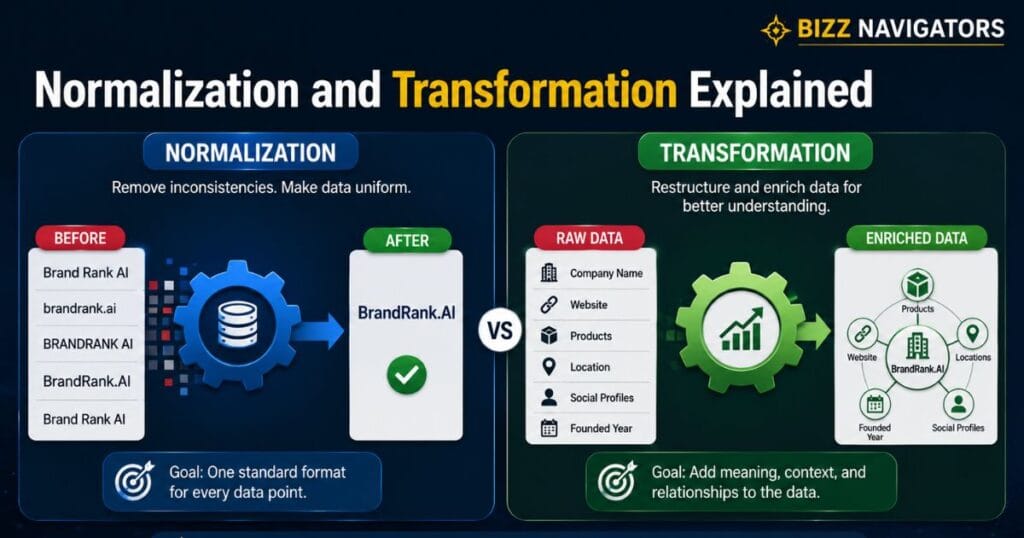
Normalization removes inconsistencies.
Transformation enriches and restructures information so that machines can understand relationships more accurately.
Together, these processes create a reliable digital identity that can travel across search engines, AI assistants, and recommendation systems.
Normalization and Transformation Explained
| Process | Primary Goal | Example |
| Normalization | Remove inconsistencies | Changing “Brand Rank AI” and “BrandRank AI” into one approved version |
| Transformation | Improve machine understanding | Connecting products, locations, and services to the main brand entity |
Normalization creates consistency.
Transformation creates intelligence.
Modern AI visibility requires both.
The Journey of Brand Data Inside AI Models
AI systems collect information from websites, public databases, news sources, business listings, and social platforms.
The information then passes through several stages:
Entity Identification
The model attempts to determine whether two mentions refer to the same organization.
Entity Resolution
Duplicate references are merged into a single entity profile whenever confidence is high enough.
Relationship Mapping
Products, executives, locations, and services become connected to the parent brand.
Confidence Scoring
AI systems assign trust scores based on source quality, consistency, and corroboration.
Brands with stronger consistency usually receive stronger confidence signals.
The Most Important BrandRank.AI Normalization Categories
Brand Name Alignment
A company should use one official spelling everywhere.
Minor variations may appear harmless to humans but can create uncertainty for AI systems.
Website Standardization
The preferred domain should remain consistent across citations, directories, and media references.
Mixing multiple URLs often weakens entity recognition.
Product and Service Consistency
Products should maintain identical names across marketplaces, websites, and promotional material.
Frequent naming variations reduce citation accuracy.
Geographic Information Alignment
Addresses, cities, and regional offices should follow one approved format.
This becomes especially important for local businesses and franchises.
Social Identity Synchronization
Social profiles should use the same brand names, logos, descriptions, and website references whenever possible.
Historical Brand Management
Businesses that have rebranded should maintain proper connections between old and new names.
Otherwise, valuable authority signals may disappear.
Multilingual Entity Standardization
International organizations often face translation inconsistencies.
AI systems perform better when multilingual references remain connected to the same core entity.
Canonical Brand Mapping and Why It Matters
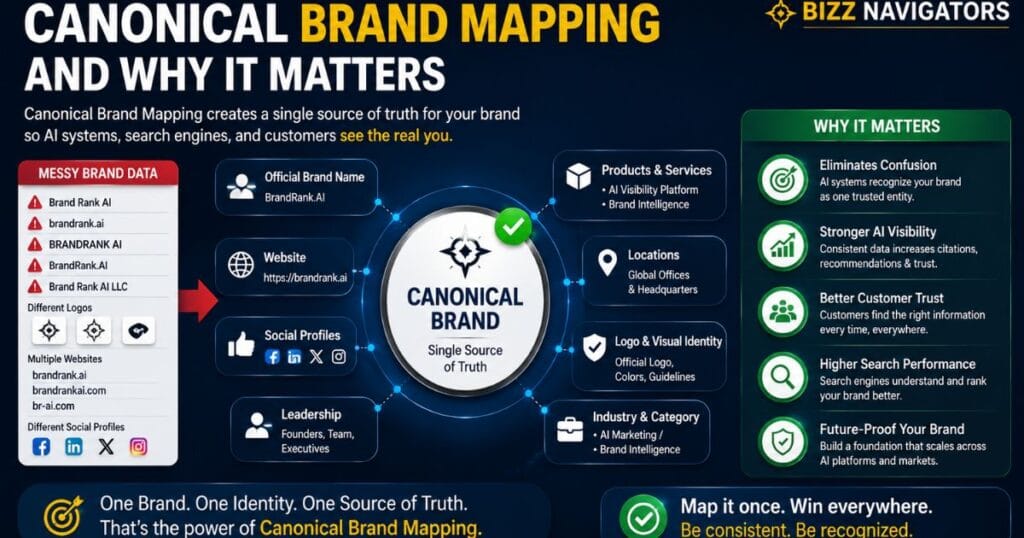
Canonical mapping establishes a single source of truth for every brand asset.
This source includes:
Official company name
Primary website
Approved logo
Product list
Social accounts
Locations
Leadership profiles
Every external mention should match this canonical record.
The stronger the alignment, the stronger the entity recognition.
How AI Detects Brand Quality Signals
AI models evaluate more than simple mentions.
Several hidden signals influence recommendations.
Citation Quality
Authoritative sources carry more weight than random mentions.
Sentiment Consistency
Positive and neutral discussions strengthen trust.
Conflicting sentiment creates uncertainty.
Topic Relevance
Brands receive stronger visibility when discussions consistently occur within relevant industries.
Recommendation Strength
Some systems estimate how confidently they can recommend a brand to users.
Consistency improves those scores.
Competitor Separation
AI models must distinguish between similar company names operating in different industries.
Normalization makes this process easier.
Common Data Problems That Hurt AI Visibility
Many organizations unknowingly damage their AI presence through inconsistent information.
Common issues include:
Multiple versions of the company name.
Different website URLs across directories.
Products with several naming formats.
Outdated addresses remain online.
Missing structured data implementation.
Incomplete social profiles.
Each inconsistency reduces machine confidence.
Practical Example of Normalization in Action
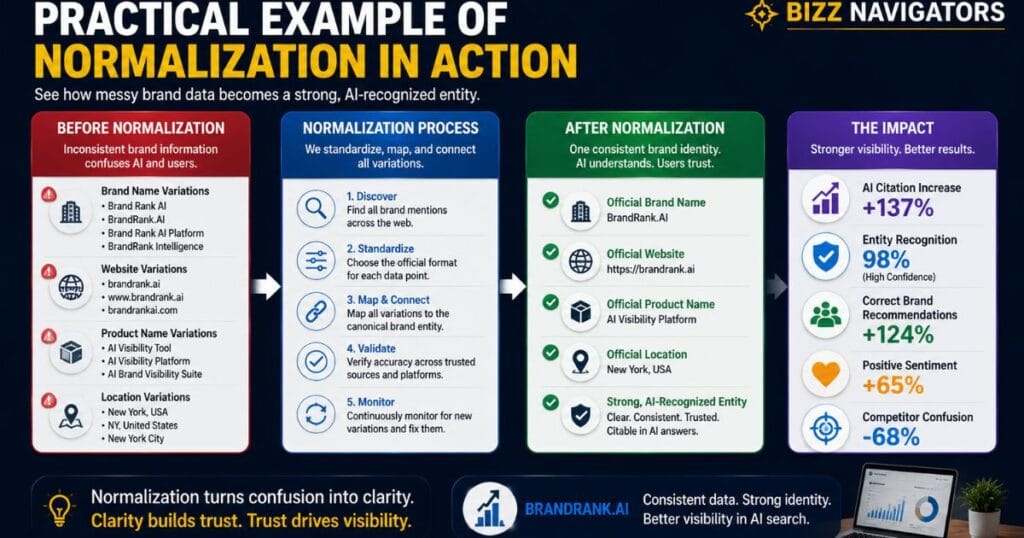
Imagine a company appears online using these variations:
BrandRank AI
BrandRank.AI
Brand Rank AI Platform
BrandRank Intelligence
Humans immediately understand these names refer to one organization. AI models may not reach the same conclusion.
After normalization, all references point to a single approved identity while historical variations remain connected as aliases.
This approach improves entity confidence and reduces ambiguity.
Structured Data Strengthens Brand Understanding
Structured data acts as a translator between websites and machines. Schema markup helps AI systems understand:
Organization details
Products
Authors
Reviews
Services
Locations
Without structured data, AI models rely more heavily on assumptions and external sources. Machine-readable trust signals are becoming increasingly valuable.
Measuring the Impact of Normalization Efforts
Businesses should track improvements using measurable indicators.
Important metrics include:
AI Citation Frequency
How often does the brand appear in generated answers?
Share of Voice
How visible is the organization compared with competitors?
Sentiment Distribution
What percentage of discussions are positive, neutral, or negative?
Entity Accuracy
How often do AI systems correctly identify products and services?
Competitive Visibility
Which competitors appear more frequently and why?
Measurement transforms normalization from theory into strategy.
Mistakes Organizations Frequently Make
Many businesses approach AI visibility incorrectly. The most common mistakes include:
Treating mentions as citations.
Ignoring legacy brand names.
Forgetting regional versions of content.
Publishing vague and generic information.
Assuming schema markup alone solves entity problems.
Monitoring only one AI platform.
AI visibility requires ongoing maintenance rather than a one-time project.
A Practical Implementation Checklist
Organizations can simplify adoption by following a structured process:
1. Create an official brand record.
2. Define approved naming conventions.
3. Audit third-party mentions.
4. Correct inconsistent citations.
5. Implement structured data.
6. Monitor AI-generated answers.
7. Repeat audits regularly.
Consistency compounds over time.
The Future of Brand Recognition in AI Search
Search behavior continues moving toward conversational experiences.
Users increasingly ask questions rather than type keywords.
As this transition accelerates, AI systems will prioritize brands with clear, trustworthy, and machine-readable identities.
Normalization transformation rules are becoming a competitive requirement rather than an optional enhancement.
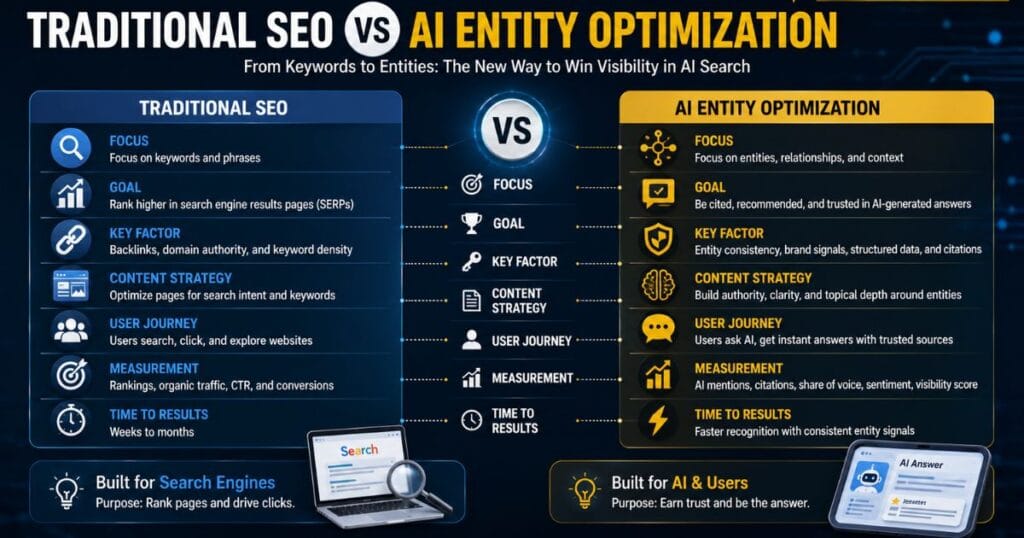
Traditional SEO vs AI Entity Optimization
The rules that helped websites rank ten years ago are no longer enough for the answer economy.
AI systems evaluate entities, relationships, and trust signals alongside traditional SEO metrics.
| Traditional SEO | AI Entity Optimization |
| Focuses on keywords | Focuses on entities and relationships |
| Competes for rankings | Competes for AI citations and recommendations |
| Relies heavily on backlinks | Relies heavily on data consistency |
| Optimizes pages | Optimizes brand understanding |
| Measures search visibility | Measures answer visibility |
Businesses that combine both approaches create stronger long-term visibility.
Who Should Implement BrandRank.AI Normalization Transformation Rules?
Normalization is not limited to large enterprises. Several types of organizations can benefit significantly:
SaaS Companies
Software companies often operate across multiple review platforms and directories where inconsistent product naming can create confusion.
Ecommerce Brands
Online stores frequently launch product variations that require consistent naming and categorization.
Local Businesses
Multi-location businesses depend heavily on accurate addresses, business names, and contact information.
Digital Agencies
Marketing agencies need accurate representation across client portfolios and service listings.
Enterprise Organizations
Large organizations often manage multiple brands, acquisitions, and regional identities that require central governance.
Real-World Example of AI Entity Improvement
Consider a technology company that used three different versions of its name across its website, LinkedIn page, and industry directories. The business also maintained separate product names in different regions.
After standardizing brand names, updating structured data, and correcting third-party listings, AI systems became more consistent in identifying the company and connecting its products to the parent organization.
The company experienced:
Improved entity recognition.
Fewer incorrect citations.
Stronger association between products and the brand.
Better visibility in AI-generated responses.
Although results vary between industries, consistent brand data almost always improves machine confidence.
Experience-Based Insight from AI Visibility Audits
During AI visibility audits, one recurring issue appears across organizations of all sizes: fragmented brand identity.
Many businesses unknowingly use different company names on social platforms, directories, review websites, and press releases.
Humans usually understand these variations immediately.
Large Language Models often do not.
This mismatch creates uncertainty that can reduce recommendation confidence and citation frequency.
Organizations that maintain a single source of truth for brand information generally perform better in AI-driven environments.
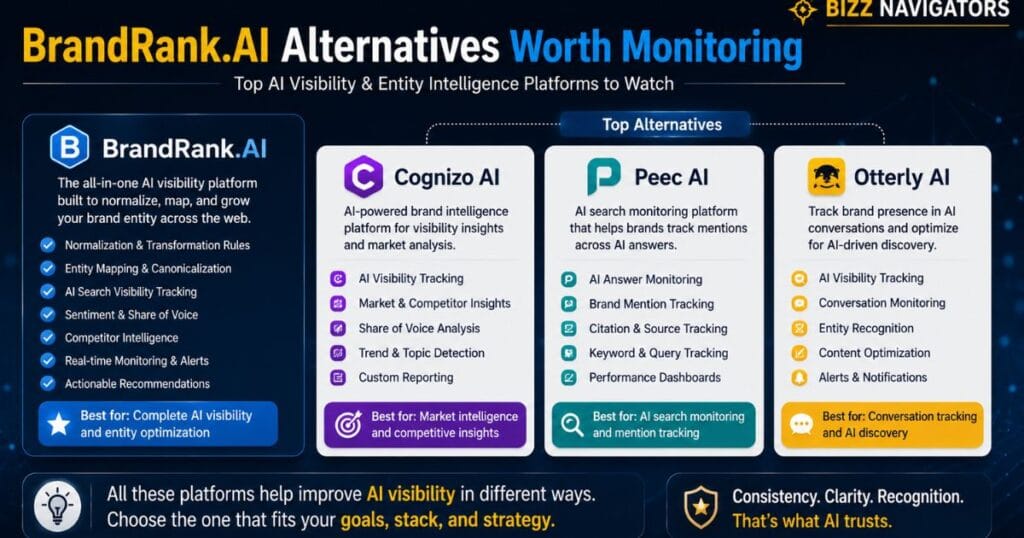
BrandRank.AI Alternatives Worth Monitoring
Businesses evaluating AI visibility solutions may also encounter other platforms operating in adjacent areas.
Some notable examples include:
Cognizo AI
Peec AI
Otterly AI
Each platform approaches AI visibility differently, but all highlight the growing importance of entity consistency and machine-readable trust signals.
Key Takeaways
AI platforms rely heavily on entity understanding rather than keywords alone.
Inconsistent brand information reduces machine confidence.
Structured data strengthens entity recognition.
AI visibility requires continuous monitoring and maintenance.
Organizations that standardize their digital identity gain a competitive advantage in answer engines.
The brands most likely to succeed in the future will not simply publish more content. They will publish clearer, more consistent, and more verifiable information.
Conclusion
The future of digital visibility extends beyond search rankings alone. AI systems increasingly reward organizations that provide clear, consistent, and verifiable information across the web. BrandRank.AI normalization transformation rules provide a framework for achieving that consistency.
Brands that invest in structured identity management today will likely become the organizations AI systems trust and recommend tomorrow. If you’d like, I can also generate an SEO title (under 60 characters), a meta description (under 160 characters), and an FAQ schema for this article.
Frequently Asked Questions
Are BrandRank.AI normalization transformation rules an official Google ranking factor?
No. They are not an official Google algorithm update or ranking signal. They represent best practices for improving brand clarity across AI ecosystems.
Can small businesses benefit from normalization?
Yes. Smaller organizations often see significant improvements because local and niche entities are more vulnerable to data inconsistencies.
How long does implementation take?
Initial audits may require several weeks, while measurable visibility improvements typically appear over several months.
Does normalization improve ChatGPT’s visibility?
Better entity consistency increases the probability of accurate recognition and citation by AI assistants, including ChatGPT and similar systems.
Is normalization a replacement for SEO?
No. Traditional SEO and AI entity optimization work best when implemented together.

At BizzNavigators, we answer the questions you’re actually searching for, honestly and clearly. We check our facts before we publish anything, and if we’re not sure about something, we tell you instead of guessing. Whatever you’re looking for- a tech fix, a business tip, or a simple how-to- we want to give you an answer you can trust.