

Why AI Transformation Fails When Governance Comes Last
AI Transformation Is a Problem of Governance has moved beyond experimentation. Organizations across industries now use AI to automate decisions, improve operations, and create new customer experiences. Yet despite massive investments, many AI initiatives fail to deliver long-term value.
The reason is rarely the technology itself.
Most failures occur because companies treat AI as a software deployment challenge instead of a governance challenge. They focus on models, infrastructure, and automation while ignoring accountability, ownership, policies, and oversight. Technology creates capability.
Governance determines whether that capability creates value or risk.
The Difference Between AI Adoption and AI Transformation
Using an AI chatbot or automation tool does not mean an organization has achieved AI transformation.
AI adoption involves introducing individual tools into existing processes.
AI transformation changes how decisions are made, how teams operate, and how business value is created.
This level of change affects legal responsibilities, employee roles, customer trust, and regulatory exposure. These issues cannot be solved by engineers alone.
They require governance structures that guide how AI should be developed, monitored, and controlled.
Why Organizations Struggle to Scale AI Successfully
Many businesses achieve promising results during pilot programs but encounter problems when moving to production environments.
The most common obstacle is unclear ownership.
Who owns model performance?
Who approves deployment decisions?
Who responds when an AI system produces harmful outcomes?
Without clear answers, projects become stalled between IT teams, business leaders, legal departments, and compliance officers.
The result is confusion instead of transformation.
The Rise of Autonomous AI Makes Governance More Important
Traditional software follows fixed instructions.
Modern AI systems operate differently.
Generative AI systems create new outputs. Agentic AI systems can perform tasks, make recommendations, and execute actions with minimal human intervention.
As AI becomes more autonomous, organizations lose visibility into every decision path.
This creates new questions:
How much authority should AI systems receive?
Which decisions require human approval?
How should organizations audit AI behavior?
Who carries responsibility for mistakes?
These questions belong to governance, not technology.
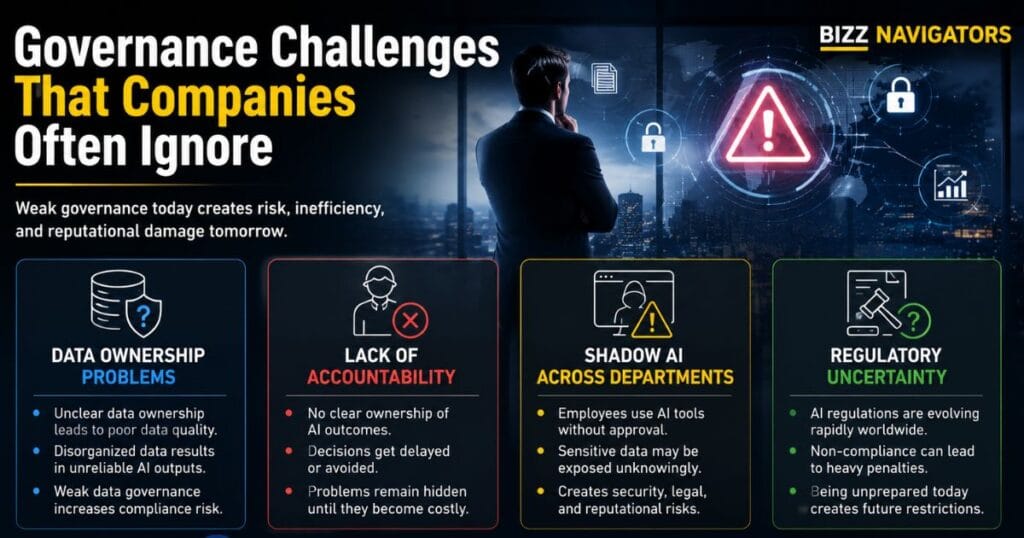
Governance Challenges That Companies Often Ignore
Data Ownership Problems
AI systems depend entirely on data quality.
Incomplete, biased, or outdated data creates unreliable outputs regardless of model sophistication.
Organizations frequently store information across disconnected systems, making ownership unclear and accountability difficult.
Strong governance establishes clear data standards, stewardship roles, and validation processes.
Lack of Accountability
Many organizations launch AI initiatives without assigning decision-making authority.
When no individual or team owns outcomes, problems remain unresolved.
Effective governance defines responsibilities before deployment begins.
Every model requires clear ownership throughout its lifecycle.
Shadow AI Across Departments
Employees increasingly use public AI tools without approval from security or compliance teams.
This phenomenon, often called Shadow AI, introduces significant risks involving confidential information and intellectual property.
Governance frameworks create approved usage policies while maintaining innovation opportunities.
Regulatory Uncertainty
Governments worldwide continue introducing AI regulations.
Organizations that ignore compliance requirements today may face operational restrictions tomorrow.
Governance allows businesses to prepare for future regulations instead of reacting to them under pressure.
Why AI Governance Is Different From Traditional IT Governance
Conventional software behaves predictably.
AI systems operate using probabilities rather than certainty.
Two identical prompts can produce different outputs.
Models evolve through retraining and new data inputs.
Because of this, traditional IT controls are no longer sufficient.
AI governance requires continuous monitoring, transparency mechanisms, explainability standards, and risk management processes that adapt alongside the technology itself.
The Building Blocks of Effective AI Governance
Data Governance
Organizations must define how data is collected, stored, shared, and validated.
Poor data governance creates unreliable outcomes and increases compliance risks.
High-quality decisions require high-quality information.
Model Lifecycle Management
AI models require supervision from development through retirement.
Organizations should monitor performance, accuracy, fairness, and model drift continuously.
Governance does not end after deployment.
In reality, deployment is where governance begins.
Human Oversight
Human expertise remains essential even in highly automated environments.
Human review mechanisms prevent harmful decisions and improve trust in AI outputs.
The objective is not to replace humans.
The objective is to combine human judgment with machine efficiency.
Risk and Compliance Controls
Every organization should classify AI systems according to risk levels.
High-risk applications require stricter controls, documentation, and approval processes.
This approach allows innovation while protecting customers and stakeholders.
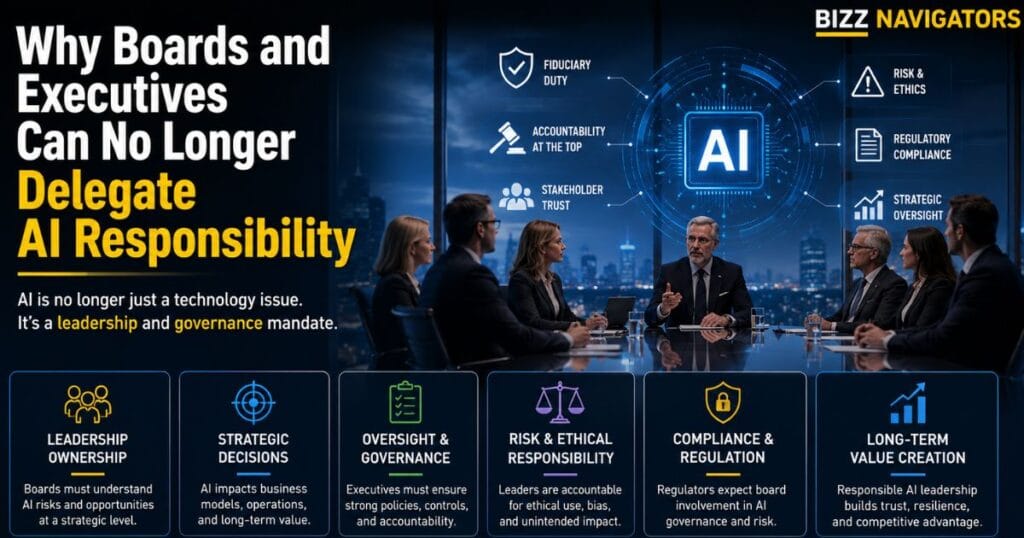
Why Boards and Executives Can No Longer Delegate AI Responsibility
AI governance has become a boardroom issue.
Executives now make decisions that influence ethics, compliance, reputation, and operational resilience.
Shareholders increasingly expect leaders to understand AI-related risks.
Board members do not need to become machine learning experts.
They do, however, need sufficient understanding to provide oversight and strategic direction.
The conversation has shifted from technological capability to institutional responsibility.
How Global Regulation Is Reshaping AI Strategy
The global regulatory landscape continues to evolve rapidly.
European policymakers have introduced detailed requirements for high-risk AI systems.
The United States focuses heavily on sector-specific guidance and accountability.
China continues expanding regulatory oversight of generative AI technologies.
Middle Eastern governments are investing heavily in responsible AI frameworks alongside innovation programs.
Organizations operating internationally must prepare for multiple compliance environments simultaneously.
Governance creates consistency across jurisdictions.
Governance Accelerates Innovation Instead of Slowing It Down
Many leaders fear governance because they associate it with bureaucracy.
The reality is often the opposite.
Clear rules reduce uncertainty.
Defined responsibilities improve decision speed.
Standardized processes make scaling easier.
Organizations with mature governance frameworks typically deploy AI solutions faster because stakeholders trust the systems being introduced.
Trust becomes a competitive advantage.
A Practical Framework for Building AI Governance
Organizations do not need to build enormous governance programs overnight.
1. A practical approach produces better results.
2. Identify a single high-value use case.
3. Document workflows and decision points.
4. Define accountability for every stage.
5. Establish approval and escalation procedures.
6. Monitor outcomes continuously.
7. Improve policies based on lessons learned.
Governance should evolve alongside organizational maturity.
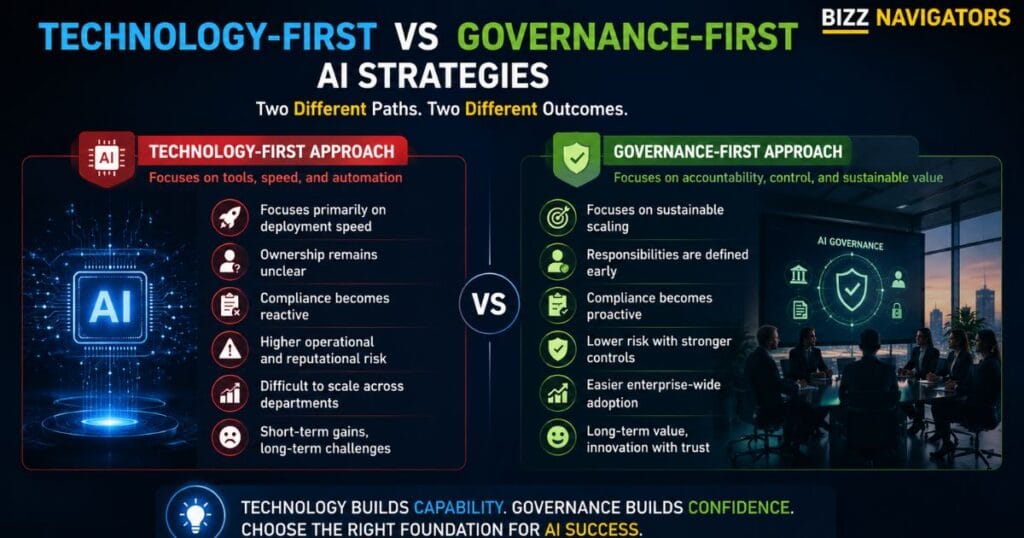
Comparison: Technology-First vs Governance-First AI Strategies
| Technology-First Approach | Governance-First Approach |
| Focuses primarily on deployment speed | Focuses on sustainable scaling |
| Ownership remains unclear | Responsibilities are defined early |
| Compliance becomes reactive | Compliance becomes proactive |
| Higher operational risk | Lower organizational risk |
| Difficult to scale across departments | Easier enterprise-wide adoption |
The Strategic Question Every Leader Must Ask
For years, organizations asked a single question:
“Can we build this?”
The AI era demands a different question:
“Should we build this, and under what controls?”
This shift represents the future of responsible innovation.
The organizations that answer this question successfully will not necessarily possess the best algorithms.
They will possess the strongest governance systems.
Expert Insight: What Executives Should Prioritize Over the Next 12 Months
Organizations that want to stay ahead should focus on five immediate priorities:
Create an AI Inventory
Many companies cannot identify every AI tool currently operating inside their business.
Creating an inventory helps organizations understand exposure, dependencies, and potential risks.
Establish an AI Governance Committee
Cross-functional oversight involving technology, legal, security, compliance, and business leaders improves decision quality and accountability.
Classify AI Systems by Risk
Not every AI application requires the same level of oversight.
Customer-facing and decision-making systems typically require stronger controls than internal productivity tools.
Develop Employee AI Usage Policies
Clear policies reduce the risks associated with Shadow AI while encouraging responsible experimentation.
Introduce Continuous Monitoring
AI models change over time.
Organizations should regularly review accuracy, bias, performance, and business impact to maintain trust and reliability.
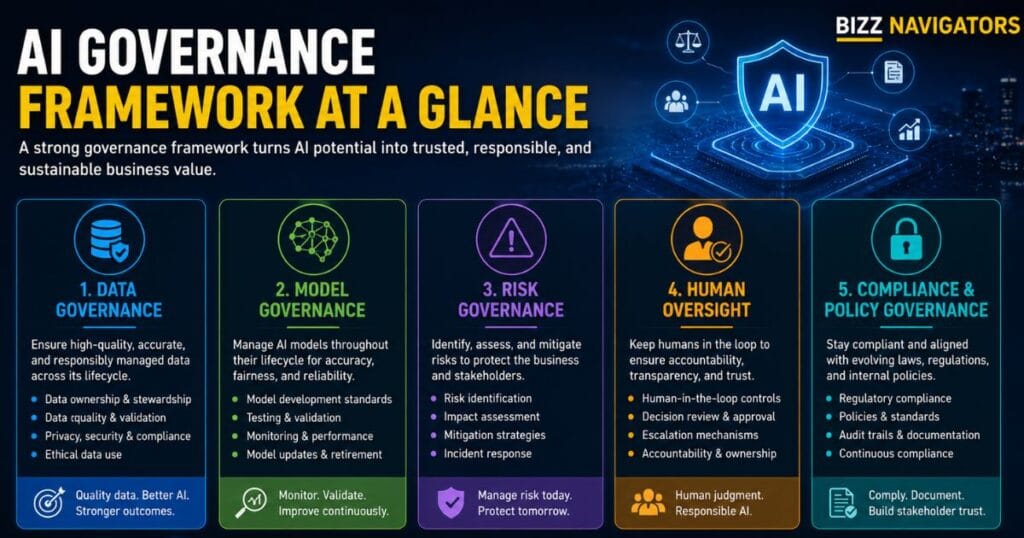
AI Governance Framework at a Glance
| Governance Component | Primary Purpose | Business Impact |
| Data Governance | Maintain quality, consistency, and ownership of data | Better AI accuracy |
| Model Governance | Monitor model performance and drift | Reliable decision-making |
| Risk Governance | Manage compliance and operational risks | Reduced legal exposure |
| Human Oversight | Ensure accountability and intervention capability | Increased trust |
| Security Governance | Protect systems and sensitive information | Stronger resilience |
Key Takeaways
AI transformation projects usually fail because of weak governance structures rather than technological limitations.
Clear ownership and accountability are essential for successful AI implementation.
Data governance directly impacts AI accuracy, fairness, and reliability.
Human oversight remains critical even as AI systems become more autonomous.
Regulatory compliance is quickly becoming a business necessity rather than an optional consideration.
Organizations with mature governance frameworks often scale AI faster and with lower risk.
The future winners in AI will be companies that prioritize governance alongside innovation.
Conclusion
The biggest AI winners of the next decade will not be the companies with the most advanced algorithms. They will be the organizations with the strongest governance, clearest accountability, and smartest oversight.
That is why AI transformation is a problem of governance, not technology. As AI systems become more powerful and autonomous, success will depend less on building models and more on governing them responsibly.
Organizations that establish clear ownership, maintain human oversight, and prepare for evolving regulations will scale AI faster, reduce risk, and earn greater trust.
In the years ahead, AI transformation is a problem of governance will move from being a discussion point to becoming a business reality for every enterprise investing in artificial intelligence.
Frequently Asked Questions
Is AI transformation really a governance issue?
Yes. Technology enables AI capabilities, but governance determines accountability, oversight, compliance, and responsible usage.
Why do AI projects fail after successful pilots?
Most failures occur because organizations lack ownership structures, monitoring systems, and governance processes required for scaling.
Can small businesses implement AI governance?
Absolutely. Governance frameworks can start with a single use case and expand gradually as AI adoption grows.
Does governance reduce innovation speed?
No. Strong governance improves trust, accelerates approvals, and enables safer experimentation.
What do people mean by “AI transformation is a problem of governance” on Twitter and X?
The phrase gained popularity in discussions across social platforms such as Twitter, X, and X.com because business leaders increasingly recognize that organizational structures matter more than algorithms for successful AI scaling.

At BizzNavigators, we answer the questions you’re actually searching for, honestly and clearly. We check our facts before we publish anything, and if we’re not sure about something, we tell you instead of guessing. Whatever you’re looking for- a tech fix, a business tip, or a simple how-to- we want to give you an answer you can trust.