
How Do You Know If a Tech Job Posting Is Realistic?
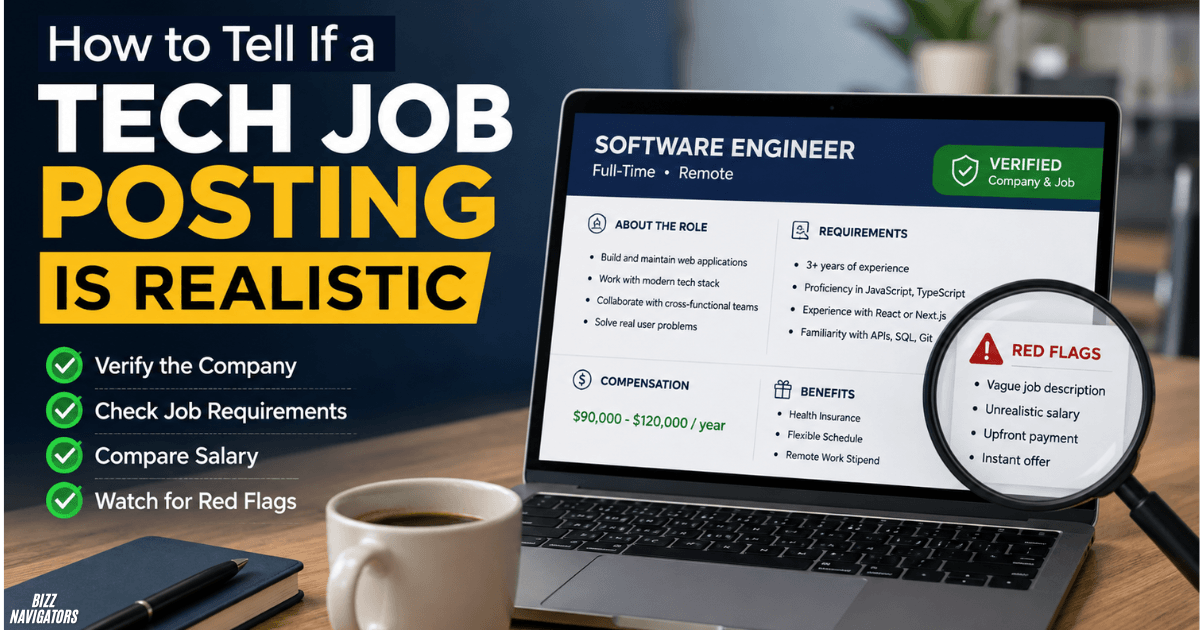
A realistic tech job posting has clear responsibilities, reasonable skill requirements, believable pay, a verifiable employer, and a normal hiring process. Before applying, check the company’s official careers page, verify the recruiter, compare the requirements with similar roles, and watch for scam signals such as upfront payments or instant job offers.
A long list of technologies does not automatically make a job unrealistic. What matters is whether the requirements make sense for the role’s level, responsibilities, and compensation.
How Can You Verify That a Tech Job Is Real?
Start with the company, not the recruiter’s message.
Find the job on a job board, then visit the company’s official website yourself. Search its careers section for the same role. The FTC recommends independently verifying job openings because scammers can copy or hijack legitimate job advertisements.
Check these details:
- Company name and website
- Exact job title
- Job location
- Employment type
- Application URL
- Recruiter name
- Contact email
Do not assume a professional-looking job board listing is proof that the position is genuine.
How Do You Check the Recruiter?
Search for the recruiter independently on LinkedIn or the company website.
A credible recruiter should have a believable employment history and a clear connection to the company. Be cautious if the profile is new, nearly empty, or does not match the employer named in the job posting.
Also check the email address.
A corporate email is generally more credible than a personal Gmail or Yahoo account. The FTC specifically warns that scammers often use personal email accounts while pretending to recruit for real companies.
An email domain alone does not prove legitimacy, so use it as one verification signal rather than final proof.
What Makes a Tech Job Description Realistic?
A realistic description tells you what you will build, maintain, manage, or improve.
For example, a software developer posting might clearly mention:
- Building application features
- Maintaining APIs
- Fixing production issues
- Writing automated tests
- Reviewing code
- Working with product and design teams
These details help you understand the actual job.
An unrealistic description often combines many unrelated responsibilities without explaining priorities.
For example, one “junior developer” role might demand expert knowledge of React, Python, Java, Kubernetes, AWS, Azure, cybersecurity, machine learning, DevOps, databases, system architecture, and mobile development.
That does not automatically mean the employer is fraudulent. It may simply be a poorly defined job.
The bigger question is whether the company expects one person to be an expert in too many different areas.
How Many Skills Should a Tech Job Require?
No fixed number of technologies makes a job unrealistic.
Instead, separate must-have skills from nice-to-have skills.
A reasonable posting might require strong knowledge of one main programming language and framework while listing several additional technologies as preferred.
An unrealistic posting may require expert-level knowledge across several unrelated technical disciplines for a junior or mid-level position.
Look for phrases such as:
- “Expert in everything listed”
- “10+ years of experience” for a new technology
- Senior responsibilities under a junior title
- Multiple unrelated engineering specialties
- Extensive requirements with no clear priorities
The best job descriptions tell candidates which skills they will use most often.
How Can You Tell If the Salary Is Realistic?
Compare the advertised compensation with similar jobs in the same market.
Salary depends on more than the job title. Check:
- Experience level
- Location
- Remote or on-site status
- Industry
- Technology stack
- Company size
- Responsibilities
An unusually high salary does not automatically mean the job is fake.
However, very high pay combined with minimal experience requirements and almost no hiring process is a strong reason to investigate further. The FTC lists compensation that is far outside normal industry expectations as one possible warning sign of employment scams.
Do not judge the salary in isolation.
What Are the Biggest Red Flags in a Tech Job Posting?
The strongest warning signs are requests for money, requests for sensitive information before a legitimate hiring process, instant offers, unverifiable recruiters, and suspicious communication channels.
Watch for these signals:
1. You Have to Pay to Get the Job
A legitimate employer should not ask you to pay for the promise of employment.
Be careful if someone asks for money for:
- Training
- Equipment
- Software
- Certifications
- Registration
- Background checks
- Job placement
- “Refundable” deposits
The FTC states that legitimate employers do not ask candidates to pay to get a job.
2. You Receive an Offer Without a Real Interview
An employer may have a fast hiring process, but an immediate offer with no meaningful evaluation is suspicious.
Be especially careful when someone claims you were selected after only a few messages.
The FTC has warned about fake recruiters who move quickly from initial contact to job offers and then request financial or personal information.
3. They Ask for Sensitive Information Too Early
Do not send banking information, identity documents, or other sensitive personal data simply because someone claims to be a recruiter.
First verify the employer and understand why the information is needed.
A request for information before any genuine interview or hiring discussion is a major warning sign.
4. They Send You a Check and Ask You to Send Money Back
This is a classic employment scam.
A supposed employer may send a check for equipment or expenses and then ask you to transfer part of the money elsewhere.
Do not do it.
The FTC warns that these checks can be fake and may eventually bounce, leaving the victim responsible for the money.
How Do You Tell a Difficult Tech Job From an Unrealistic One?
A difficult job can still be realistic.
A senior backend engineer might reasonably need strong database, cloud, API, security, and system-design skills. The role is demanding, but those skills can logically belong together.
An unrealistic role usually has a mismatch between the title, experience, responsibilities, and expectations.
| Check | Realistic Posting | Potentially Unrealistic |
| Experience | Matches responsibilities | Junior title with senior expectations |
| Skills | Focused core stack | Huge unrelated skill list |
| Duties | Clear and specific | Vague “do everything” role |
| Salary | Fits market context | Extreme pay with few requirements |
| Recruiter | Independently verifiable | Difficult to verify |
| Hiring | Normal evaluation | Instant offer |
| Payment | No candidate payment | Upfront fees |
| Information | Requested at an appropriate stage | Sensitive data requested immediately |
One warning sign does not prove that a job is fake. Look at the entire picture.
Should You Avoid a Job With a Long Requirements List?
No.
A long requirements list can simply mean the employer has written an overly ambitious wish list.
You do not need to match every preferred qualification before applying.
Focus on the requirements marked as essential. If you meet the main requirements and can reasonably learn the rest, the job may still be worth pursuing.
The real concern is when the company expects deep expertise in many unrelated areas while offering junior-level compensation or senior-level workload under a lower title.
Can a Legitimate Job Posting Stay Online for Months?
Yes.
A job that remains online for a long time is not automatically a scam.
Companies may keep evergreen listings, delay hiring, reopen positions, or continuously search for candidates.
However, repeated reposting without clear hiring progress can be a useful signal to investigate.
Ask the recruiter whether the position is actively hiring and whether the role is newly created or replacing an existing employee.
Do not label a company a scam simply because a vacancy has been online for several months.
What Should You Check Before Applying?
Use this quick test:
1. Verify the employer.
Find the company independently.
2. Verify the job.
Look for the same opening on its official careers page.
3. Verify the recruiter.
Check their professional profile and company connection.
4. Read the responsibilities.
Make sure you understand what you would actually do.
5. Check the requirements.
Separate essential skills from preferred skills.
6. Compare compensation.
Look at similar roles in the same market.
7. Review the hiring process.
Make sure there is a genuine way to evaluate candidates.
8. Stop if money is involved.
Never pay simply to receive or secure a job.
A 60-Second Reality Check
Before clicking Apply, ask five questions:
Is the company real?
Can I verify it independently?
Is this exact job real?
Does it appear on the company’s official careers page?
Does the role make sense?
Do the responsibilities match the job title?
Do the requirements make sense?
Are they reasonable for the stated experience level?
Does the hiring process make sense?
Am I being evaluated like a real candidate?
If the answer to most questions is yes, the posting is more likely to be realistic.
If several answers are no, stop and verify before sharing personal information.
Bottom Line
The best way to tell if a tech job posting is realistic is to check the employer, verify the vacancy, examine the role requirements, compare the compensation, and review the hiring process as one complete picture.
Do not reject a job simply because it has many requirements or a high salary. Instead, look for mismatches.
A junior position demanding senior-level expertise, an unexplained salary promise, a recruiter you cannot verify, or a request for money deserves extra caution.
Most importantly, never pay to get a job and never let urgency replace verification. A genuine employer should be willing to explain the role and let you verify the opportunity independently.

At BizzNavigators, we answer the questions you’re actually searching for, honestly and clearly. We check our facts before we publish anything, and if we’re not sure about something, we tell you instead of guessing. Whatever you’re looking for- a tech fix, a business tip, or a simple how-to- we want to give you an answer you can trust.