
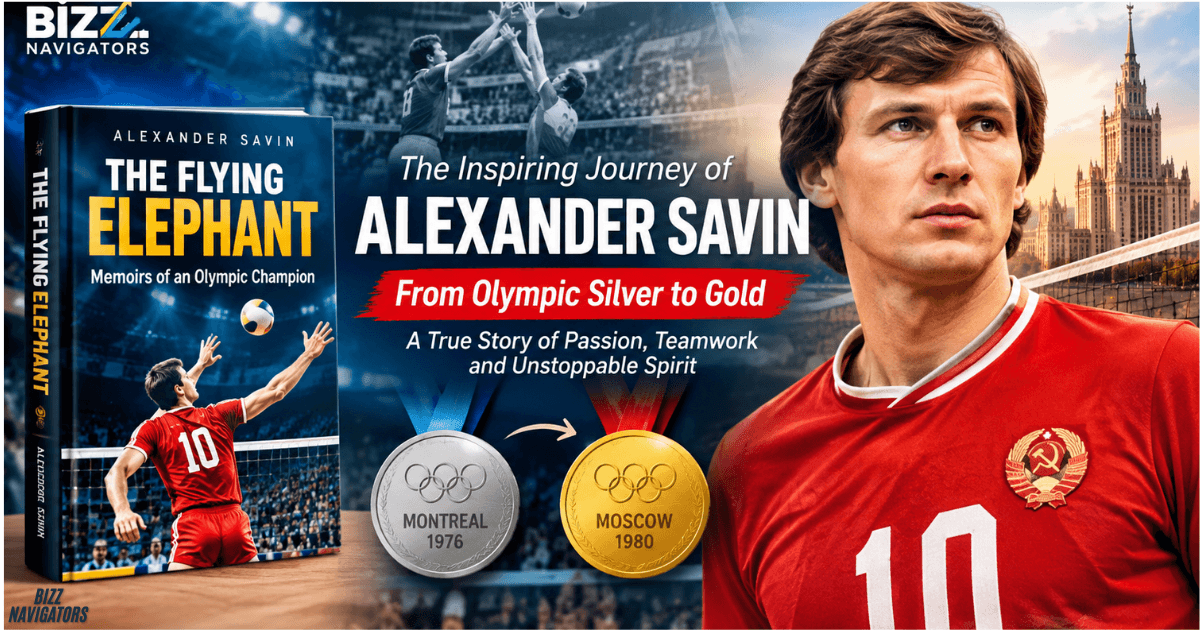
What Is The Flying Elephant Memoirs of an Olympic Champion Alexander Savin?
The Flying Elephant Memoirs of an Olympic Champion is the autobiography of Soviet volleyball player Alexander Savin, who won Olympic silver at Montreal 1976 and Olympic gold at Moscow 1980. The memoir looks beyond medals to explore elite volleyball, training, teammates, competition, and the world of Soviet sport. Current listings describe the English Kindle edition as a 514-page book with more than 240 photographs.
The book is especially interesting because Savin experienced two very different Olympic outcomes. He was part of the Soviet team that lost the 1976 final to Poland before returning four years later to win gold on home soil in Moscow.
Rather than treating those medals as the whole story, the memoir provides a personal perspective on the years of work behind them.
Who Is Alexander Savin?
Alexander Savin is a former Soviet volleyball player and Olympic champion who became an important figure in international volleyball during the late 1970s and early 1980s.
His Olympic record is particularly notable. At the 1976 Montreal Olympics, the Soviet men’s volleyball team reached the final but lost to Poland in five sets, earning silver. Savin was part of that squad.
At the 1980 Moscow Olympics, the Soviet team went all the way. It defeated Bulgaria in the final and won the gold medal, giving Savin his Olympic championship.
His career also unfolded during an important period for Soviet volleyball. The sport was highly competitive internationally, and the Soviet national program produced several generations of elite players.
That historical setting gives his memoir value beyond a conventional athlete biography.
Savin’s Playing Career
Savin competed at a time when Soviet volleyball emphasized physical preparation, tactical discipline, teamwork, and long-term athlete development.
Contemporary coverage also highlighted his exceptional jumping ability and athletic presence. A 1981 Washington Post article, quoting earlier volleyball coverage, described Savin as an extraordinary leaper on the Soviet national team.
That reputation helps explain why the unusual image of a “flying elephant” fits naturally with the story surrounding the memoir.
What Does The Flying Elephant Memoir Cover?
The memoir is centered on Savin’s experience of elite volleyball, but its subject is broader than individual matches.
Current descriptions of the English edition indicate that the book discusses training, Olympic competition, teammates, coaches, Soviet volleyball culture, personal experiences, and the pressures surrounding high-level sport.
This makes the book useful for readers who want to understand how an Olympic career is built, rather than simply seeing the final medal count.
The memoir can be viewed through several connected themes:
- Athletic development
- Intensive training
- Olympic preparation
- Teamwork
- Coaching
- Competition
- Soviet-era volleyball
- Personal sacrifice
- Athlete identity
- Life around elite sport
The strongest appeal is the firsthand perspective. A statistics page can tell readers that Savin won Olympic gold. A memoir can provide context about the people, environment, preparation, and experiences surrounding that achievement.
Why Did Alexander Savin Call It The Flying Elephant?
The title is one of the most intriguing parts of the book.
“The Flying Elephant” combines two ideas that appear contradictory. An elephant suggests size, strength, and power, while flying suggests speed, elevation, and something unexpected.
That combination works particularly well for a volleyball player known for his athletic ability and jumping.
Some current accounts describe the phrase as a nickname connected to Savin’s combination of physical strength and remarkable jumping ability. However, readers should distinguish that explanation from independently documented biographical facts because the exact origin of the title is not consistently established across available sources.
The title can also be understood symbolically.
It represents the idea of doing something that appears unlikely at first. In elite sport, athletes repeatedly confront physical and mental limits. Progress comes from training, adaptation, teamwork, and persistence.
That interpretation makes the title meaningful even for readers who are unfamiliar with volleyball.
What Makes This Memoir Different From a Typical Sports Biography?
Many sports biographies concentrate on famous victories. The Flying Elephant appears to take a wider approach by giving attention to the people and environment surrounding Savin’s career.
Current descriptions emphasize stories involving teammates, coaches, training camps, competitions, and less familiar figures from Soviet volleyball.
That matters because Olympic success is rarely the product of one athlete working alone.
A volleyball team depends on coordination. Players must understand one another’s movements, trust tactical decisions, and perform under intense pressure.
Savin’s story therefore provides a useful look at the team behind the champion.
The Human Side of Olympic Success
An Olympic medal is a visible result. The preparation behind it is much less visible.
Elite athletes deal with:
- Repetitive training
- Competition for selection
- Physical fatigue
- Performance pressure
- Tactical demands
- Coaching decisions
- Team dynamics
- Expectations from supporters and officials
A memoir gives those issues a personal dimension.
For readers, that can make Savin’s achievements easier to understand. His Olympic gold was not an isolated event. It came after years of development and, importantly, after the disappointment of losing the Olympic final in 1976.
The 1976 and 1980 Olympics in Savin’s Story
The contrast between Montreal and Moscow is one of the most important parts of Savin’s Olympic journey.
| Olympic Games | Soviet Men’s Volleyball Result | Savin’s Result |
| Montreal 1976 | Silver | Olympic silver medalist |
| Moscow 1980 | Gold | Olympic champion |
In Montreal, the Soviet Union reached the final against Poland but lost 3–2. Savin was among the Soviet players listed for the tournament.
Four years later, the situation changed dramatically. At Moscow 1980, the Soviet men’s team defeated Bulgaria 3–1 in the final and claimed gold. Savin was included in the championship roster.
That progression—from Olympic silver to Olympic gold—adds an important layer to his memoir.
It shows that elite careers do not always follow a straight path from talent to victory.
What Is Included in the English Edition?
The English edition has attracted attention partly because of its size and visual material.
Current listings describe it as a 514-page Kindle edition, published in English in October 2025, with more than 240 photographs. Reported contributors include Andrei Savine, Julia Savine, Peter Murphy, and Alfredo Cabero in translation, editing, and introductory roles.
The photographs add another dimension to the memoir.
Instead of relying entirely on written recollections, the edition reportedly brings together archival and family material connected with Savin’s career and the wider volleyball community.
That makes the book interesting not only as an autobiography but also as a visual record of an earlier era of international volleyball.
A Family Translation Project
One particularly interesting part of the English edition’s background is the involvement of Savin’s family.
Andrei Savine has publicly described the translation as a personal project connected with his half-brother Alexander Savin. He explained that the work developed into an effort to preserve the stories of Savin’s teammates, coaches, friends, and the wider volleyball generation.
This context gives the English edition an additional historical purpose.
It is not simply a modern release of an old sports story. It also represents an attempt to bring memories from Soviet-era volleyball to a broader English-speaking audience.
Who Should Read The Flying Elephant?
The memoir is a natural fit for volleyball fans, but its appeal is not limited to them.
It may be especially useful for:
- Olympic history enthusiasts
- Volleyball players
- Coaches
- Sports historians
- Readers interested in Soviet sport
- Fans of athlete autobiographies
- People interested in leadership and teamwork
You do not need advanced volleyball knowledge to understand the broader story.
The central ideas—discipline, pressure, teamwork, competition, disappointment, and achievement—apply well beyond the volleyball court.
What Can Readers Learn From Alexander Savin’s Story?
The most useful lessons are not simply about winning.
First, setbacks can become part of a successful career. Savin experienced Olympic defeat in 1976 before winning gold in 1980.
Second, elite performance depends on preparation. Olympic success is the result of years of development rather than one spectacular performance.
Third, teams matter. Volleyball is inherently collaborative, so individual ability must work within a larger system.
Fourth, sporting history is also human history. Behind every famous team are coaches, teammates, families, and competitors whose contributions can disappear from mainstream accounts.
Finally, athletic careers have a life beyond medals. The experience of competing, learning, coaching, and preserving memories can remain valuable long after an athlete leaves the court.
Is The Flying Elephant Worth Reading?
Yes, especially if you are interested in Olympic volleyball, Soviet sports history, or firsthand athlete stories. The memoir offers more than a list of Alexander Savin’s achievements. Its value comes from the personal and historical context surrounding those achievements.
The reported 514-page English Kindle edition and collection of more than 240 photographs also make it substantially more detailed than a short biography or basic Olympic profile.
Readers looking for a fast celebrity-style sports biography may find the historical detail less immediate. But readers who want a deeper look at an Olympic athlete and his sporting generation have more reason to explore it.
Final Verdict on The Flying Elephant Memoirs of an Olympic Champion Alexander Savin
The Flying Elephant Memoirs of an Olympic Champion is best understood as both an athlete’s autobiography and a window into Soviet-era volleyball.
Alexander Savin’s Olympic journey gives the story a strong foundation: silver at Montreal 1976 followed by gold at Moscow 1980.
But the real interest lies beyond those two results.
The memoir brings attention to training, teammates, coaches, competition, personal experience, and the sporting culture surrounding one of volleyball’s important generations.
Its English edition also expands the book’s reach through translation and extensive photographic material.
For anyone searching for The Flying Elephant Memoirs of an Olympic Champion Alexander Savin, the key takeaway is simple: this is not merely a book about an Olympic medal. It is a personal record of the work, people, pressure, and history behind one.
Frequently Asked Questions
Who is Alexander Savin?
Alexander Savin is a former Soviet volleyball player and Olympic champion. He won silver with the Soviet men’s team at Montreal 1976 and gold at Moscow 1980.
What is The Flying Elephant about?
It is Savin’s memoir about his life and career in elite volleyball, including training, competition, Olympic experiences, teammates, coaches, and Soviet-era sports culture.
What Olympic medals did Alexander Savin win?
He won an Olympic silver medal at the 1976 Montreal Games and an Olympic gold medal at the 1980 Moscow Games.
Is The Flying Elephant available in English?
Yes. Current coverage describes an English Kindle edition. Retail availability and edition details can vary by marketplace, so readers should verify the current retailer listing before purchasing.
How long is the English Kindle edition?
Current listings report a length of 514 pages.
Does the memoir contain photographs?
Yes. Current descriptions report more than 240 photographs, including archival and family material.
Is the book only for volleyball fans?
No. Volleyball is central to the memoir, but its themes include discipline, teamwork, competition, resilience, leadership, and Olympic history. Those subjects can interest general readers as well.

At BizzNavigators, we answer the questions you’re actually searching for, honestly and clearly. We check our facts before we publish anything, and if we’re not sure about something, we tell you instead of guessing. Whatever you’re looking for- a tech fix, a business tip, or a simple how-to- we want to give you an answer you can trust.
1 thought on “The Flying Elephant Memoirs of an Olympic Champion Alexander Savin”