
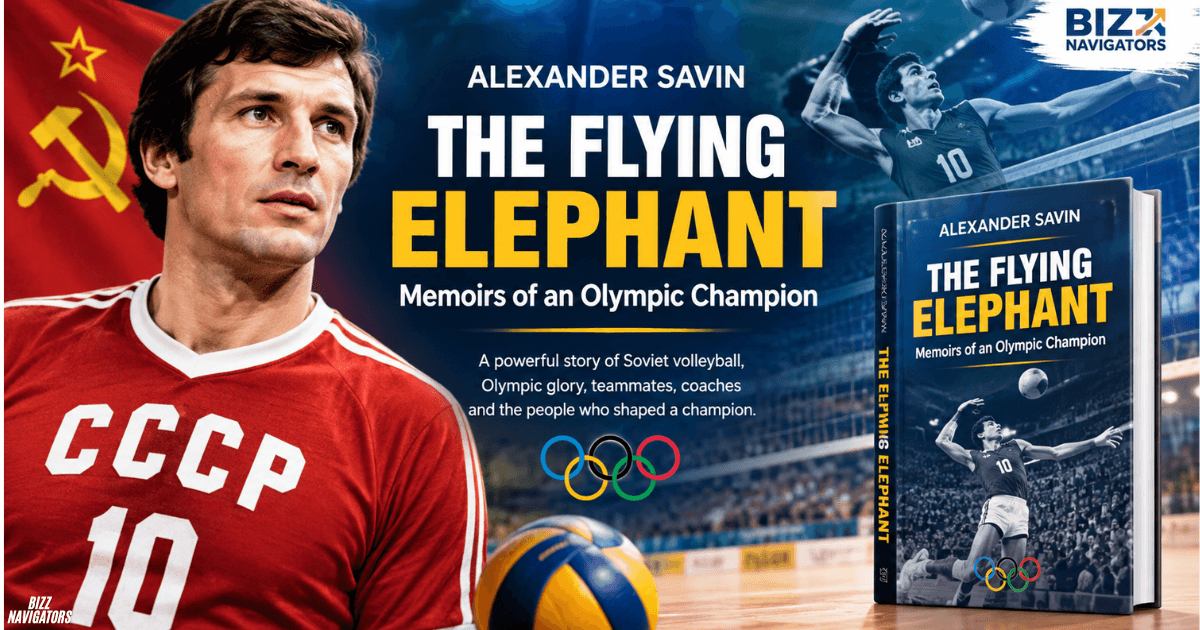
What Is Alexander Savin The Flying Elephant Memoirs of an Olympic Champion About?
The Flying Elephant Memoirs of an Olympic Champion is Alexander Savin’s autobiographical book about his life in Soviet volleyball, Olympic competition, teammates, coaches, and the people who shaped his career. The original Russian title is Летающий слон. Записки олимпийского чемпиона, which translates as The Flying Elephant: Notes of an Olympic Champion. The book was presented publicly in 2024.
The memoir is not only about winning medals. Savin focuses on the people and experiences behind his sporting career.
That makes the book useful for readers interested in Olympic history, volleyball, athlete memoirs, and Soviet-era sport.
Who Is Alexander Savin?
Alexander Savin is a former Soviet volleyball player and Olympic champion. He was born in 1957 and became one of the major players of Soviet men’s volleyball.
Savin won Olympic silver at Montreal 1976 and Olympic gold at Moscow 1980.
His career also included major international success. Russian volleyball sources describe him as a multiple world and European champion, World Cup winner, 13-time Soviet champion, and member of the Volleyball Hall of Fame.
His Olympic career is therefore only one part of a much larger sporting legacy.
Why Is the Book Called The Flying Elephant?
The title refers to Savin’s identity as a volleyball player.
Savin was known for his exceptional physical ability and jumping power. The unusual combination of size, strength, and movement made the “Flying Elephant” name memorable.
Savin has also explained that people who remember him as a player understand the title more easily. Others, he suggested, will understand it by reading the book.
So the title is not simply a catchy phrase. It connects directly with how Savin was remembered on the volleyball court.
What Does the Memoir Focus On?
The book covers more than tournament results.
Its main subjects include:
- Olympic experiences
- Savin’s volleyball career
- Teammates
- Coaches
- Training and competition
- Important people from his sporting life
- Memories from Soviet volleyball
- Questions previously asked by fans and readers
A Russian volleyball publication reported that the book contains around 300 pages, including stories, photographs, and answers to questions that had been asked of Savin.
This makes it closer to a personal sports history than a simple list of achievements.
Alexander Savin’s Olympic Career
Savin’s Olympic record is straightforward but important.
| Olympic Games | Result |
| Montreal 1976 | Silver medal |
| Moscow 1980 | Gold medal |
At Montreal in 1976, the Soviet men’s volleyball team reached the final but lost to Poland. Savin therefore left the Games with an Olympic silver medal.
Four years later, he returned to the Olympics in Moscow.
The Soviet team won the men’s volleyball gold medal, making Savin an Olympic champion.
That progression—from silver in 1976 to gold in 1980—is one of the most important parts of his sporting story.
Why Was the 1980 Olympic Gold Important?
The Moscow Olympics were held during a tense period of the Cold War.
The Games were also affected by a major international boycott. That gave the tournament an unusual political and historical background.
For Savin, however, the result was clear: he became an Olympic champion on home soil.
That achievement remains central to his legacy.
What Makes The Flying Elephant Different From a Normal Sports Biography?
The biggest difference is perspective.
Savin is telling the story himself.
The book does not treat his career only as a collection of medals and statistics. It gives attention to the people who shared his journey.
During the 2024 presentation of the book, Savin reportedly said that the book was not simply about him and that he was not the only “hero” of the story.
That point is important.
The memoir tries to preserve memories of a whole sporting generation, not just one athlete.
Why Are Coaches and Teammates Important?
Volleyball is a team sport, so individual success depends heavily on cooperation.
Savin’s memoir reflects that reality.
The book discusses coaches and the people who travelled the same sporting path as him. Contemporary coverage of the Russian edition specifically highlights these relationships.
This gives readers a broader view of how an Olympic team develops.
It also shows why sporting achievements rarely belong to one person alone.
Why Is Alexander Savin Important to Volleyball History?
Savin competed during one of the strongest periods of Soviet volleyball.
He represented a system that produced major international results and competed against some of the best teams in the world.
Russian volleyball sources credit Savin with multiple world and European titles, a World Cup victory, and 13 Soviet championships.
His career therefore provides a useful connection to the history of Soviet volleyball.
The memoir adds something that statistics cannot provide: personal memories.
Results can tell you who won.
A memoir can tell you what the experience felt like.
What Can Readers Expect From the Book?
Readers should expect a sports memoir rather than a technical volleyball manual.
The central story is about Savin’s experiences as an elite athlete.
The book also pays attention to the people around him and the sporting environment in which he competed.
The original Russian edition was presented at VDNKh in Moscow in January 2024 and later presented in Obninsk, where Savin is closely associated with the city’s volleyball history.
The book also contains photographs, which add visual context to the memories.
For readers interested in sports history, these details make the memoir more valuable than a standard career summary.
Is There an English Kindle Edition?
Yes. An English-language Kindle edition of The Flying Elephant: Memoirs of an Olympic Champion is currently described online.
Current listings and coverage describe the English edition as a digital version of Savin’s memoir. Reports also describe it as a large illustrated edition containing more than 240 photographs.
However, readers should distinguish this edition from the original Russian publication.
The original Russian book was presented in 2024 and was reported to be around 300 pages. Current descriptions of the English Kindle edition give a different digital page count.
Digital page counts can vary because of formatting and reading devices.
Who Should Read The Flying Elephant?
This memoir is a good choice for:
- Volleyball fans
- Olympic sports readers
- Sports history enthusiasts
- Readers interested in Soviet sport
- Fans of athlete autobiographies
- Coaches and athletes
- Readers interested in team culture
You do not need deep volleyball knowledge to understand the main story.
The wider themes are simple: training, competition, teamwork, pressure, achievement, and the people behind success.
What Is the Main Takeaway From Alexander Savin’s Memoir?
The main value of The Flying Elephant is that it shows the human side of Olympic volleyball.
Savin’s medals tell only part of the story.
The memoir adds the people, memories, coaches, teammates, competitions, and experiences behind those achievements.
His Olympic journey is especially compelling because he experienced both sides of the podium: silver in Montreal in 1976 and gold in Moscow in 1980.
His wider career also makes the book relevant to the history of Soviet volleyball.
For someone searching for Alexander Savin The Flying Elephant Memoirs of an Olympic Champion, the simplest answer is this:
It is Alexander Savin’s personal account of an elite volleyball career, with a strong focus on Olympic experiences and the people who shared his journey.
FAQs
Who wrote The Flying Elephant?
Alexander Savin wrote The Flying Elephant: Memoirs of an Olympic Champion. It is an autobiographical account of his volleyball career and experiences.
What Olympic medals did Alexander Savin win?
Savin won silver at the 1976 Montreal Olympics and gold at the 1980 Moscow Olympics.
Is The Flying Elephant about volleyball?
Yes. Volleyball is the main subject, but the memoir also covers Olympic experiences, coaches, teammates, and the wider sporting environment.
What does The Flying Elephant mean?
The title refers to Savin’s distinctive identity as a powerful volleyball player known for his athletic movement and jumping ability.
When was the book presented?
The Russian edition was presented publicly in January 2024 at VDNKh in Moscow, with another presentation held in Obninsk in April 2024.

At BizzNavigators, we answer the questions you’re actually searching for, honestly and clearly. We check our facts before we publish anything, and if we’re not sure about something, we tell you instead of guessing. Whatever you’re looking for- a tech fix, a business tip, or a simple how-to- we want to give you an answer you can trust.