What Are Windows Focus Sessions?
Windows Focus Sessions are a built-in productivity feature that helps you work or study for a set period with fewer distractions. When you start a session, Windows can activate Do Not Disturb, reduce taskbar distractions, and display a focus timer. You can launch Focus from Settings, the notification area, or the Clock app.
Instead of relying on a separate productivity app, you can use Windows Focus Sessions to create dedicated blocks of time for writing, studying, coding, meetings, research, or other tasks.
The feature is especially useful when notifications and constantly changing taskbar alerts make it difficult to maintain concentration.
How Windows Focus Sessions Work
A focus session combines a countdown timer with Windows notification controls. Once the session starts, Do Not Disturb can automatically silence notifications, while taskbar badges and flashing indicators can be hidden temporarily.
You can also configure the session duration and decide whether the timer appears in the Clock app.
When the session finishes, Windows notifies you. You can also stop a session before its scheduled end if your work is complete or circumstances change.
How to Start Windows Focus Sessions
Windows provides several ways to begin a focus session, so you do not have to navigate through multiple menus every time.
Start a Focus Session From Settings
On supported Windows versions:
1. Open Settings.
2. Select System.
3. Choose Focus.
4. Set your preferred session duration.
5. Select Start focus session.
Microsoft also provides options for showing the timer, hiding taskbar badges, hiding taskbar flashing, and enabling Do Not Disturb.
This method is useful when you want to adjust your focus settings before starting work.
Start Focus From the Notification Area
You can also start a session without opening the full Settings application.
Select the clock or notification bell on the taskbar, choose the amount of time you want, and select Focus. Windows also supports opening the notification area with Windows + N.
This is probably the quickest method for starting an occasional session.
Start Focus Sessions in the Clock App
The Clock app provides a more dedicated workspace for focus sessions.
Open Clock, select Focus sessions, choose your session length, decide whether you want breaks, and select Start focus session. A focus timer then appears on screen.
The Clock app can also integrate additional productivity features, including Microsoft To Do tasks and Spotify audio, when those integrations are available.
What Happens During a Windows Focus Session?
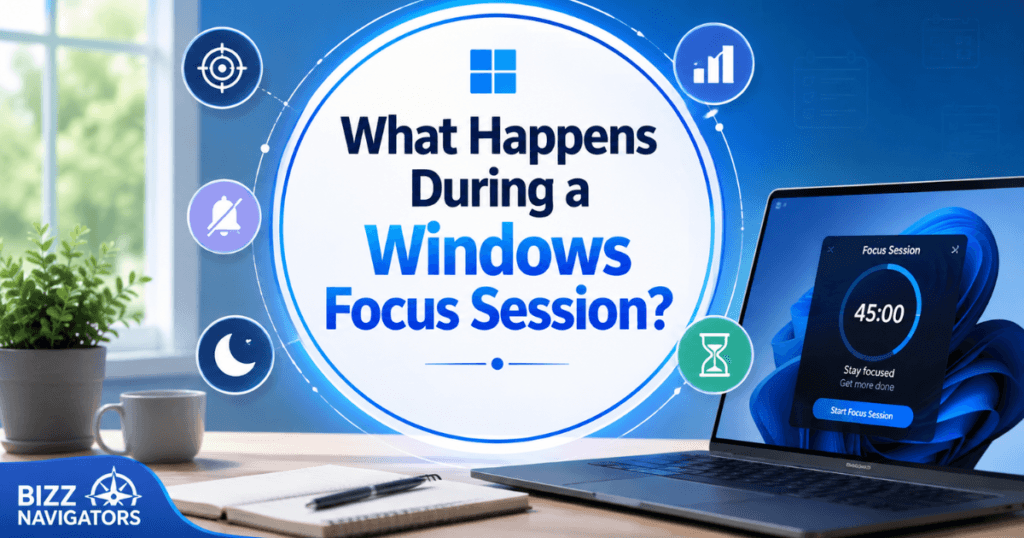
Windows Focus Sessions are more than a simple countdown timer. Several system behaviors can change while your session is active.
Do Not Disturb
When you start a focus session, Windows automatically turns on Do Not Disturb to reduce notification interruptions. Notifications received during the session can still be reviewed later through the notification center.
One important detail is easy to overlook: if Do Not Disturb was already active before you started the focus session, it can remain enabled after the session ends.
Fewer Taskbar Distractions
Focus can temporarily hide taskbar app badges and flashing indicators. That matters because even a small visual alert can pull your attention away from the task at hand.
You can control these behaviors from Settings > System > Focus.
Focus Timer
The focus timer gives your work block a clear beginning and end. Instead of checking the clock repeatedly, you can concentrate on the task until the session finishes.
This approach works particularly well for tasks that benefit from uninterrupted blocks, such as writing, programming, reading, studying, or editing.
Windows Focus Sessions vs. Focus Assist
Windows users sometimes confuse Focus Sessions with Focus Assist. They are related, but they are not the same thing.
| Feature | Windows Focus Sessions | Focus Assist |
| Main purpose | Structured focus period | Reduce unwanted notifications |
| Timer | Yes | No dedicated focus timer |
| Do Not Disturb | Can activate automatically | Notification-control feature |
| Clock app integration | Yes | No |
| Taskbar distraction controls | Yes | Limited to notification behavior |
| Best for | Planned work or study blocks | Quiet periods and notification control |
Microsoft’s current documentation describes Focus as the newer feature for maintaining concentration, while older Windows 10 documentation uses Focus Assist for controlling notification interruptions.
So, if you are looking for a timed productivity session, Focus Sessions are the more relevant option.
How to Use Focus Sessions Effectively
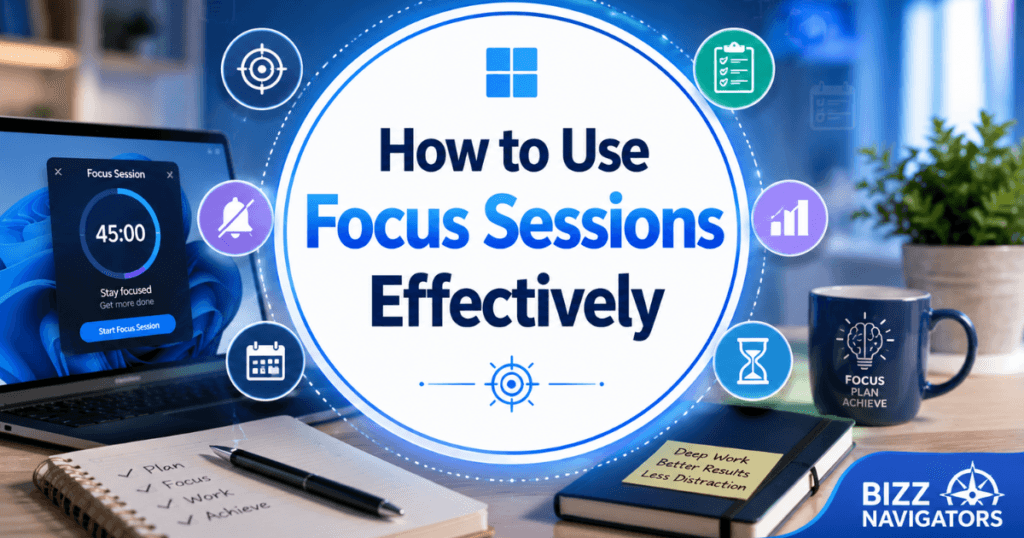
Simply turning on a timer will not automatically make you productive. The best results come from combining the feature with a clear work routine.
Choose One Specific Task
Before starting a session, decide exactly what you want to accomplish.
Instead of saying, “I will work on my website,” set a measurable target such as:
Finish one article section
Research five sources
Fix a specific software issue
Review one document
Complete one study chapter
A specific objective makes the timer more useful because you know what the session is supposed to accomplish.
Remove Distractions Before Starting
Close unnecessary browser tabs, minimize unrelated applications, and put your phone somewhere outside your immediate workspace.
Windows Focus can reduce system notifications, but it cannot stop every distraction you create yourself.
Use Breaks Strategically
Long sessions are not automatically better. If you are losing concentration, shorter work periods with deliberate breaks may produce better results.
The Clock app’s Focus Sessions allows you to include breaks, making it easier to build a repeatable work-and-rest routine.
Combine Focus With Microsoft To Do
If you already organize your work in Microsoft To Do, Windows can connect your tasks with Focus Sessions through the Clock app. You can select tasks to work on before beginning a session.
This creates a useful workflow: choose the task → start Focus → work until the timer ends → review the result.
Can You Disable Windows Focus Sessions?
Yes. You can stop an active focus session before its scheduled end. Windows also lets you control which Focus behaviors are enabled, including the timer, taskbar badges, taskbar flashing, and Do Not Disturb.
If your real problem is that notifications are being silenced, check Settings > System > Focus and review the Do Not Disturb setting.
This distinction matters because ending a focus session and changing Windows’ notification behavior are two different actions.
How to Use Focus Sessions in Windows 10
Windows 10 requires some extra context. Microsoft’s current Focus documentation covers both Windows 10 and Windows 11, but Windows 10 reached its end of support on October 14, 2025. Microsoft no longer provides free Windows Update software updates, technical assistance, or security fixes for Windows 10.
If you are still using Windows 10, some focus-related behavior may be presented through Focus Assist rather than the newer Windows 11 Focus experience.
Focus Assist can be configured through Settings > System > Focus Assist, where Windows provides options such as Off, Priority only, and Alarms only, along with automatic rules.
For a supported, current Windows experience, moving to Windows 11 is the better long-term option.
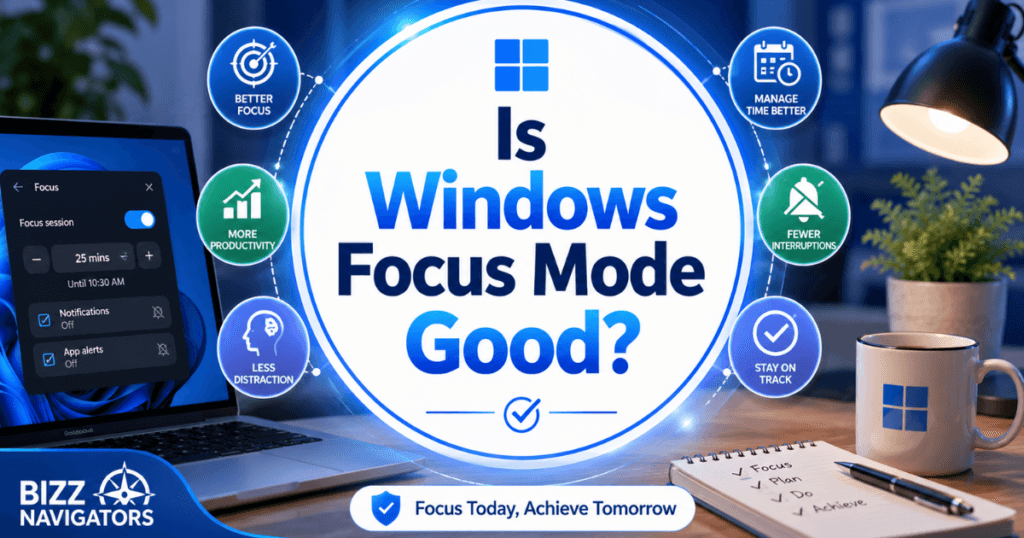
Is Windows Focus Mode Good?
Yes, Windows Focus Sessions can be very useful, especially if notifications and visual alerts regularly interrupt your work.
Its biggest advantage is convenience. The feature is already integrated into Windows, so you do not necessarily need another productivity application just to create distraction-free work periods.
However, Focus is not a magic productivity switch. If your distractions come mainly from social media, unnecessary browser tabs, phone usage, or poor task planning, Windows can only solve part of the problem.
The best approach is to use Focus as a structure for your work, not as a replacement for good habits.
Windows Focus Sessions: Key Takeaways
Windows Focus Sessions provide timed periods for concentrated work.
Focus can automatically activate Do Not Disturb.
Taskbar badges and flashing indicators can be hidden during sessions.
You can start Focus from Settings, the notification area, or the Clock app.
The Clock app supports focus timers and optional breaks.
Microsoft To Do can be integrated into the focus workflow.
Spotify can be connected through the Clock app for focus audio when supported.
Focus Sessions and Focus Assist are related but different Windows features.
Windows 10 reached end of support on October 14, 2025.
For consistent results, pair Focus with a specific task and a distraction-free workspace.
Frequently Asked Questions
What is a focus session in Windows?
A focus session is a timed Windows productivity period designed to help you concentrate by reducing distractions. It can activate Do Not Disturb, hide taskbar distractions, and display a focus timer while you work.
How do I disable the focus session in Windows 11?
To stop an active session, end the focus session from the Focus controls. If you want to change its behavior instead, go to Settings > System > Focus and adjust options such as Do Not Disturb, the timer, taskbar badges, and flashing.
How do I use focus sessions in Windows 10?
Windows 10 includes focus-related notification controls through Focus Assist, while Microsoft’s current Focus documentation also references Windows 10. However, Windows 10 has been unsupported since October 14, 2025, so upgrading to Windows 11 is recommended for a supported experience.
Is focus mode good?
Yes. Focus mode is useful when notifications, taskbar alerts, and other interruptions break your concentration. It works best when you combine it with a clearly defined task and planned breaks.
Do Focus Sessions block all notifications?
Not necessarily. Focus primarily uses Do Not Disturb and configurable notification controls to reduce interruptions. You can customize Windows notification behavior rather than assuming every alert will be permanently blocked.
Can I use Focus Sessions for studying?
Absolutely. A practical approach is to choose one study objective, start a focused work period, avoid unrelated applications, and take a planned break afterward. This turns Windows into a simple study timer without requiring another productivity tool.
Does Focus Sessions work without the Clock app?
The Windows Focus feature can be started from Settings and the notification area, while the Clock app provides the dedicated Focus sessions experience and additional tools. If the Clock app has been removed, Microsoft notes that it may need to be reinstalled to use Focus with Clock-based focus periods.
Final Verdict
Windows Focus Sessions are a practical built-in solution for anyone who wants more structured, distraction-free work time. The combination of a timer, Do Not Disturb, taskbar controls, optional breaks, and Clock app integrations makes the feature more capable than a basic countdown.
For Windows 11 users, Focus is particularly convenient because it is already part of the operating system. For Windows 10 users, Focus Assist provides related notification controls, but the platform is now past its official support date
The smartest way to use Focus Sessions is simple: choose one task, set a realistic time block, remove avoidable distractions, and start working. That small routine can make the feature genuinely useful rather than just another Windows setting.

At BizzNavigators, we answer the questions you’re actually searching for, honestly and clearly. We check our facts before we publish anything, and if we’re not sure about something, we tell you instead of guessing. Whatever you’re looking for- a tech fix, a business tip, or a simple how-to- we want to give you an answer you can trust.