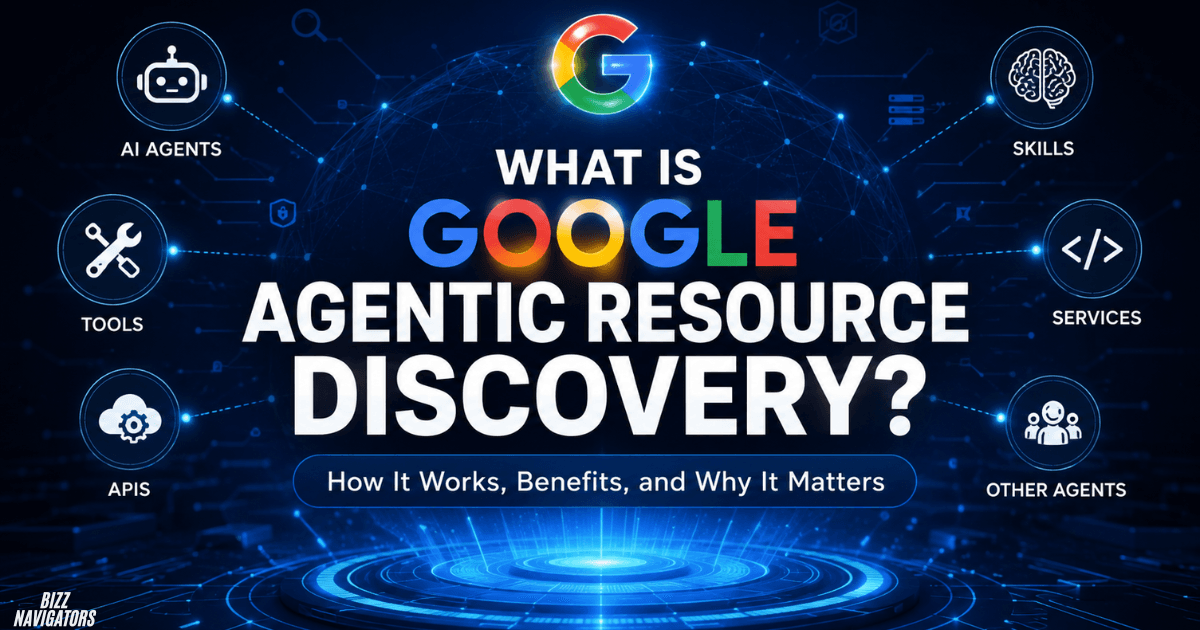
What Is Google Agentic Resource Discovery?
Google Agentic Resource Discovery (ARD) could change how AI agents find and connect to tools, APIs, skills, and other AI agents across the web. Introduced by Google on June 17, 2026, Google Agentic Resource Discovery is an open specification that helps agents discover suitable capabilities, verify their publishers, and connect to them securely.
Unlike manually configured tool lists, ARD creates a standardized discovery layer for the growing agentic web. Developed with major technology organizations, it could make AI agents more flexible, interoperable, and capable of finding the right resources when they need them.
Why Was Agentic Resource Discovery Created?
AI agents are becoming more capable, but their usefulness increasingly depends on the external resources they can access.
Imagine an AI agent investigating a technical problem. It might need a documentation search tool, an observability service, a deployment system, a ticketing platform, or another specialized AI agent.
The problem isn’t necessarily how to use these resources. Protocols such as MCP and A2A already address parts of that problem.
The missing piece is often how the AI finds the right resource in the first place.
Google describes three questions that an agent needs to answer:
1. Where does the required capability exist?
2. Which available capability is appropriate?
3. How can the agent verify that the capability is trustworthy?
ARD was designed to provide a common discovery mechanism for those questions.
How Does Agentic Resource Discovery Work?
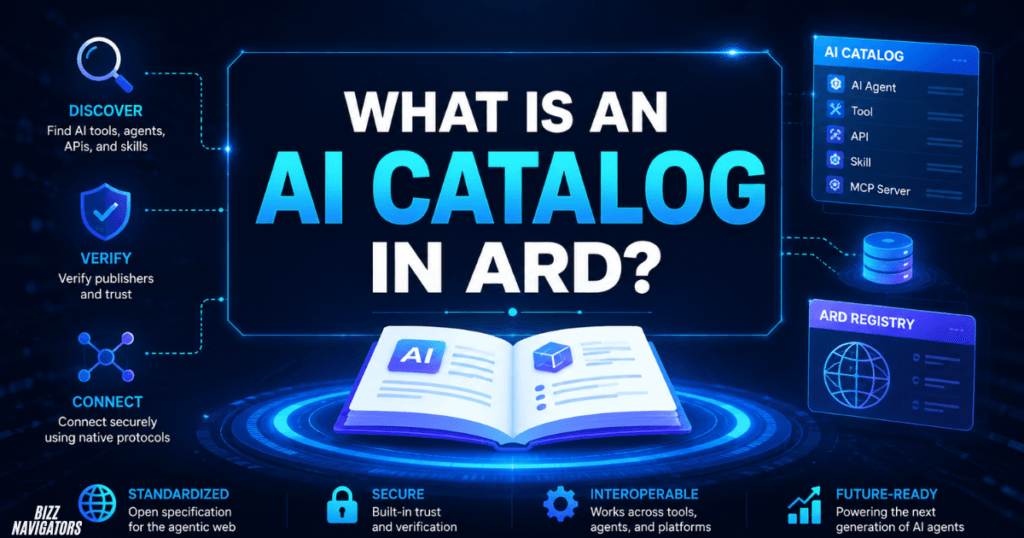
ARD uses two important concepts: catalogs and registries.
A provider publishes a catalog describing its available AI capabilities. The catalog can identify resources such as MCP servers, A2A agents, OpenAPI tools, skills, or other catalogs.
Registries then discover and index those catalogs so AI clients can search for relevant capabilities.
A simplified flow looks like this:
AI agent needs capability → searches ARD registry → finds matching resource → verifies publisher → connects directly to resource
This approach separates discovery from execution. ARD helps locate and verify the resource, while the resource continues to operate through its own protocol or API.
What Is an AI Catalog in ARD?
An AI catalog is a machine-readable description of the capabilities an organization makes available to AI clients.
According to Google’s announcement, a provider can publish an ai-catalog.json file at a well-known location on its own domain. This catalog can describe the organization’s available agentic resources.
Keeping the catalog on the provider’s own domain is important because the domain establishes a foundation for identifying the publisher.
The catalog can then be discovered through an ARD registry or fetched directly when an agent already knows the provider’s domain.
This is different from creating one giant central directory containing every AI tool on the internet.
What Are ARD Registries?
ARD registries work somewhat like search engines for the agentic web.
They crawl published catalogs, index the capabilities they contain, and make those resources searchable. When an AI client asks for a particular capability, the registry can return matching resources together with information needed to verify the publisher.
The important distinction is that ARD is not intended to be one central global registry.
Multiple discovery services can exist, including private enterprise registries and public services. Each can apply its own policies for ranking, trust, coverage, and access. (agenticresourcediscovery.org)
That decentralized approach could become important as the number of AI agents and machine-accessible services grows.
How Does ARD Verify AI Resources?
Discovery alone isn’t enough. An AI agent also needs confidence that the resource it found actually belongs to the claimed provider.
ARD therefore includes a trust layer that can provide verifiable metadata about the publisher. In production environments, this allows clients or registries to verify the publisher’s cryptographic identity before establishing a connection.
This matters because blindly allowing an AI agent to connect to unknown external tools could introduce security, privacy, or operational risks.
ARD doesn’t simply answer:
“I found a tool.”
It aims to provide additional information for answering:
“Who published this tool, and can I verify that identity before connecting?”
Is Google Agentic Resource Discovery a Google-Only Framework?
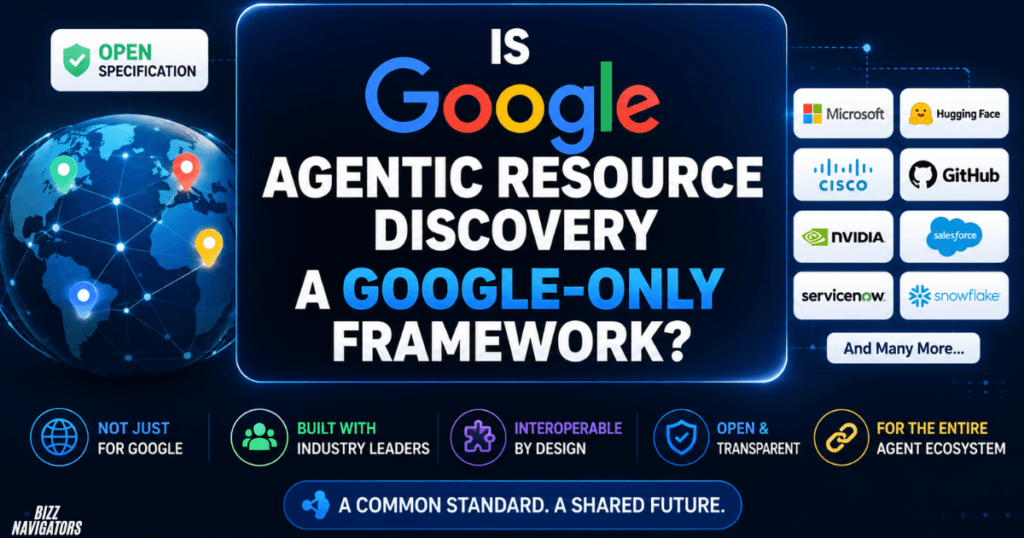
No. Agentic Resource Discovery is not a Google-exclusive agent framework. It is an open specification developed with multiple organizations and intended to provide a common discovery layer across different agent ecosystems. (Google Developers Blog)
This distinction is important because the phrase “Google Agentic Resource Discovery” can make ARD sound like another Google-only AI product.
It isn’t.
Google is one of the major contributors, but the specification is designed for interoperability. The ARD project includes participants from across the broader AI and technology ecosystem. (blog.tobira.ai)
Is Agentic Resource Discovery the Same as MCP or A2A?
No. ARD, MCP, and A2A solve different parts of the agentic AI workflow.
| Technology | Main purpose |
| ARD | Discover and verify AI resources |
| MCP | Connect AI applications with tools and data |
| A2A | Enable communication between AI agents |
| API | Provide programmatic access to software capabilities |
ARD sits earlier in the process.
For example, an agent might use ARD to discover an MCP server. Once discovered and verified, the agent can use MCP to interact with that server.
Similarly, ARD could help an agent discover another agent that communicates through A2A.
The official ARD documentation explicitly describes the specification as a discovery layer rather than an execution runtime or replacement for MCP, A2A, Skills, or APIs.
What Is Google’s Agentic AI Strategy Behind ARD?
Google’s ARD initiative reflects a broader shift toward an agentic web, where AI systems can discover and use capabilities distributed across different organizations.
Traditional web search was primarily designed to help humans find information.
Agentic Resource Discovery approaches a related problem from an AI-agent perspective: helping software agents find capabilities they can actually use.
Google has also connected ARD with its enterprise agent infrastructure. Its Gemini Enterprise Agent Platform includes Agent Registry capabilities for discovering, managing, and governing agents, skills, MCP servers, and other tools. Google says native ARD support in Agent Platform is planned as the broader ecosystem develops.
This makes ARD particularly relevant to businesses operating multiple AI agents and internal tools.
What Could ARD Change for AI Agents?
The biggest potential change is moving agents away from fixed connections toward more dynamic discovery.
Today, developers often decide beforehand which tools an AI agent can access. They configure those integrations, maintain them, and update them when services change.
With a discovery layer, an agent could potentially search for an appropriate capability at runtime.
For example:
“Find a verified service that can analyze this type of database.”
Instead of relying entirely on a developer-maintained list, an ARD-enabled client could search available resources, compare suitable capabilities, verify the provider, and then establish a direct connection.
That could make future AI agents more flexible and scalable.
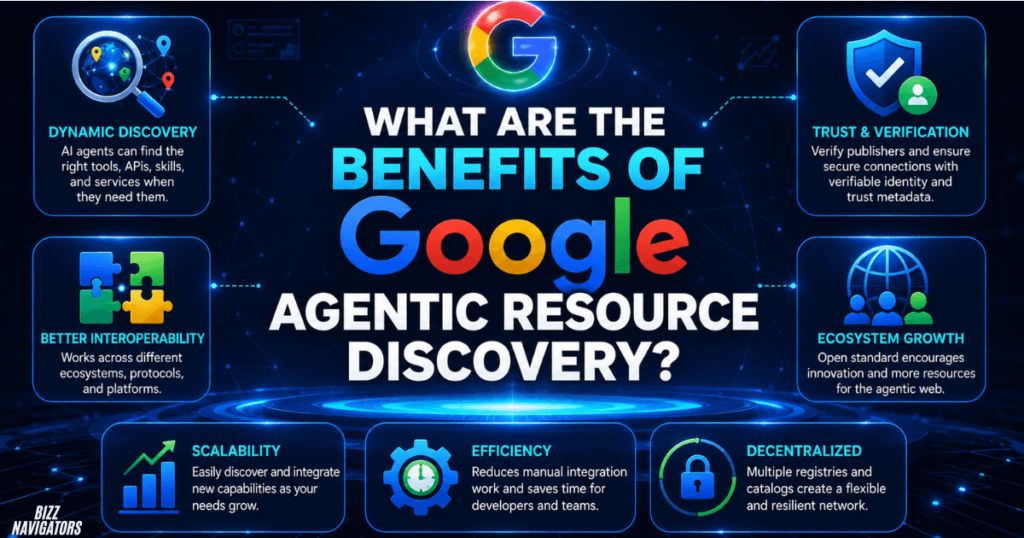
What Are the Benefits of Google Agentic Resource Discovery?
ARD could provide several important benefits as agentic ecosystems mature:
Dynamic discovery: Agents can locate capabilities instead of relying only on preconfigured connections.
Interoperability: Different providers can publish resources through a common discovery mechanism.
Publisher verification: Trust metadata can help clients verify resource ownership.
Decentralization: Organizations can maintain their own catalogs and registries.
Runtime flexibility: Agents can potentially discover capabilities when a task requires them.
Easier ecosystem growth: Developers can publish new tools without requiring every AI client to maintain a separate hard-coded directory.
These benefits address one of the biggest scaling challenges for agentic AI: the number of available capabilities can grow much faster than developers can manually integrate them.
What Does Agentic Resource Discovery Mean for the Future of AI?
Agentic Resource Discovery could become an important infrastructure layer if AI agents increasingly operate across organizational and technical boundaries.
The web already provides humans with mechanisms for discovering websites, applications, services, and information. ARD proposes a more structured way for AI clients to discover machine-usable capabilities.
However, ARD is still an emerging specification. Its long-term importance will depend on adoption, registry quality, security practices, interoperability, and how widely AI platforms implement it.
So it would be premature to describe ARD as the final standard for the agentic web.
What is clear is that it targets a real problem: AI agents need a reliable way to discover and verify capabilities before they can use them.
Final Takeaway
Google Agentic Resource Discovery is an open specification for discovering and verifying AI agents, tools, skills, MCP servers, APIs, and other capabilities across the web. It does not replace MCP or A2A; instead, it provides a discovery layer that can help AI clients find the right resource and verify its publisher before connecting.
The bigger idea is the transition from today’s manually connected AI tools toward a more discoverable, interoperable, and decentralized agentic web.
If that ecosystem grows as expected, ARD could become an important part of the infrastructure that enables AI agents to find not just information but the right capabilities to act on it.
Frequently Asked Questions
What is Agentic Resource Discovery?
Agentic Resource Discovery is an open specification that allows AI clients to discover and verify tools, agents, skills, MCP servers, and other machine-usable capabilities across the web.
What is Google’s agentic tool?
Google’s Agentic Resource Discovery is not a single AI tool. It is an open specification that establishes a discovery layer to find and verify agentic resources.
Is Agentic Resource Discovery a framework?
Not exactly. ARD is an open specification, not an AI agent framework or execution runtime. It focuses specifically on discovering and verifying resources.
Is ARD the same as MCP?
No. MCP focuses on how AI applications connect to tools and data, while ARD focuses on discovering and verifying those resources before they are used.
Does Google have agentic AI?
Yes. Google is actively developing agentic AI technologies and infrastructure, including its Gemini ecosystem and Agent Development Kit offerings. ARD is one part of the broader infrastructure being developed for AI agents.
Why is Agentic Resource Discovery important?
ARD addresses a growing problem: AI agents may have access to thousands or millions of potential tools and services, making manual discovery and integration increasingly difficult. A standardized discovery layer could make those resources easier to locate, verify, and connect.

At BizzNavigators, we answer the questions you’re actually searching for, honestly and clearly. We check our facts before we publish anything, and if we’re not sure about something, we tell you instead of guessing. Whatever you’re looking for- a tech fix, a business tip, or a simple how-to- we want to give you an answer you can trust.