
Why Businesses Need a Strategy Before Buying AI
Artificial intelligence has moved beyond experimentation. Companies of every size are investing in automation, AI assistants, analytics systems, and intelligent workflows to improve productivity and reduce operational costs. The challenge is no longer finding AI tools. The challenge is selecting the right ones.
Thousands of AI platforms claim to increase efficiency, automate work, and improve customer experiences. Many businesses spend money on tools that fail to integrate with existing processes or deliver measurable results. This is where Droven.io AI for Business enters the conversation.
What Is Droven.io?
Droven.io is a business-focused AI intelligence platform designed to help organizations understand, evaluate, and select AI technologies that meet their needs.
Instead of creating language models or selling proprietary AI software, the platform focuses on helping companies identify technologies that fit their objectives, budgets, and technical capabilities.
In simple terms, businesses use Droven.io to reduce uncertainty before making AI investments. This approach helps decision-makers avoid expensive mistakes while accelerating digital transformation initiatives.
How Droven.io Differs from Traditional AI Platforms
Many AI vendors promote their own products regardless of whether they fit a business problem.
Droven.io takes a different approach by focusing on recommendations and evaluation rather than on software sales.
| Feature | Traditional AI Vendors | Droven.io |
| Builds proprietary AI models | Yes | No |
| Provides vendor-neutral guidance | Limited | Yes |
| Focuses on business use cases | Sometimes | Yes |
| Helps compare multiple solutions | Rarely | Yes |
| Supports AI decision-making | Partial | Core function |
This distinction is one reason businesses increasingly search for information about what is Droven.io and how it supports AI adoption strategies.
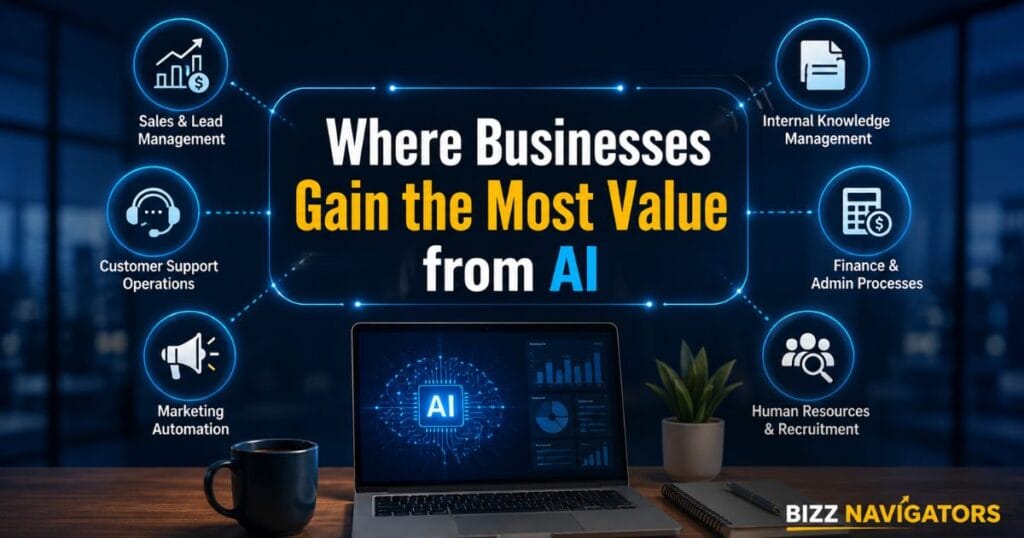
Where Businesses Gain the Most Value from AI
Not every business process requires artificial intelligence.
The highest returns usually come from repetitive, high-volume activities that consume employee time.
Sales and Lead Management
AI can automatically qualify leads, prioritize opportunities, score prospects, and schedule meetings.
Sales teams spend less time on administration and more time closing deals.
Customer Support Operations
Modern AI assistants answer routine customer questions twenty-four hours a day.
This reduces ticket volume while improving response times.
Marketing and Campaign Optimization
AI systems analyze campaign performance, generate content ideas, personalize messaging, and optimize advertising budgets.
Marketing teams gain insights much faster than manual reporting methods allow.
Finance and Back-Office Processes
Invoice processing, expense validation, compliance checks, and reporting tasks can often be automated with minimal risk.
Internal Knowledge Management
Businesses lose significant time searching for documents and information.
Retrieval-based AI systems allow employees to ask questions and receive answers from internal company knowledge bases within seconds.
A Practical Framework for Choosing Business AI Solutions
One of the biggest reasons AI projects fail is poor planning.
Before investing in any platform, organizations should answer several important questions.
Which Process Costs the Business the Most Time?
Automation delivers the highest value when applied to repetitive tasks that employees perform every day.
Manual data entry and repetitive reporting are common examples.
Is Company Data Organized?
Artificial intelligence performs best when businesses maintain clean and structured information.
Poor-quality data often leads to disappointing outcomes.
Does the Organization Have Technical Resources?
Some solutions require developers and integration specialists.
Others are designed for non-technical teams using drag-and-drop interfaces.
Understanding internal capabilities prevents implementation delays.
How Will Success Be Measured?
Businesses should define measurable objectives before deployment.
Examples include reduced costs, faster processing times, improved customer satisfaction, or increased revenue.
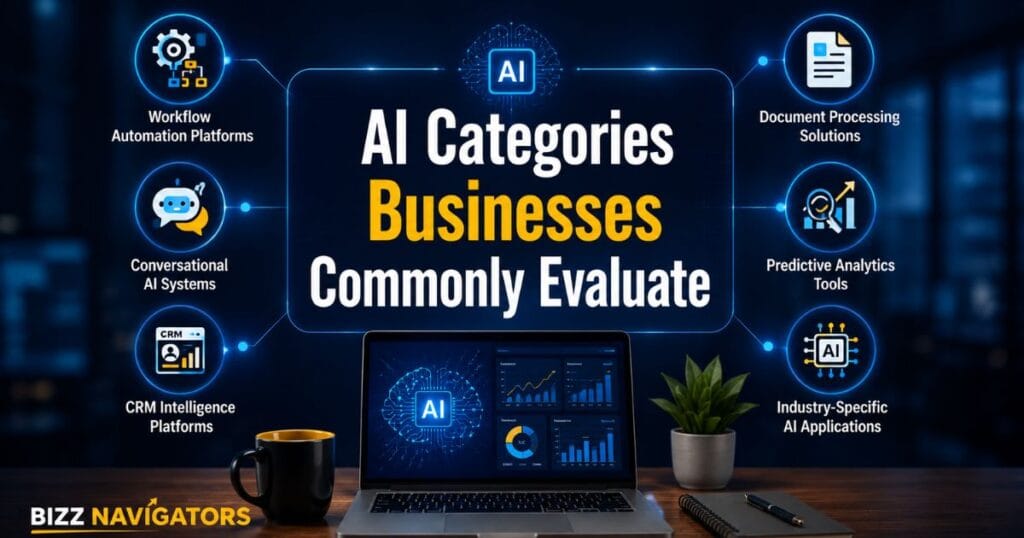
AI Categories Businesses Commonly Evaluate
Different business problems require different technologies.
Workflow Automation Platforms
These tools connect applications and automate repetitive actions across departments.
They are often the starting point for AI transformation projects.
Conversational AI Systems
These solutions power chatbots, virtual assistants, and customer service applications.
They are especially valuable for organizations with large support teams.
CRM Intelligence Platforms
AI-powered CRM systems improve forecasting, customer segmentation, and lead prioritization.
Document Processing Solutions
Businesses that manage contracts, invoices, or legal documents benefit significantly from intelligent extraction technologies.
Predictive Analytics Tools
These platforms identify trends, forecast demand, and improve strategic planning decisions.
Common AI Mistakes Businesses Continue to Make
The excitement surrounding AI often leads organizations into avoidable mistakes.
Purchasing Too Many Tools Simultaneously
Companies frequently adopt multiple platforms before understanding how they work together.
This creates unnecessary complexity.
Ignoring Employee Adoption
Technology alone does not create transformation.
Employees need training, support, and clear expectations.
Expecting Immediate Financial Returns
AI projects often require testing and optimization before producing significant value. Patience is an important part of implementation.
Overlooking Integration Requirements
Disconnected systems create operational bottlenecks. Integration planning should begin before purchase decisions are made.
Risks That Business Leaders Should Understand
Artificial intelligence creates opportunities, but it also introduces responsibilities.
Data Privacy Concerns
Organizations handling customer information must ensure compliance with local regulations and privacy requirements.
Vendor Dependency
Relying heavily on a single provider can increase long-term costs and reduce flexibility.
Inaccurate AI Outputs
Generative AI systems occasionally produce incorrect information. Human review remains essential for important decisions.
Security Vulnerabilities
API connections and automated workflows can create new attack surfaces if they are not properly secured.
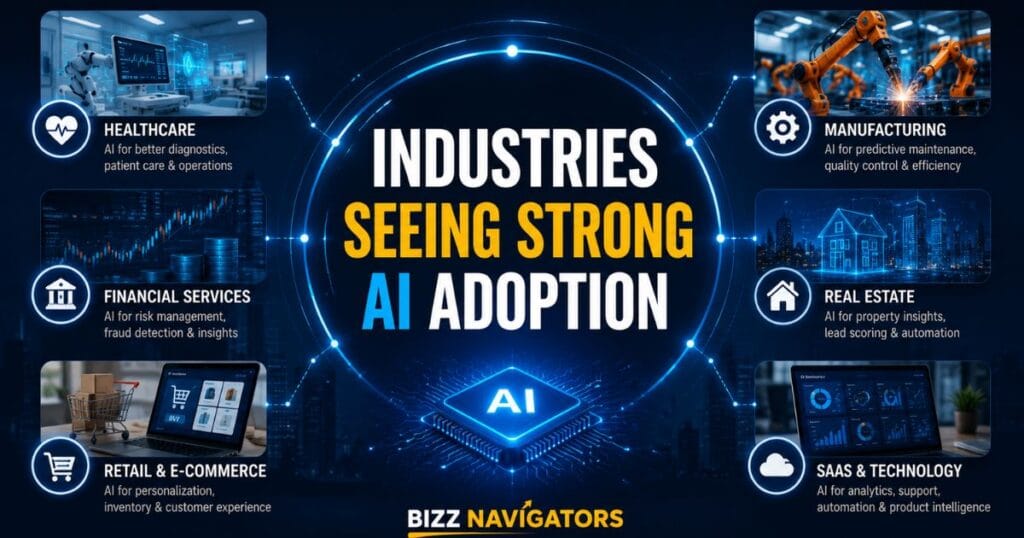
Industries Seeing Strong AI Adoption
Artificial intelligence is no longer limited to technology companies.
Healthcare
Hospitals and clinics use AI for scheduling, patient communication, and administrative support.
Financial Services
Banks automate document processing, fraud detection, and risk assessments.
Real Estate
Agencies use AI to qualify leads and manage customer interactions.
Manufacturing
Predictive maintenance systems reduce downtime and improve operational efficiency.
E-commerce
Online stores use AI for product recommendations, customer support, and inventory forecasting.
Measuring AI Return on Investment
Many organizations focus on implementation costs while ignoring performance indicators. Successful companies monitor outcomes continuously.
Important metrics include:
Hours saved through automation.
Reduced operational expenses.
Faster customer response times.
Increased employee productivity.
Higher customer retention rates.
Revenue growth generated by improved efficiency.
Clear measurement frameworks help businesses identify which technologies deserve further investment.
How to Calculate Whether an AI Project Is Worth the Investment
Many businesses approve AI budgets without defining expected outcomes.
A simple evaluation framework includes:
| Metric | Example Target |
| Time saved | 20 hours per employee per month |
| Cost reduction | 15% decrease in operational expenses |
| Customer response time | 50% improvement |
| Employee productivity | 25% increase in output |
| Revenue growth | 10% increase in automation efficiency |
Projects with measurable targets are easier to justify and optimize.
Why AI Governance Has Become Essential
One topic often ignored in AI discussions is governance.
Businesses need policies covering data usage, access permissions, compliance requirements, and accountability.
Without governance structures, organizations risk inconsistent decisions and operational challenges.
As AI adoption increases, governance will become just as important as automation itself.
Expert Recommendation for First-Time AI Buyers
Businesses new to artificial intelligence should avoid enterprise-scale deployments during the initial phase.
A smaller pilot project allows teams to:
Validate assumptions.
Measure performance.
Identify workflow bottlenecks.
Train employees gradually.
Build confidence before expanding.
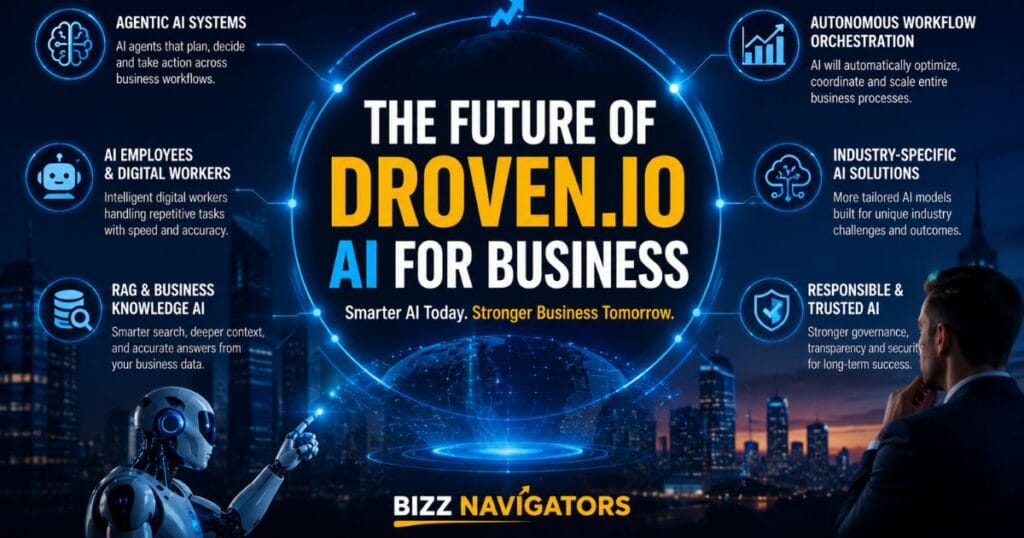
The Future of Droven.io AI for Business
The next generation of business AI will move beyond simple automation.
Organizations are preparing for AI agents capable of managing workflows, conducting research, and assisting employees in real time.
Knowledge retrieval systems will become standard infrastructure across enterprises.
Industry-specific AI models will continue replacing generic solutions.
Platforms such as Droven.io are positioned to help businesses navigate this rapidly changing environment without making costly decisions based solely on marketing claims.
Key Takeaways for Business Leaders
Before investing in artificial intelligence, decision-makers should focus on solving business problems rather than chasing technology trends. Start with one high-impact process instead of automating everything at once.
Select tools that integrate with existing systems. Measure results using clear business metrics. Prioritize employee adoption alongside technology implementation. Establish governance rules before scaling AI initiatives.
Conclusion
The future of business growth will depend heavily on intelligent technology decisions rather than simply purchasing more software. Understanding what is Droven.io and how Droven.io AI for Business supports technology evaluation allows organizations to approach AI adoption with greater confidence.
Businesses that prioritize strategy, governance, and measurable outcomes will outperform those that chase trends without a clear roadmap.
Frequently Asked Questions
Is Droven.io an AI software provider?
No. Droven.io primarily focuses on AI evaluation, guidance, and technology selection rather than on developing proprietary AI models.
Can small businesses benefit from Droven.io AI recommendations?
Yes. Smaller organizations often benefit the most because they have fewer resources available for failed technology investments.
Does Droven.io replace AI consultants?
It can support decision-making, but complex projects may still require implementation specialists or consultants.
Which businesses should explore AI first?
Companies with repetitive processes, large amounts of data, and manual workflows usually see the fastest returns.

At BizzNavigators, we answer the questions you’re actually searching for, honestly and clearly. We check our facts before we publish anything, and if we’re not sure about something, we tell you instead of guessing. Whatever you’re looking for- a tech fix, a business tip, or a simple how-to- we want to give you an answer you can trust.