
What is the water-resistant twill fabric pioneered by Burberry?
The water-resistant twill fabric pioneered by Burberry is gabardine, a tightly woven fabric developed by Thomas Burberry in 1879 and patented in 1888. It was designed to protect from rain while remaining lighter and more breathable than many traditional weatherproof fabrics of the period.
Gabardine became the foundation of Burberry’s reputation for practical outerwear and later became inseparable from the brand’s iconic trench coat.
Why did Burberry develop gabardine?
Thomas Burberry built his business around practical clothing designed for Britain’s unpredictable weather. His goal was not simply to create another textile, but to improve how outdoor clothing performed in wet conditions.
Traditional waterproof clothing could be heavy, uncomfortable, and poorly ventilated. Gabardine offered a different solution through its closely woven twill construction, creating a fabric that could resist water while remaining relatively comfortable to wear.
Burberry patented the material in 1888, turning gabardine into one of the company’s defining textile innovations.
Is Burberry twill fabric water-resistant?
Yes. Burberry’s traditional cotton gabardine is water- or shower-resistant, but it should not be confused with completely waterproof fabric. Its dense twill construction helps water run off the surface while retaining useful breathability.
This distinction is important because the level of protection depends on the specific fabric, garment construction, and finish.
Modern Burberry Heritage gabardine is described by the company as shower-resistant and breathable, rather than completely waterproof.
How does gabardine resist water?
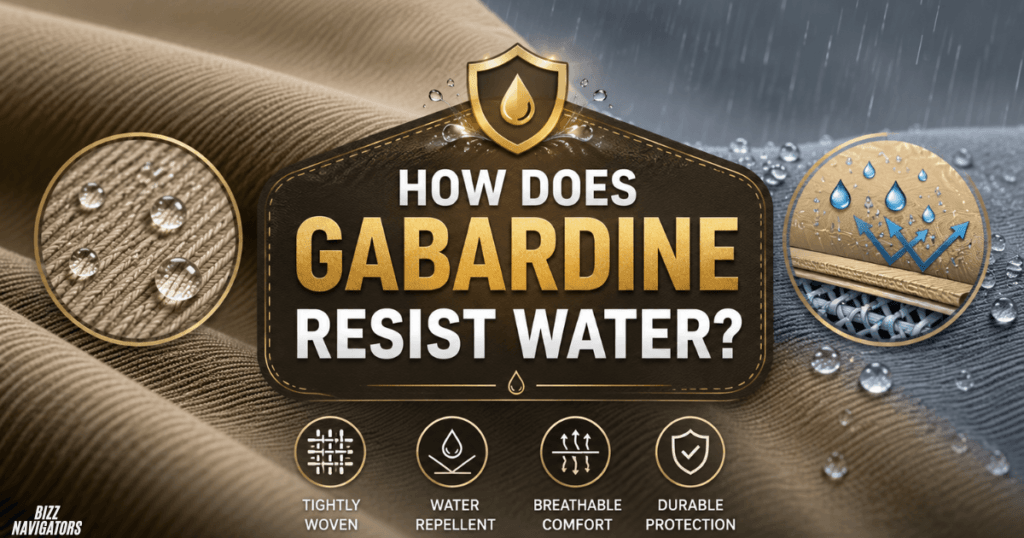
Gabardine’s performance comes primarily from its tight twill weave. The closely packed yarns create a dense surface that makes it more difficult for water to penetrate quickly.
The fabric therefore sits between ordinary lightweight clothing and fully waterproof technical rainwear.
| Feature | Burberry gabardine |
| Textile construction | Twill weave |
| Developed | 1879 |
| Patented | 1888 |
| Main characteristic | Dense, weather-resistant construction |
| Breathability | Yes |
| Water protection | Water/shower-resistant |
| Fully waterproof | No |
| Signature use | Burberry outerwear |
What fabric does Burberry use?
Burberry uses several different materials, but gabardine remains its signature fabric for Heritage outerwear. Depending on the product, Burberry also uses cotton, wool, cashmere, silk, leather and other fibres and textiles.
For its Heritage Trench Coats, Burberry currently uses 100% organically grown cotton gabardine for selected models. The company says this gabardine is woven at its historic mill in Keighley, Yorkshire.
This is why the phrase “Burberry fabric” does not refer to one universal material. The fabric depends on the product, collection and intended use.
What is Burberry tropical gabardine?
Tropical gabardine is a lighter version of Burberry’s signature gabardine intended for warmer conditions. Burberry describes it as the lightest of its signature gabardine fabrics and uses it in lightweight outerwear and other warm-weather garments.
Current tropical gabardine pieces can use 100% cotton and may carry a shower-resistant finish, making them more suitable for warmer climates than heavier traditional outerwear.
The key difference is therefore weight and intended climate, not a completely different textile identity.
What is another name for twill fabric?
Twill is not the name of one particular fabric; it describes a method of weaving yarns that produces a characteristic diagonal pattern.
Gabardine is a type of twill fabric, but the terms are not interchangeable. Other familiar textiles, including denim and many chino fabrics, can also use twill construction.
This distinction helps explain the focus keyword: gabardine is the Burberry-associated fabric, while twill describes its weave structure.
How is gabardine different from ordinary twill?
The difference is mainly in fabric construction, density, weight, and intended performance.
“Twill” is a broad category of woven construction. Gabardine is a more specific fabric traditionally recognised for its tightly woven structure and smooth, durable surface.
So, saying “Burberry twill” identifies the weave family, while Burberry gabardine identifies the historically significant fabric associated with the brand’s weather-resistant outerwear.
How did gabardine become associated with the Burberry trench coat?
Gabardine became particularly important when Burberry’s practical outerwear evolved into the trench coat.
During the First World War, Burberry adapted its outerwear designs for military requirements. Features such as epaulettes, D-rings, a storm shield and gun flap were developed around practical functions rather than decoration.
Gabardine provided the weather-resistant outer shell, while the coat’s construction helped it work as functional outdoor clothing.
That military heritage later helped transform the trench coat from specialist outerwear into one of the world’s most recognisable fashion garments.
What is a Burberry?
Burberry is a British luxury fashion house founded by Thomas Burberry in 1856. The company became particularly famous for outerwear, including trench coats made using its signature gabardine.
Its identity developed from a practical purpose: creating clothing that could protect people from difficult weather conditions.
Today, Burberry operates as a global luxury brand, but its original connection with British outerwear, weather protection and gabardine remains central to its heritage.
Why is Burberry so expensive?
Burberry’s prices reflect its luxury positioning, product design, materials, craftsmanship, manufacturing, distribution and brand heritage. The cost of a Burberry garment therefore cannot be explained by its fabric alone.
Its Heritage outerwear also involves specialist manufacturing. Burberry says its Heritage Trench and Car Coats are made at its Castleford site in Yorkshire, while the cotton gabardine is woven at its Keighley mill.
The brand’s history and recognition also contribute to the value consumers associate with its products.
Which country is Burberry made in?
Burberry products are manufactured in multiple countries, so not every Burberry item is made in Britain. The company has manufacturing operations and suppliers across different locations, including the United Kingdom and Italy.
However, Burberry’s Heritage Trench and Car Coats have a particularly strong British manufacturing connection. Selected Heritage models are made in Castleford, Yorkshire, using gabardine woven at the company’s Keighley mill.
Therefore, the statement “Burberry is made in England” should be applied to relevant products rather than the entire Burberry product range.
How to tell fake Burberry?
The best way to identify a potentially fake Burberry product is to examine several authenticity indicators together, rather than relying on a single logo or label. Stitching, labels, hardware, pattern alignment, materials, product details, and seller reputation should all be considered.
Common signs worth checking
Look for inconsistent or poorly finished stitching.
Compare fonts and label details with official product information.
Examine hardware for poor finishing or inconsistent markings.
Check whether the signature pattern aligns correctly across relevant seams.
Compare the product’s materials and specifications with official listings.
Be cautious when an unknown seller offers a new luxury item at an unusually low price.
No individual detail automatically proves that an item is genuine or counterfeit. For high-value purchases, buying directly from Burberry or an authorised retailer provides stronger protection.
What is Burberry most famous for?
Burberry is best known for its trench coat, gabardine outerwear and distinctive Burberry Check. Its long association with practical British clothing helped turn the trench coat into an international fashion symbol.
The brand is also recognised for its Equestrian Knight Design, scarves, leather goods, footwear and wider luxury fashion collections.
However, gabardine remains particularly important because it connects Burberry’s modern fashion identity with the company’s original textile innovation.
Why is it called Burberry?
The brand is named after its founder, Thomas Burberry, who established the business in Basingstoke in 1856.
The company later became associated with gabardine after Burberry developed the fabric in the late nineteenth century.
The word gabardine, meanwhile, has a separate linguistic history and was used for certain types of garments before becoming associated with the tightly woven fabric we know today.
Who is the CEO of Burberry?
Joshua Schulman is Burberry’s current Chief Executive Officer. He became CEO and Executive Director in July 2024.
His appointment followed Jonathan Akeroyd’s tenure and placed Schulman in charge of the company’s efforts to strengthen its luxury positioning, improve performance, and reconnect the brand with its heritage.
Because executive leadership can change, the company’s current corporate information is the best source for verifying this detail.
What is the new Burberry logo?
Burberry’s current visual identity includes the Equestrian Knight Design (EKD) and its modern wordmark. The knight has historical roots in the Burberry brand and represents an important part of its visual heritage.
Burberry has changed its branding several times. In 2018, the company introduced a new logo and revived the Thomas Burberry Monogram, showing that its visual identity can evolve while retaining historical references.
This is also why the appearance of an older Burberry logo does not automatically mean that a product is fake; authentication requires consideration of the product’s age and design period.
What celebrities wear Burberry?
Burberry has been worn and promoted by numerous celebrities, actors, musicians, athletes, and fashion personalities over the years.
Celebrity visibility has helped reinforce Burberry’s position in popular culture, but it is not the foundation of the brand’s heritage.
The stronger historical connection remains Thomas Burberry, gabardine, British outerwear, and the trench coat.
How much is Burberry worth?
Burberry’s market value changes continuously because its market capitalisation depends on its share price. It is therefore more accurate to distinguish market value from revenue, profit and brand value.
For FY2025/26, Burberry reported £2.42 billion in total revenue and £160 million in adjusted operating profit.
These figures describe the company’s financial performance, not its exact market value. Market capitalisation changes as investors buy and sell the company’s shares.
Is Burberry a cheap brand?
No. Burberry is positioned as a luxury fashion brand, not a budget clothing label. Its pricing reflects the combination of design, materials, craftsmanship, manufacturing, brand heritage and luxury positioning.
Gabardine itself is only one part of the equation. A Burberry trench coat carries the value of its construction, design history and association with one of Britain’s best-known luxury fashion houses.
Why is Burberry gabardine still important?
The water-resistant twill fabric pioneered by Burberry is gabardine, and its significance comes from the practical problem it solved.
Thomas Burberry developed gabardine in 1879 and patented it in 1888, creating a tightly woven fabric capable of resisting wet weather without relying entirely on heavy waterproofing.
More than a century later, gabardine remains part of Burberry’s Heritage outerwear story. That continuity makes it more than a historical textile: it is a direct link between Burberry’s original weatherwear innovation and its modern luxury identity.
Key takeaway
If you encounter the phrase “water-resistant twill fabric pioneered by Burberry,” the answer is gabardine.
The essential relationship is simple:
Thomas Burberry → Gabardine → Weather-resistant outerwear → Trench coat → Burberry’s modern heritage
That connection is what makes gabardine one of the most important fabrics in the history of British fashion.

At BizzNavigators, we answer the questions you’re actually searching for, honestly and clearly. We check our facts before we publish anything, and if we’re not sure about something, we tell you instead of guessing. Whatever you’re looking for- a tech fix, a business tip, or a simple how-to- we want to give you an answer you can trust.