
How Does GPT-5.6 Improve AI Coding?
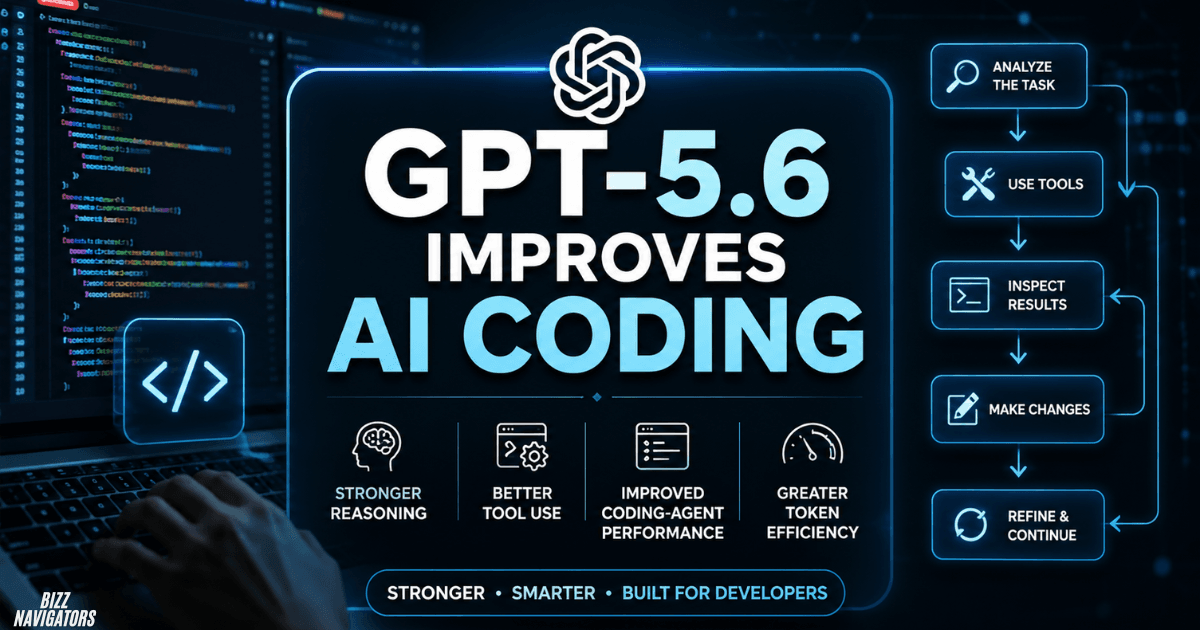
GPT-5.6 improves AI coding through stronger reasoning, better tool use, improved coding-agent performance, and greater token efficiency. It can handle complex software tasks across implementation, debugging, terminal workflows, codebases, and frontend development. OpenAI describes GPT-5.6 Sol as its strongest coding model, with improvements designed for longer and more demanding engineering workflows.
Instead of only generating code from a prompt, GPT-5.6 can work through a coding problem in multiple steps.
It can analyze the task, use tools, inspect results, make changes, and continue refining the solution.
Key GPT-5.6 Coding Improvements
| Improvement | What it means for developers |
| Stronger reasoning | Better handling of difficult coding problems |
| Better coding agents | More capable multi-step software workflows |
| Tool use | Can work with tools and intermediate results |
| Token efficiency | Reaches solutions with fewer unnecessary tokens |
| Terminal performance | Better command-line and repository tasks |
| Frontend design | Better visual and interface refinement |
| Model choices | Sol, Terra, and Luna for different workloads |
Why Is GPT-5.6 Better at Complex Coding Tasks?
GPT-5.6 is better at complex coding because it can combine reasoning with tool-based actions across longer workflows. OpenAI reports improved results on coding-agent, terminal, and long-horizon software engineering benchmarks. This makes it more suitable for debugging, repository changes, testing, and other tasks that require several connected decisions.
A simple coding request might only require one generated function.
A real development task can require:
1. Understanding the existing code.
2. Finding the cause of an error.
3. Editing several files.
4. Running commands or tests.
5. Reviewing the results.
6. Fixing new issues.
GPT-5.6 is designed to handle this type of workflow more effectively.
How Does GPT-5.6 Improve Coding Agents?
GPT-5.6 improves coding agents by allowing them to coordinate tools, process intermediate results, monitor progress, and decide what to do next. OpenAI specifically highlights its ability to write and run lightweight programs that coordinate tools during ongoing work, making it more useful for autonomous software-engineering workflows.
This changes the role of AI from a basic code generator into a more capable development assistant.
For example, an agent can inspect a repository, identify a relevant file, modify the implementation, run a test, examine the output, and continue working.
That is particularly useful for large projects where one prompt cannot describe every required step.
Is GPT-5.6 More Efficient for Coding?
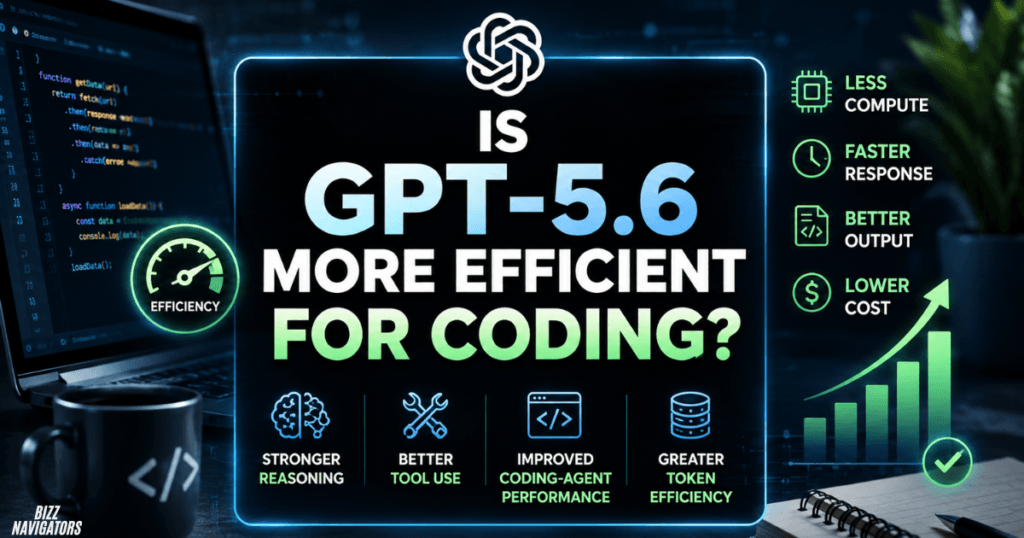
Yes. GPT-5.6 is designed to deliver stronger coding performance while using fewer output tokens and less time on many tasks. OpenAI reports that GPT-5.6 Sol achieved an 80 score on the Artificial Analysis Coding Agent Index while using less than half the output tokens and taking less than half the time of the cited comparison model.
Efficiency matters because coding agents can make many model calls during one task.
Fewer unnecessary tokens can mean:
Faster responses
Lower operating costs
More efficient agent workflows
Better scalability
Less wasted output
The goal is not simply to produce more reasoning. It is to produce better results with more efficient reasoning.
How Does GPT-5.6 Improve Debugging?
GPT-5.6 improves debugging by handling multi-step investigation more effectively. Instead of only explaining an error message, it can reason about the surrounding code, inspect relevant information, use tools, test possible fixes, and refine the implementation based on the results.
This makes it useful for problems such as:
Runtime errors
Failed tests
Build problems
Dependency conflicts
Logic bugs
Regression issues
Repository-level debugging
For complicated bugs, developers can provide the error, expected behavior, relevant files, and testing requirements so the model has enough context to investigate the problem.
Does GPT-5.6 Improve Terminal Coding?
Yes. GPT-5.6 shows stronger performance on terminal-based coding workflows, where an AI system must interact with command-line environments and complete multiple steps. OpenAI reports 88.8% for GPT-5.6 Sol on Terminal-Bench 2.1, compared with 85.6% for GPT-5.5.
Terminal capability is important for coding agents because many development tasks happen outside the chat interface.
Typical examples include:
Running tests
Inspecting files
Installing dependencies
Checking build output
Running scripts
Diagnosing command failures
Managing project changes
This makes GPT-5.6 more practical for real development environments.
Does GPT-5.6 Improve Frontend Development?
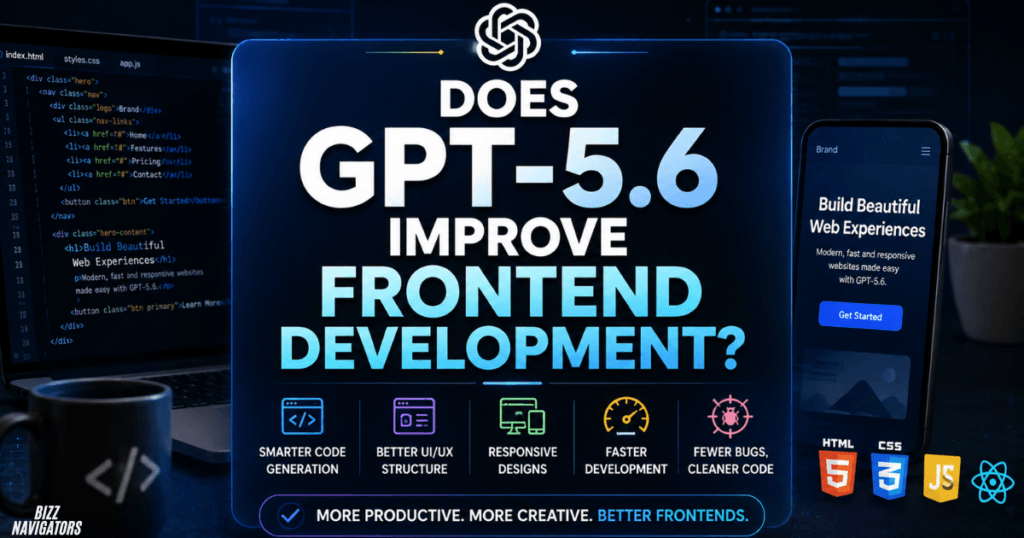
GPT-5.6 also improves frontend development by showing stronger design judgment and computer-use capabilities. OpenAI says the model can inspect rendered results and refine them, rather than simply generating HTML, CSS, or JavaScript. This helps produce interfaces with better layout, visual hierarchy, usability, and finishing details.
That distinction matters because functional frontend code can still produce a poor-looking website.
GPT-5.6 can help developers refine:
Page layouts
Spacing
Visual hierarchy
Components
Interactive elements
Responsive interfaces
Overall design quality
GPT-5.6 Sol vs Terra vs Luna: Which Is Best for Coding?
GPT-5.6 Sol is the best choice for complex coding and advanced reasoning. GPT-5.6 Terra balances capability and cost, while GPT-5.6 Luna targets cost-sensitive, high-volume workloads. OpenAI recommends Sol for complex reasoning and coding, Terra for balanced workloads, and Luna when efficiency and scale are the priority.
| Model | Best use | Coding choice |
| GPT-5.6 Sol | Complex coding and reasoning | Best overall |
| GPT-5.6 Terra | Capability + cost balance | Best value |
| GPT-5.6 Luna | High-volume workloads | Best for efficiency |
The gpt-5.6 API alias currently routes to GPT-5.6 Sol.
Is GPT-5.6 Better Than GPT-5.5 for Coding?
For demanding coding-agent workloads, GPT-5.6 Sol improves on GPT-5.5 across several published coding evaluations. OpenAI reports 80 versus 76.4 on the Artificial Analysis Coding Agent Index, 64.6% versus 59.4% on SWE-Bench Pro, and 72.7% versus 67% on DeepSWE.
The improvement is most relevant to complex engineering tasks.
For basic code generation, the difference may be less noticeable.
For debugging, long-running agents, terminal workflows, and repository-level tasks, GPT-5.6’s improvements are more significant.
Is GPT-5.4 or GPT-5.5 Better Than GPT-5.6?
GPT-5.6 is the newer choice for complex coding and reasoning. OpenAI currently recommends GPT-5.6 as its latest model, while GPT-5.5 and GPT-5.4 remain available for workloads where their specific pricing or performance characteristics make sense.
For developers choosing a current flagship coding model, GPT-5.6 Sol is the recommended starting point.
Is GPT-5.5 More Efficient Than GPT-5.6?
GPT-5.6 is generally designed to improve efficiency rather than simply increase model capability. OpenAI says GPT-5.6 can maintain or improve quality with fewer tokens when compared with earlier models, although the best reasoning setting depends on the workload.
Developers can also choose reasoning levels such as none, low, medium, high, xhigh, and max.
For simple tasks, lower reasoning can reduce latency.
For complex coding, higher reasoning can provide better results.
What Can GPT-5.6 Do?
GPT-5.6 can handle coding, reasoning, research, knowledge work, cybersecurity, computer use, and design. For developers, its most important capabilities include code generation, debugging, terminal workflows, coding agents, tool use, repository work, and frontend development.
Its value is strongest when a task requires multiple steps rather than a single answer.
What Is GPT-5.6 Sol?
GPT-5.6 Sol is the flagship model in the GPT-5.6 family and is designed for complex professional work, including advanced reasoning and coding. The API alias gpt-5.6 routes to GPT-5.6 Sol. OpenAI recommends Sol when maximum capability matters more than minimizing cost.
What Is GPT-5.6 Luna?
GPT-5.6 Luna is the cost-efficient model in the GPT-5.6 family. It is designed for cost-sensitive, high-volume workloads while retaining strong general capabilities. Developers can choose Luna when many model calls are required and keeping costs low is more important than using the flagship Sol model.
How Do You Use GPT-5.6 for Coding?
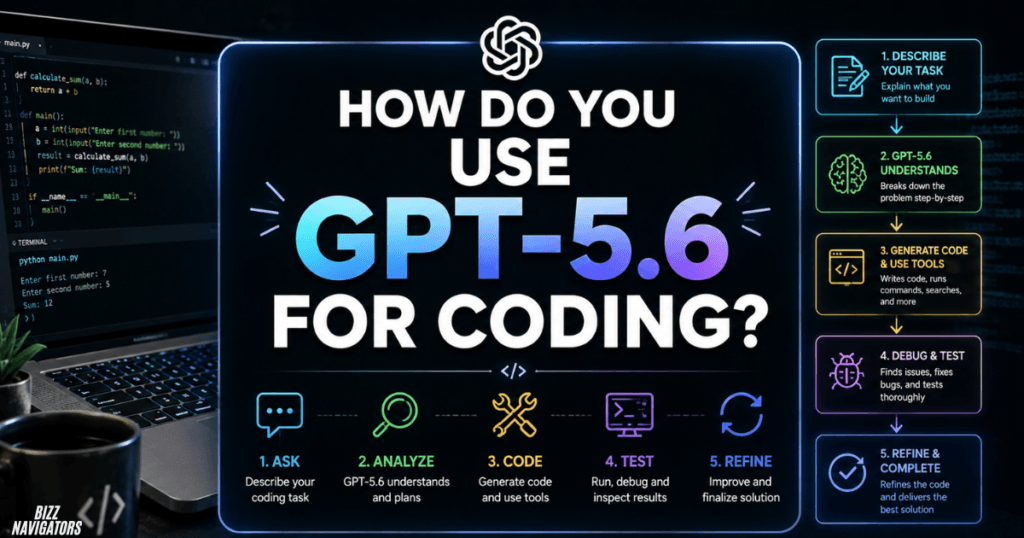
To use GPT-5.6 effectively for coding, provide the model with the programming language, framework, problem, relevant code, expected behavior, current error, and testing requirements. For API-based development, OpenAI recommends the Responses API for reasoning, tool-calling, and multi-turn workflows.
A strong coding prompt should specify:
What needs to change
Where the problem occurs
What the expected result is
What constraints must remain
How the solution should be tested
Better context usually produces a more useful engineering result.
Is GPT-5.6 Free?
GPT-5.6 availability depends on the ChatGPT plan and rollout status. OpenAI says GPT-5.6 is gradually rolling out to eligible ChatGPT plans, so users may not see GPT-5.6 Sol immediately. Availability and usage limits can differ by plan.
API access is separate from ChatGPT access.
Developers using the API are charged according to the selected model and token usage.
Why Is GPT-5.6 Restricted?
GPT-5.6 can have access restrictions because availability varies by ChatGPT plan, rollout stage, usage limits, and capability. OpenAI also says GPT-5.6 Sol includes stronger safeguards for higher-risk activities, including sensitive cybersecurity requests and repeated misuse.
Therefore, the absence of a model option does not necessarily mean the model has been removed.
It may simply not be available for that account or workload yet.
Why Pay $20 for ChatGPT?
Paying for ChatGPT can make sense when higher usage limits, stronger models, or advanced features save enough time to justify the subscription. For developers, researchers, and frequent AI users, the value depends on how heavily those capabilities are used.
For occasional users, a paid plan may provide less practical value.
Why Are People Leaving ChatGPT?
People may leave ChatGPT for different reasons, including pricing, usage limits, model preferences, competing AI products, or changes to features. There is no single explanation that applies to every user.
For coding specifically, developers often compare models based on coding quality, agent performance, speed, cost, tool support, and workflow integration.
What Are the 5 Things You Shouldn’t Tell ChatGPT?
Do not share passwords, authentication codes, private financial credentials, highly sensitive personal information, or confidential business secrets in an AI conversation. Treat sensitive information carefully and follow your organization’s security policies when using AI tools.
The safest rule is simple: never provide an AI system with a secret that it does not need to complete your task.
Final Verdict: Is GPT-5.6 Good for AI Coding?
GPT-5.6 is a major step toward more capable AI coding agents. Its biggest improvements are stronger reasoning, better tool coordination, more efficient token usage, stronger terminal performance, improved long-horizon coding, and better frontend refinement. (OpenAI)
For difficult software engineering tasks, GPT-5.6 Sol is the strongest option in the family.
Terra is better when capability and cost need to be balanced, while Luna is designed for high-volume and cost-sensitive workloads.
The key change is straightforward:
GPT-5.6 is not just better at writing code; it is better at completing the coding workflow.

At BizzNavigators, we answer the questions you’re actually searching for, honestly and clearly. We check our facts before we publish anything, and if we’re not sure about something, we tell you instead of guessing. Whatever you’re looking for- a tech fix, a business tip, or a simple how-to- we want to give you an answer you can trust.