
What Was the First 3D Game?
Before the modern gaming experiences we enjoy today, developers spent years experimenting with technology to create the first 3D game. The answer isn’t as straightforward as many people think, because different games introduced different 3D innovations.
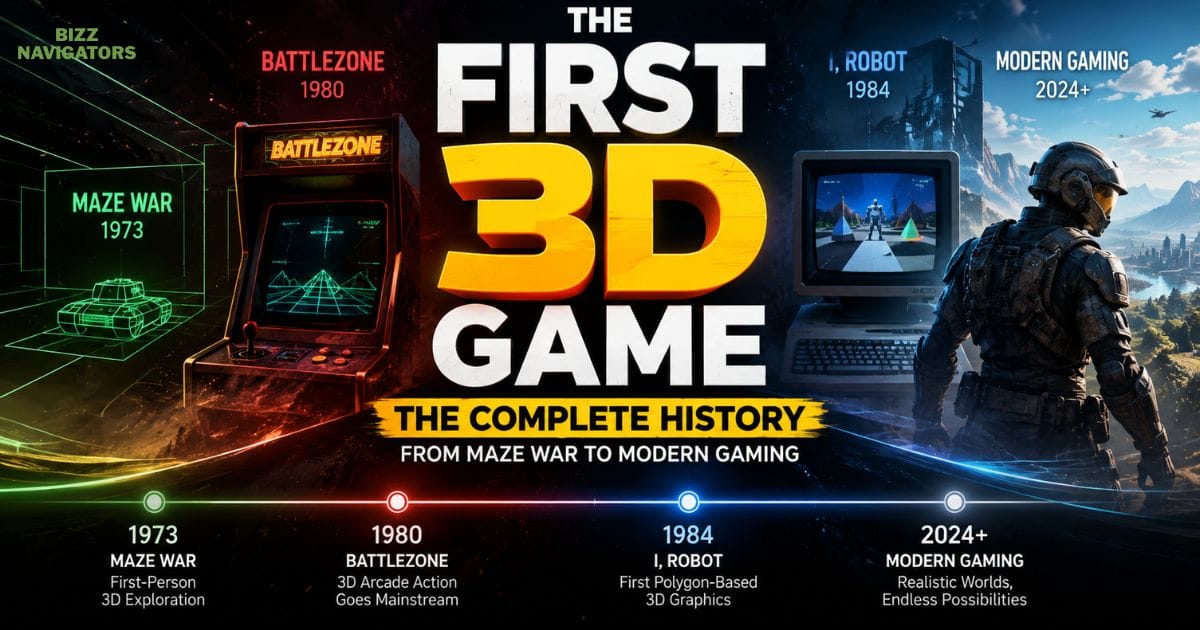
Maze War (1973) pioneered first-person exploration, Battlezone (1980) brought immersive 3D action to arcades, and I, Robot (1984) introduced real-time filled polygon graphics. So, which title truly deserves to be called the first 3D game?
This guide breaks down the history, compares the leading contenders, and explains how these groundbreaking games shaped the future of 3D gaming.
Why Identifying the First 3D Game Isn’t Simple
Unlike the shift from black-and-white television to color, gaming technology evolved in stages. Developers experimented with different rendering techniques long before powerful graphics processors existed.
Several factors make it difficult to identify one definitive first 3D game:
Different games introduced different types of 3D rendering.
Early computers had severe hardware limitations.
Many experimental games were never released commercially.
Historians use different technical definitions of “true 3D.”
For these reasons, gaming historians usually recognize several milestone games instead of naming a single undisputed winner.
Understanding What Makes a Game Truly 3D
Before exploring gaming history, it helps to understand what actually qualifies as a 3D game.
Difference Between 2D and 3D Games
Traditional 2D games display movement on only two axes: height and width. Characters move left, right, up, or down.
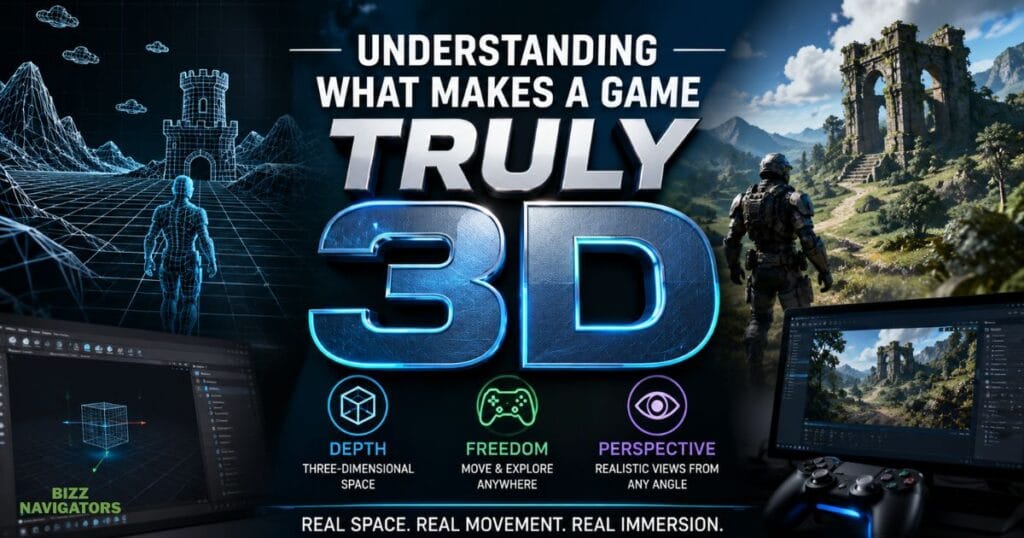
A true 3D game introduces depth, allowing players to move freely through a virtual space while viewing the world from changing camera angles.
This additional dimension dramatically changes gameplay by creating realistic environments, exploration, and perspective.
Pseudo-3D vs True 3D
Many early games looked three-dimensional without actually being rendered in real-time 3D space.
Pseudo-3D techniques included:
Scaling sprites
Isometric graphics
Perspective tricks
Layered backgrounds
True 3D rendering, however, calculates objects within three-dimensional coordinates, allowing the camera and objects to move naturally.
This distinction explains why different games receive credit depending on which technology historians prioritize.
The Earliest Games That Introduced 3D Concepts
Modern 3D gaming did not appear overnight. Several groundbreaking projects laid the foundation years before 3D became mainstream.
Maze War (1973)
Released in 1973, Maze War is widely regarded as one of the earliest first-person games ever created.
Players explored a maze from a first-person viewpoint while searching for opponents. The walls were displayed using simple wireframe graphics, creating an illusion of moving through a three-dimensional environment.
Remarkably, later versions even supported multiplayer gameplay across connected computers.
Although primitive by today’s standards, Maze War introduced concepts that would later define first-person shooters.
Key innovations included:
First-person navigation
Wireframe environments
Multiplayer networking
Player-versus-player combat
Many gaming historians therefore recognize Maze War as one of the strongest candidates for the title of the first 3D game.
Spasim (1974)
Only one year later, Spasim expanded the possibilities of three-dimensional gameplay.
Instead of exploring mazes, players piloted spacecraft through a simulated 3D universe while competing against others.
Its focus on movement within open space represented another major step toward modern simulation games.
Spasim demonstrated that 3D technology could support much larger environments than early maze-based experiments.
Battlezone: The Arcade Game That Popularized 3D
When Atari released Battlezone in 1980, players experienced something unlike anything seen before in arcades.
Instead of controlling flat sprites, players viewed the battlefield through the driver’s perspective inside a tank.
Using vector graphics, Battlezone displayed mountains, enemy vehicles, and landscapes that appeared genuinely three-dimensional.
Although the graphics consisted of glowing wireframe outlines, the sense of depth felt revolutionary.
Battlezone became a commercial success and proved that players were excited about immersive first-person experiences.
Why Battlezone Was So Important
Battlezone introduced several innovations that influenced future games.
These included:
First-person tank combat
Smooth vector graphics
Real-time battlefield movement
Immersive arcade gameplay
Its popularity also inspired military training simulators based on the game’s technology, demonstrating how advanced it seemed for its era.
Even today, Battlezone remains one of gaming history’s most influential arcade titles.
I, Robot and the Birth of Polygon Graphics
By 1984, computing power had improved enough for developers to attempt something entirely new.
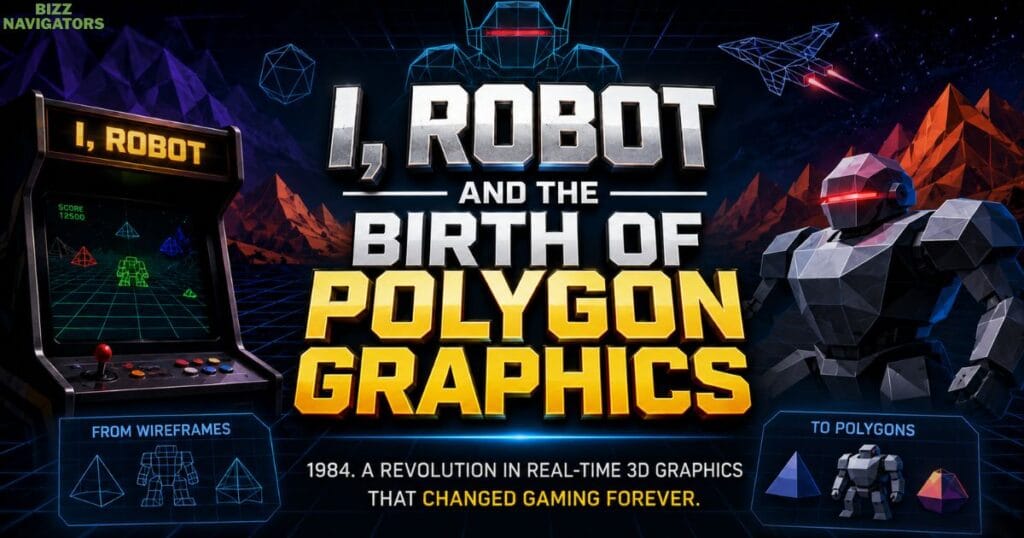
Atari released I, Robot, a game that abandoned wireframe graphics in favor of filled polygonal objects.
Instead of displaying outlines, objects were rendered as solid geometric shapes.
This represented a massive leap toward modern graphics technology.
Although I, Robot was not a major commercial success, historians now recognize it as one of the earliest examples of real-time polygon rendering in a commercial video game.
Why I, Robot Changed 3D Graphics Forever
The game introduced several technologies that would later become industry standards.
These included:
Filled polygon graphics
Rotating 3D environments
Dynamic camera perspectives
Real-time rendering
While hardware limitations prevented widespread adoption immediately, the ideas behind I, Robot shaped future generations of game development.
Timeline of Major Early 3D Gaming Milestones
The development of 3D gaming occurred over many years rather than through a single invention.
| Year | Game | Major Innovation | Historical Importance |
| 1973 | Maze War | First-person maze exploration | Early 3D navigation |
| 1974 | Spasim | Multiplayer space simulation | Large-scale 3D movement |
| 1980 | Battlezone | Vector graphics arcade gameplay | Popularized commercial 3D |
| 1983 | Star Wars Arcade | Advanced vector rendering | Cinematic 3D experience |
| 1984 | I, Robot | Filled polygon graphics | First commercial polygon-based 3D game |
| 1992 | Wolfenstein 3D | Fast first-person gameplay | Popularized FPS genre |
| 1993 | Doom | Enhanced pseudo-3D engine | Revolutionized PC gaming |
| 1996 | Super Mario 64 | Fully explorable 3D worlds | Set the standard for modern 3D platformers |
How Early 3D Graphics Actually Worked
Today’s games rely on powerful GPUs capable of rendering billions of calculations every second.
Early developers had nothing close to that level of computing power.
Instead, they relied on clever mathematical techniques to simulate depth.
Vector Graphics
Vector graphics drew objects using lines instead of pixels.
Advantages included:
Smooth animation
Sharp images
Lower hardware requirements
The downside was the lack of textures and realistic surfaces.
Wireframe Rendering
Wireframe graphics displayed only the edges of objects.
Although simple, this method allowed computers to calculate movement much faster than rendering solid surfaces.
Games like Maze War and Battlezone relied heavily on this approach.
Polygon Rendering
Polygon graphics transformed gaming forever.
Instead of drawing outlines, developers created solid objects made from connected triangles and polygons.
This technology eventually evolved into the realistic graphics used in modern games.
First 3D Video Game vs. First True 3D Game
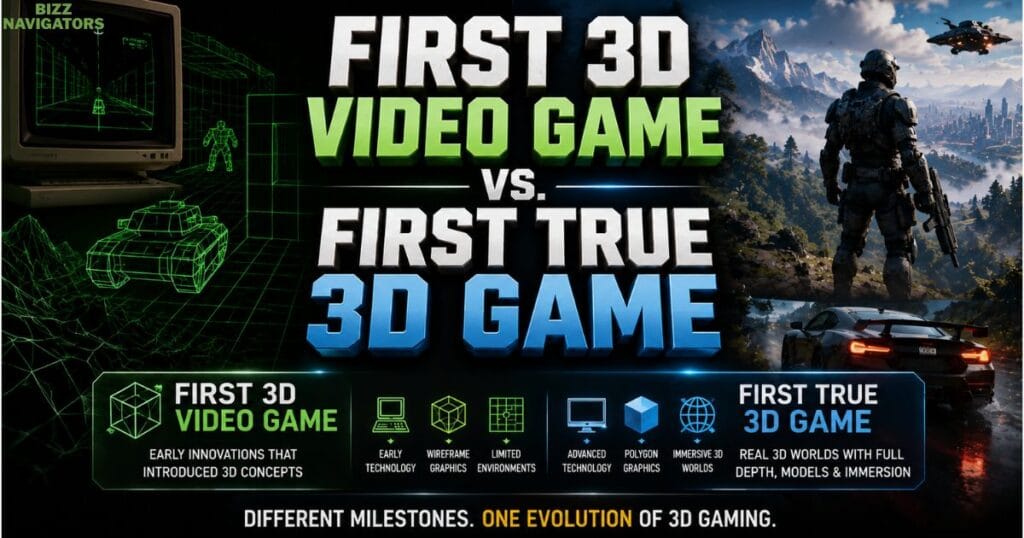
One reason the debate continues is that people often use the terms “first 3D video game” and “first true 3D game” interchangeably. In reality, they describe different milestones.
The first 3D video game may refer to the earliest title that created the illusion of depth or allowed players to navigate a three-dimensional space. By this definition, Maze War and Spasim are strong contenders.
The term “first true 3D game,” however, usually refers to a game that rendered objects using real-time three-dimensional geometry rather than visual tricks. Under this definition, I, Robot often receives the most recognition because it displayed filled polygon graphics instead of simple wireframes.
Rather than searching for a single correct answer, it is more accurate to recognize that each game introduced a breakthrough that moved the industry closer to modern 3D gaming.
Was Super Mario 64 the First 3D Game?
A common misconception is that Super Mario 64 was the first 3D game. While it transformed gaming forever, it was not the earliest example of 3D technology.
Released in 1996 for the Nintendo 64, the game introduced players to a fully explorable world with a movable camera, precise character controls, and seamless movement in every direction.
Its biggest achievements included:
A freely controlled camera system
Open environments instead of fixed levels
Analog movement for precise control
Interactive 3D platforming
These innovations established design principles that countless games still follow today.
Although Mario 64 was not the first 3D game, many developers consider it the title that perfected 3D gameplay.
Was Crash Bandicoot the First 3D Game?
Another popular myth involves Crash Bandicoot.
Released later in 1996, Crash Bandicoot featured detailed polygon graphics and memorable environments. However, its gameplay remained mostly linear compared to the open exploration seen in Super Mario 64.
Crash Bandicoot demonstrated how cinematic presentation and carefully designed levels could succeed in a three-dimensional world.
Its strengths included:
High-quality character animation
Detailed polygon models
Smooth performance on limited hardware
Creative level design
While it became one of the PlayStation’s defining games, several fully 3D titles had already been released years earlier.
What Was the First 3D Street Fighter Game?
The Street Fighter series built its reputation on traditional 2D fighting mechanics before making the transition into three dimensions.
The first major 3D entry was Street Fighter EX, released in 1996 through a collaboration between Capcom and Arika.
Unlike earlier Street Fighter games, EX featured polygon-based fighters while preserving the fast-paced gameplay that fans expected.
Its impact included:
Fully polygonal character models
3D visual presentation
New movement possibilities
A bridge between classic and modern fighting games
Although gameplay still emphasized side-view combat, the graphical leap demonstrated how established franchises could successfully adopt 3D technology.
How the First 3D Games Changed the Gaming Industry
The arrival of 3D graphics did more than improve visuals. It fundamentally changed how games were designed, played, and experienced.
Developers could now create worlds that felt larger, more realistic, and more immersive.
Several genres benefited immediately.
First-Person Shooters
Games such as Wolfenstein 3D, Doom, and later Quake showed that first-person gameplay could deliver speed, exploration, and tension unlike anything possible in traditional 2D games.
These titles established the foundation of today’s FPS genre.
Racing Games
Three-dimensional tracks allowed realistic corners, elevation changes, and dynamic camera angles.
Players experienced speed in a way that flat racing games could never replicate.
Adventure and Action Games
3D environments encouraged exploration instead of simple left-to-right progression.
Developers began creating puzzles, hidden areas, and interactive worlds that rewarded curiosity.
Open-World Gaming
Modern open-world games owe much of their success to early 3D experiments.
Without advances in rendering technology, massive interactive cities and landscapes would not have been possible.
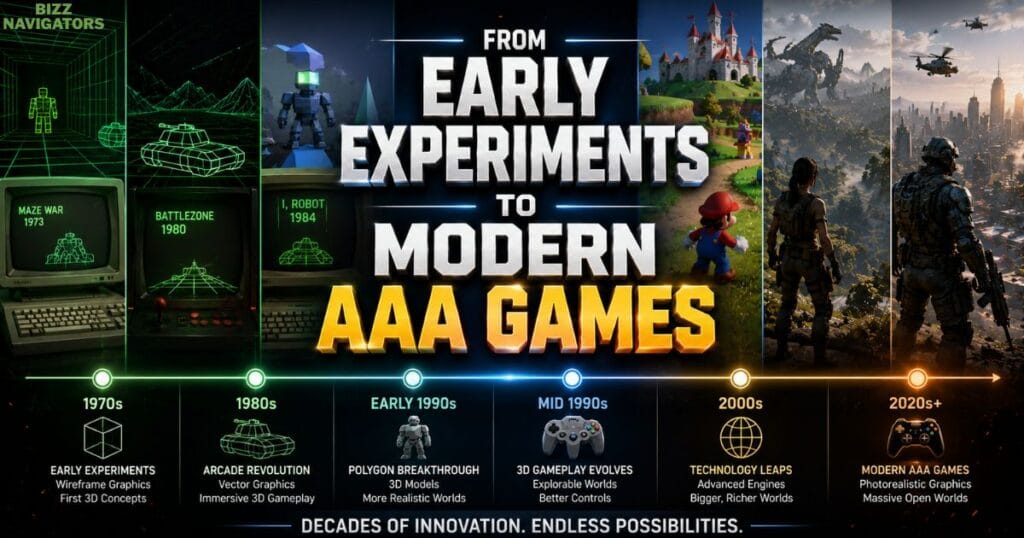
From Early Experiments to Modern AAA Games
The journey from wireframe graphics to photorealistic worlds happened over several decades.
Each generation introduced new technologies that expanded what developers could achieve.
| Era | Major Advancement | Representative Games |
| 1970s | First-person navigation | Maze War, Spasim |
| Early 1980s | Vector graphics | Battlezone |
| Mid-1980s | Polygon rendering | I, Robot |
| Early 1990s | Fast 3D engines | Wolfenstein 3D, Doom |
| Mid-1990s | Fully explorable worlds | Super Mario 64 |
| 2000s | Realistic physics and lighting | Half-Life 2, Halo |
| Today | Ray tracing, AI, and massive open worlds | Modern Unreal Engine and Unity games |
Today’s developers build games using technologies such as real-time ray tracing, physically based rendering, advanced animation systems, and artificial intelligence—innovations that can all trace their roots back to those pioneering 3D experiments.
Common Myths About the First 3D Game
Many misconceptions continue to appear in discussions about gaming history.
Myth 1: There Was Only One First 3D Game
Reality: Multiple games introduced different 3D technologies, making several titles historically important.
Myth 2: Super Mario 64 Invented 3D Gaming
Reality: Mario 64 revolutionized gameplay design but arrived more than twenty years after early 3D experiments.
Myth 3: Battlezone Used Polygon Graphics
Reality: Battlezone primarily relied on vector wireframe graphics rather than filled polygons.
Myth 4: Every Polygon Game Was Fully 3D
Reality: Some early polygon games still limited movement or camera control despite using 3D models.
Key Takeaways
The answer to “What was the first 3D game?” depends on the technical definition being used.
Maze War (1973) pioneered first-person navigation.
Spasim (1974) expanded 3D gameplay with multiplayer space simulation.
Battlezone (1980) brought immersive 3D experiences to mainstream arcades.
I, Robot (1984) introduced commercial real-time filled polygon graphics.
Later classics such as Super Mario 64 and Crash Bandicoot refined 3D gameplay but did not invent it.
Every milestone contributed to the evolution of modern gaming.
Final Thoughts
The first 3D game wasn’t a single breakthrough but the result of years of innovation that transformed the gaming industry. Whether you recognize Maze War, Battlezone, or I, Robot as the true pioneer depends on how you define 3D technology. Each title introduced ideas that paved the way for modern first-person shooters, open-world adventures, and realistic 3D experiences.
By understanding these milestones, you gain a clearer picture of how early innovations evolved into the immersive games enjoyed by millions today.
Frequently Asked Questions
What was the first actual 3D game?
Many historians consider Maze War (1973) the first actual 3D game because it featured first-person movement through a three-dimensional environment. Others argue that I, Robot deserves the title for its polygon-based graphics.
What was the first 3D video game?
The earliest examples include Maze War and Spasim, both of which introduced key elements of 3D gameplay during the 1970s.
What was the first 3D model game?
I, Robot (1984) is widely recognized as the first commercial game to use filled 3D polygon models rendered in real time.
What was the first 3D Street Fighter game?
Street Fighter EX, released in 1996, was the first major Street Fighter title to feature polygonal 3D graphics.
Was Mario 64 the first 3D game?
No. Super Mario 64 revolutionized 3D platforming but arrived after several earlier 3D games had already introduced first-person navigation, vector graphics, and polygon rendering.
Was Crash Bandicoot the first 3D game?
No. Crash Bandicoot became one of the most successful early 3D platformers, but it was released decades after the earliest 3D gaming experiments.
Why do experts disagree about the first 3D game?
Different experts prioritize different technical achievements. Some focus on first-person movement, others on commercial release, while many define true 3D by polygon rendering.
Which early game had the greatest influence on modern gaming?
There is no single answer. Maze War influenced first-person shooters, Battlezone popularized immersive 3D gameplay, I, Robot advanced graphics technology, and Super Mario 64 established modern 3D game design principles.

At BizzNavigators, we answer the questions you’re actually searching for, honestly and clearly. We check our facts before we publish anything, and if we’re not sure about something, we tell you instead of guessing. Whatever you’re looking for- a tech fix, a business tip, or a simple how-to- we want to give you an answer you can trust.